|
    |
|
|
|


Nirmala Rajasekar: Music is her all consuming passion - Lalitha Venkat, Chennai e-mail: lalvenkat@yahoo.com December 20, 2007 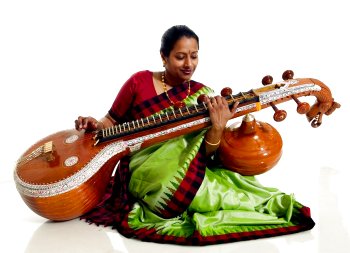 Nirmala Rajasekar is a disciple of Kalpakam Swaminathan on the veena and Prof T R Subramanyam and B Sitarama Sarma for vocal music. At 13, Nirmala began her performing career as a musician. With over 27 years of performing experience she has been seen and heard in many world-renowned venues in London, Berne, Zurich, Bombay, New Delhi, Chennai, Bangalore, Jaipur, Mumbai, New York, Cleveland and Minneapolis. As a young teen she was chosen by the Indian Council for Cultural Relations to present concerts in Festivals of India around the world. She has performed at many such festivals worldwide as an ambassador of Indian music. Nirmala has been a featured performer by several organizations in the USA - such as the Bharatiya Vidya Bhavan - New York , American Composer's Alliance - New York, Trance Dance Company - Berkeley, Madison Center for Performing Arts - Madison, Cleveland Thyagaraja Festival, to name a few. Nirmala was one of the youngest veena artists to receive the prestigious 'A Grade ranking artist' honor in 1990 from Indian Radio and Television. Her creativity and musicianship is showcased in many recordings and albums - including the BBC, England 'Library of world artists album,' Audio Lit. Inc- California, USA 'Poems of Mirabai,' Shruthilaya Records Chennai, India 'Melodic Expressions,' Speak Easy Records- Minnesota, USA 'Words will heal the wound.' Her CD 'Strings in Unison' (a duet on the veena and the violin with violinist Mullaivasal Chandramouli) was released in India in the Margazhi Winter Music Festival in Dec 2004. The music of the documentary film 'The story of Vishnu - the temple elephant' has been co-authored by Nirmala. Her newest work 'Song of the Veena,' a full length concert on the veena, has been released globally in Nov 2007 by INNOVA records. It is the first Indian classical album by this label which produces music in many genres. 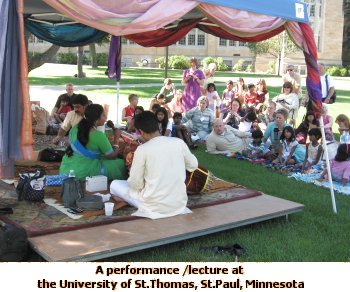 Nirmala has the unique honor of becoming the first Indian Classical musician in 35 years to be chosen as a BUSH artistic fellow (2006) by the Bush Foundation USA. She is also winner of a Best Concert award from KFAI Radio in Minneapolis. She has received many such honors from organizations in India - from the Indian Fine Arts Society, Bangalore Gayana Samaj, Maharajapuram Vishvanatha Iyer Trust, and Saraswathi . She has won awards such as Cultural Collaboration Grants from Minnesota State Arts board and composing grants from American Composer's Forum, 'Meet the Composer New York' and the Jerome foundation. Nirmala is an avid believer in the connective power of music and has performed, composed and collaborated with artists of many genres in pursuit of this belief. She is the founder of Carnatic Energy (a group that presents the best of the improvisations of Carnatic music and its western cousin Jazz) along with Jazz bass great Anthony Cox. Nirmala has been a director of the Indian Music Society of Minnesota since 1996. She is an invited panelist for several National and State US Educational organizations. She has been on the roster of the Minnesota State Arts Board, Young Audiences of Minnesota and the CONNECT program of the St. Paul Chamber Orchestra. She is the artistic director of the Indian music organization 'Nada Rasa Center for Music.' Nirmala is in Chennai to perform during this music season and shares her thoughts with narthaki.com Can you tell us about your music composition for the documentary film 'The story of Vishnu'? The movie was produced by Lone Duck productions (producer Denise Kriesel) and narrates beautifully a day in the life of a temple elephant by the name of Vishnu. It is a very well shot documentary movie with interesting details relating to Vishnu, his relationship with his mahout, and the villagers in a village in Kerala. I was approached by Denise to write the music for this along with American composer Eddie Estrin and it was a project I enjoyed immensely. I believe the movie has been viewed in the Discovery channel and is seen as a good educational film much sought after by schools and enjoyed thoroughly by children. I found it to be a great subject. Your experience on playing with Indian / non-Indians. At the end of the day when we sit down to play/sing together, geographical distinctions seem to blur. Of course the style of music performed contributes to differences in my reactive and proactive statements; I see every performance (with the same or different artist) as a new unique experience. Playing for concerts in India and outside India - what is the difference? Again here I feel that every audience, every venue - be it in India or outside -could make for a very different experience each time. Accompanying musicians, the sound people, the sound equipment, the occasion, and the performance venue all contribute to this. This having been said some things do come to mind -- In general in my experience one of the first dictums I learnt when I performed in the US or Europe was that spending time on a sound check and understanding the space acoustics is seen as a priority. Sometimes the organizers would like us to arrive at the performing space as early as 2-3 hours ahead of the concert to make sure that all efforts are made to make the sound heard in the concert be the best possible experience for all. This is also done to ensure that there is an opportunity to work out the kinks if any. In India, when it is not season time, this happens at many venues too but during the season that does not seem to be the case. Many a time 10 minutes before the start of a concert may be the best luxury for sound check and for an instrument like the veena that may make a world of difference to the success of the concert itself! I have also found that in the western world all artists are treated alike - be it percussionists or melody leads -in terms of payment and in such areas too, there is the belief that everyone's role is equally crucial in making an event successful. Your comments on electronically enhancing the sound of the veena. I am totally fine with it as long as we are able to achieve a sound as close as possible (without distortion) to the original melodic sound of the veena. As regards the Sunadhavinodhini veena from Radel, I see it as another instrument different from the Saraswathi veena. There are great advantages in it such as the longevity of the gamaka - and portability of the veena itself :-) Do you think classical instrumental music is getting attention equal to vocal programs? Great question…I sure would like to see more of it for sure particularly for the veena... if there is more opportunity we will see a surge in the instrumental music scene itself in Carnatic music. You have also composed music for dancers like Ranee Ramaswamy and Ananya Chatterjea... do you watch the choreography and compose or the other way round? Most of my experience has been in creating the entire project along with the choreographers or directors from the beginning. Since almost all these projects stem from a particular story, incident or idea / theme, I have had the opportunity to be involved right from the inception stage. Let me share my experience in one such work- Bhakti. The work was about the devotion of two early period women poet-saints, German saint Hildegard Von Bingen and our own Andal. The three of us involved in this (Dancer/choreographer Aparna Ramaswamy, composer Ruth Mackenzie and I) took time for over a year or so to research Hildegard and Andal. We read and researched all we could find on these two incredible women and then came together to develop this piece one step at a time. It was a fascinating experience where even in that period of two years when we developed the work, I was fortunate to get a little glimpse into the lives of Andal and Hildegard. Even though I was thrilled to have this experience, it was also extremely humbling as each of these topics involved lifetimes of learning and study. You are involved in music for the concert platform, dance as well as theatre...what are the challenges in each field? It just makes me one happy camper that I have been very blessed in being able to be surrounded by the one thing that is an all consuming passion for me - music in its many splendors and outlooks. Every opportunity in learning - be it a 2 kalai keerthanai or reading a new script fills me with joy, happiness and wonderment at the depth in the length / breadth of art. Each area needs its own type of preparation. Content wise and logistical preparation... While a kutcheri may mean thinking about how I would carry a concert (with my accompanying musicians) or how to prepare for say a thematic concert (expanding repertoire to get ready for that challenge), dance projects may mean working with a piece, then sharing it with the choreographers and dancers or this may happen as a simultaneous development of the piece. Logistical differences could also be there - when do we rehearse as a team for dance involving a nattuvanar, dancers, accompanying musicians, as opposed to when will I practice for my kutcheri by myself... Will I need to call in my mridangam artist to discuss this Pallavi or that Thillana? One thing is a constant in my book - it all involves team work and working towards a common goal - successful communication of our ideas with our audience community. Your experience as a member of Carnatic Energy that showcases jazz and Carnatic music… Do you think that would work well in India too? I believe 'Carnatic Energy' works off the innovation and improvisations in the grammar of both Carnatic music and Jazz. The creative side is the heart of this synergy of Carnatic music and Jazz. Some organizations in India have expressed interest to bring Carnatic Energy to India. God willing that will happen in the near future - then I will know for sure how it will be received. Since it has been received very well in the US and there is interest in bringing it here, I believe it will be received well here too... About this heartening enthusiasm in youth for learning classical music and dance... Great! Fantastic! As someone who was actively involved in the formation of Youth Association for Classical Music (YACM) in the mid 1980s, it is very heartening to see this healthy trend in the youth to learn and preserve our classical heritage. My own organization Nada Rasa Center for Music gives me a first hand experience in this as I see younger people taking to Carnatic music - easily impressed by its scientific principles and aesthetic beauty - not hard to do at all :-) Thank you, Narthaki, for giving me this opportunity to share my thoughts with you. I have enjoyed this introspection. Contact: e-mail: nirmalarajasekar@hotmail.com Website: nirmalarajasekar.com |
