
|
    |
|
|
|


Anita Ratnam: I am not an export artiste - Lalitha Venkat December 3, 2008  Anita Ratnam has trained in Bharatanatyam under Guru Adyar K Lakshman (Chennai), S Sarada and Sarada Hoffman (Kalakshetra). Rajee Narayan was her first guru. She holds a Post Graduate Diploma in Dance from Kalakshetra. Her training in Mohiniattam was under Trichur P Ramanathan (Chennai) and Chinna Ammu Ammal (Kerala). She presented a complete Mohiniattam performance in 1976. Kathakali was an additional area of interest that Anita Ratnam trained in under the guidance of Kalamandalam Balasubramaniam Warrier (Kerala). She performed a full length Kathakali concert in Chennai in 1978. But Bharatanatyam is the mainstay of her work. Always open to new approaches, Anita Ratnam has enjoyed working in cross-disciplinary theatre productions. Her many interests have also taken her into the realm of television and cinema. Founded by Anita Ratnam in 1992, Arangham Trust is a cultural foundation that seeks to explore, enrich and promote the performing and visual arts of India and to contemporize the rich tapestry of Indian creativity for modern audiences. Through collaborations, workshops, seminars and cultural outreach activities, numerous talented but lesser-known artistes have found a voice and a platform. Arangham has begun pioneering work in reviving a tenth century performance art unique to temples in southern Tamilnadu. Traditional communities of dancers and musicians and their invaluable repertoire and literature of ritual performances like "Kaisiki Natakam" (now in its 10th year) are being sustained and revived so that their art can breathe again. narthaki.com is a path-breaking directory of Indian dance that has become an essential guide and networking tool for the international dance community. She practices calisthenics, yoga and Tai Chi for additional strength and flexibility. Anita has completed her dissertation and is awaiting her Phd degree in Women's Studies from Mother Teresa University. You have done a piece on Ahalya, an item on almost the whole Ramayana compressed into a 20 minute item and so on. What attracts you to the Ramayana story? You are referring to the Raga Alapana section of the Dikshitar Kriti "Ranga Pura Vihara" from NEELAM. That song speaks of Vishnu as Rama and the alapana just pleaded for the Ramayana to be painted in broad brush strokes. In that way, the story is so familiar that I could not imagine filling that aural space with any other images. But nothing is interesting in the Ramayana for me. The only period of time I loved the story was listening to my professional Kadhai Vadyar (story telling priest) who would unravel the mysteries and adventures of this epic while I was growing up in Mylapore. As a dancer, I never learnt any songs from the Ramayana except take part in one of Rukmini Devi's ballets RAMA VANAGAMANAM, where, due to my height, I played Kausalya - mother to the much older Janardhan Sir's Rama! It was the same production in which another tall girl, Preetha Reddy of Apollo Hospitals, played Sumitra! We were both Kalakshetra students at that time. In 1995, director Na Muthuswamy, founder of Koothu-P-Pattarai, the Tamizh contemporary theatre repertory, suggested that I read the story of Ahalya as retold by modernist Pudumai Pittan. I had never read "Shaapa Vimochanam" and the idea of Ahalya choosing not to continue her redemption intrigued me. Almost simultaneously, feminist writer Vasanthi Sankaranarayanan had translated Malayalam writer KB Sreedevi's "Shilarupini" into English and it seemed serendipity to bring both ideas together. Sreedevi came to the same conclusion as Pudumai Pittan without even knowing that someone else 50 years earlier had rewritten the same episode from the Ramayana! I worked with theatre director Yamuna and a sound design without any words created by Mohan Narayanan. That was 12 years ago and much has happened in my personal and creative life since. But Ahalya has not moved from my inner recesses. What is it to live and endure like Stone? It was more the metaphor than the woman who intrigues me now. 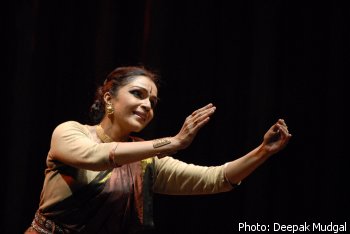 As much as for an international audience, you say it is necessary to 'explain' your classical dance items even for the local audience. Comment. Beneath all this veneer of intelligence and capacity to absorb many influences, we are covered with a patina of ignorance. Spoon feeding is the increasing order of the day. Holding a bow and arrow in two dance gestures does not mean that anyone in today's urban audience understands what that means. I recently performed FACES in New Delhi and FRAMING FIVE in Hyderabad. Both pieces relied on subtle abstractions and nothing was stated. Many in the audiences were lost. "Why did you not say it was about Rama and Sita?" they demanded later. "Why are you dancing in Tamizh? We don't understand the language." WE DON'T UNDERSTAND. WE DON'T UNDERSTAND has become the increasing chatter as my dance travels quickly into the realm of meditative silence and implied moods and images. We have never demanded that Kathak dancers perform Tamizh or Telugu padams and I have never confronted so much confusion in people's minds as now. Even many critics are not keeping pace with the tempo of modernity except for a few. I have to explain my work as a preface at least and yet not overstate it. My mother was my touchstone in many of these instances. She would encourage me to come on stage and explain with the hand gestures from age 16. Even traditional padams, kritis and varnams needed to be explained in the seventies. Today with more distractions, attention spans are reduced and so is the imagination of our audiences. Overseas, the ability to understand is deeper but the nuances of hasta-mudras is not. A different style of introduction is necessary although theatre manners and respect is far better overseas than in India. Your productions, though labeled contemporary, are very much on classical themes, especially on the women goddesses, where nowadays you predominantly intersperse dialogues with the choreography. Why? They are familiar images. They are not necessarily classical. I am Indian. South Indian. I am a woman who has made many unusual choices in my life. I am not German, Spanish or Swedish. The images and stories of my land are what reach out to me with immediacy. Maybe to 'look' contemporary, I should not remain Indian in my themes and ideas and should perhaps, discard my Indian dress mode of draped unstitched fabric and wear sleeveless black or pale colours, tights and tunics to "appear" modern or contemporary. Or perhaps I should roll on the floor as well! Perhaps I should also choose non Indian themes. Interestingly, a national award panel stated that "Anita creates more within the Bharatanatyam framework than modern." What does that really mean? I ask you as I contemplate the very idea of modernity in my work as the way writers perceive the term. Two very contemporary works of mine are 7 GRACES and FRAMING FIVE. One is on the Goddess Tara while the other has nothing to do with goddesses but explores my fascination with parallel mythology. Earlier in UTPALA, I had touched on the legends of Isis in Egypt and Kwan Yin of China. The enduring images in all my work are woman, goddess and water. You always premier your new works in Chennai. Any particular reason? No matter how abstract or modern, this is my city, my home and my cultural constituency. I am NOT an export artiste, turning up my nose at the local crowd. I live and create here and I MUST share my journey right here. Also, this city is my lucky charm. Works I have created and premiered here have gone on to endure and succeed. People often say they did not 'understand' this or that item. How necessary is to 'understand' a presentation? Why not just enjoy it? Exactly. We confuse not understanding with not liking. Your own neighbor came back after watching FACES and said he did not understand anything. That from a production that included such familiar songs like Ksheerabdi Kanyakaku, Annapoorne Visalakshi and Ayagiri Nandini. What ever does that mean? Just receive, heart to heart. Do not allow the mind to interfere and play an internal civil war with your emotions. Some of the dance sequences in films are like the contemporary shows on stage and quite interesting. Your comments. Film dance has become very interesting and more contemporary. I feel that the best modern dancers in India are those that emerge from the filmi genre since they are very flexible and have learned from a cross cultural approach rather than only one style. The choreography has become more international and more vigorous. I really enjoy some of the sequences and wish those dancers were available to me for creation. As a past convener of the Natya Kala Conference, can you tell us about the importance of such conferences? 8 years ago when e-mails and cell phones were not so widespread, getting information was much more difficult. I wonder how we accomplished it, Lalitha. I consciously tried to include the voices of the younger generation and had an open forum on the last day which was a huge hit. Normally dance conferences are very stimulating for the audiences and the participants. I have been a presenter at the Natya Kala Conference on many occasions but have inevitably felt disappointed with the level of questioning later. Still, there is much interaction and bonhomie off stage and the community sharing among colleagues happens only at such conferences. Dance writing seminars and dance videos and films should be included in the future for international visitors to enjoy and appreciate such conferences. Most artistes are still not very articulate and we need interlocutors who can interpret the artiste's presentation and bring out the focus of the paper or the demonstration. Many artistes still have to learn that the opportunity is not to perform but to share the process and the approach to a particular subject. Your comment on the Chennai season. Getting more crowded and less imaginative annually. It is impossible to mount anything special or imaginative in the cacophony of performances. Money is playing an increasing role in opportunities and good dance is difficult to watch unless you are doing the regular quasi-margam. I welcome the move that more and more sabhas, except Music Academy, allow recorded music. This cuts down the mess and the stress caused by dance accompanists. Black curtains as backdrops have become more the norm. My battle for 18 years has succeeded in many sabhas removing those ugly decorations and banners - or at least removing them for my performance. This year Krishna Gana Sabha has added more lighting on their grids. Since the season does not allow for a total free realisation of stage craft, I have decided to postpone the premiere of MA 3 KA to later next year. Kartik Fine Arts is providing all my lighting requirements for FACES. Both sabhas agreed to more time for rehearsals at night and a growing consciousness to visual aesthetics is apparent. However, it is us dancers who must insist on being given one hour between the afternoon concert and the evening slot to prepare the stage. 40 years ago, my mother would bring people from home to sweep and swab the stage before my performance. Last week, I had to continue the same tradition. Stages are filthy and not maintained at all. The less said about the green rooms and toilets the better. We do not have a single hall with acoustical fidelity. To call our city the cultural capital of India and have such poor theatres is a real joke! But it is in this contrast that such intensity can be seen and only those dancers who can navigate all such paradigms can succeed. My patience is slowly wearing thin. Contact: e-mail: arangham@gmail.com |
