
|
    |
|
|
|


Leela Venkataraman: Watching is the greatest method of learning - Lalitha Venkat December 13, 2008 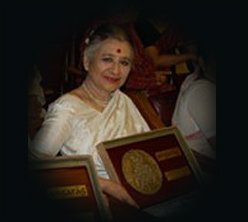 Leela Venkataraman's career as a writer on dance began as the Dance Critic for the National Herald in 1980, after which she was with another daily, The Patriot. Selected as the Dance Critic for The Hindu when the paper began its Delhi edition, she has been with the paper ever since, her Friday Review column earning a reputation for being the most incisive commentary on the dance scene in the capital. Widely traveled in India and abroad, she has participated in seminars and dance events like the international Seminar on Bharatanatyam in the Diaspora in Chicago, the North American International Dance Seminar in Houston in 2001, the Binnels de is Danse at Lyons in 2000 and the Rukmini Devi festival in Malaysia. Leela Venkataraman has written extensively for journals in India and abroad, and is on the Delhi Bureau of Sruti, a monthly journal published from Chennai. She was also on the Board of Management of the Kalakshetra Foundation for a full term. Among her publications are 'Indian Classical dance: Tradition in Transition,' 'Bharatanatyam: Step by step' and 'A Dancing Phenomenon - Birju Maharaj.' What would you say is the contribution of the dance critic in general? The dance critic is supposed to be the interface between the dancer and the audience, and the principle contribution would be to really encourage a dialogue between the two, which would enable one to ideationally make dance richer by bringing about a greater awareness in the audience of what to look for in dance and to give the dancer also a feel of how his work has been viewed and responded to. In India today, I feel with all the changes taking place - there is a widening gap between the dancer and the people who should form part of his/her audience. Very often the dancer seems to function in the dark and to encourage a dialogue amongst those who are practicing the art form and those who should be viewing it is for me the real contribution of the critic - All this is done through the critic's evaluation which while being objective has to be sympathetic even while not flattering, and encouraging while being critical. How would you describe the status of dance criticism at present? How different is it from 20 years ago? Twenty years ago, when dance was still not as widespread as it is today, critics too were more knowledgeable, and writing on dance was viewed more seriously. With space in dailies getting scarce for dance writing, journalists who are generalists not particularly well versed in dance or music are being given the task of writing, what today is more in the nature of dance chatter. Barring the Hindu, hardly any paper in Delhi devotes space for coverage of art. It is more the page 3 type of coverage where the artist's social life and parties are more news worthy than her art today. One journalist told me that when she approached a newspaper for a job, she was told that the subjects that she was qualified in had sufficient contributors. But she could always do writing for the paper on occasional dance and music features she was told - for these do not need any special qualifications. THIS is one example of how editors feel about this subject of art coverage. As an experienced critic, do dancers seek your advice or do they take affront if you do not exactly write glowing reviews of a performance? Nobody likes seeing unflattering references to one' work made in cold print. It rankles and I guess dancers are as human as anybody else. But there are some, particularly amongst the young who are very open to criticism. As a matter of fact many approach me saying, "Please list out our faults so that we may improve." And I do not get any resentful reactions from youngsters. But the seniors are more difficult and they can be very touchy. "We have been through fire and flood to reach where we have. We need no criticism. If you want to say a good thing, say so. If not just keep quiet - for when you criticise us, it creates a bad feeling amongst our students who lose their respect for us," said one senior dancer to me. I have been ostracised in more ways than one by some dancers for criticising them. But this is an occupational hazard and one has to be prepared for it. I have followed the principle that when seniors who have set the standards begin to falter they have to be told however politely. But the idea of holy cows who cannot be touched always dogs the critic and one has to be ready to take even insults sometimes. You have said, "We quote verses from the Natya Shastra or the Abhinaya Darpana upholding comments made on the dance, but keep silent when it comes to a dancer whose girth negates the physical attributes prescribed for a dancer in the shastras." Yes I have. I do not expect the dancers to be like apsaras with divine figures all the time. But I cannot understand dancers who just do not look after their bodies - the main instrument they work with. Dance is a visual art and to go beyond the physical into a realm where the body as an instrument ceases to be the focus is great. But how many achieve that level? I am not talking of physical beauty - just aesthetics which jar. And dancers seem to think arrogantly that since they have arrived, nobody can talk of their bodies. There are instances of some wonderful dancers who are very heavy. Bala was not a beautiful body - but when she danced she became the dance. You attend so many seminars and conferences all the time. Do you think anything useful has come out of these? Seminars and conferences can be platforms where great minds meet and where a wealth of information on a subject, (for which one would have to go to innumerable places and libraries), is made available. It is for the person who attends to take something from these events or not to. I always like to attend these events because it provides me with a wide range of performances, thinking processes and attitudes prevalent in various regions and in different artists and these platforms provide a wonderful opportunity for exchange of ideas amongst interested people. As a regular writer on the Natya Kala Conference over the years, do you have any observations? It has always amazed me as to why there is so much apathy amongst people in general for anything that just informs and enlightens. Too few people attend these events and since it is during the season, dancers who should be there are far too busy rehearsing for innumerable performances that they are signed up for. As a result, the Conference over the years has had its ups and downs. I also feel that not all conveners are equally efficient in organising such events. And when the Conference has a theme, it gets to be less discursive and becomes more focussed. This year Ananda Shankar has worked very hard. I only hope there are sufficient participants and really intelligent questions put by people. What advice would you give budding writers on dance? To watch dance constantly. Watching is the greatest method of learning. Learning any one form of dance (just to be informed) would be good for it gives one an idea of how the body works in dance movement. Learning one form gives you an insight into other forms too for you can see the different way in which the body is used for each dance technique. Feeling movement through one's own body gives a richer understanding of movement and body. Do not hesitate to ask questions if you are still uninformed. As you write, you must discover a writing vocabulary to describe what you are writing about. It is a gradual process. Learn to watch each performance for itself without preconceived notions. Your comment on the Chennai December season. Too much of Bharatanatyam and not enough of other dance forms. A sense of dejavu cannot be avoided. Of what use are performances with twenty persons seated in the audience? Performing in the sabhas has become adding one more chapter to the biodata of the artist. Contact: e-mail: leelakaveri@hotmail.com |
