
|
    |
|
|
|

 Ud. Amjad Ali Khan & the 'Sarod Quintet'- Manjari Sinhae-mail: manjari@sinha.com October 3, 2025 The Embassy of India in Washington, D.C., recently hosted a reception in honour of the esteemed Sarod maestro Ustad Amjad Ali Khan. Khan Saheb was in the U.S. capital for a very special concert titled "The Sarod Quintet - Three Generations, One Legacy," presented by the DC South Asian Arts Council Inc. in collaboration with the Embassy of India. The performance was held at the Terrace Theatre, Kennedy Center, on the 17th of September 2025, and brought together not only the maestro himself but also his sons, Amaan Ali Bangash and Ayaan Ali Bangash, along with his 13-year-old twin grandsons, Zohaan and Abeer. Together, the five of them form the Sarod Quintet, a living embodiment of continuity and tradition, representing India's classical music heritage. 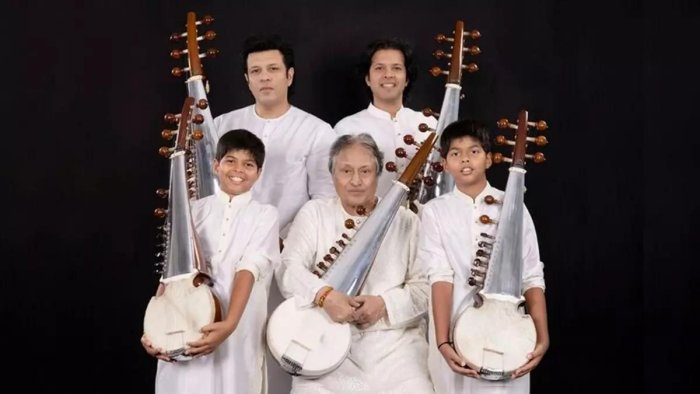 The Sarod Quintet Ustad Amjad Ali Khan, decorated with the Padma Vibhushan, India's second-highest civilian award, is widely acclaimed as one of the most distinguished exponents of Sarod. His artistry is defined not just by mastery of technique but by the unique ability to breathe life into a raga, allowing it to blossom in its natural grace. This multigenerational performance was more than a concert; it was a celebration of an unbroken chain of artistry that has stretched across centuries, carrying with it the soul of India's classical music. The Sarod Quintet was symbolic in every sense - three generations on one stage, weaving a fabric of ragas that reflected both tradition and the promise of the future. Belonging to the Senia-Bangash Gharana, a lineage that traces its roots to the legendary musician Miyan Tansen, Ud Amjad Ali Khan is the youngest son and disciple of the illustrious Ustad Hafiz Ali Khan, who nurtured his genius and instilled in him a deep reverence for tradition. Khan Saheb represents the sixth generation of this musical legacy. The Sarod Quintet, therefore, represented the 6th, 7th, and now the 8th generations of this unbroken musical tradition. After the formal reception at the Embassy, I had the privilege of engaging in an informal conversation with the maestro, whose humility and warmth were as striking as his music. Reflecting on his long association with the United States, Khan Saheb recalled his very first visit in 1963. He had come on the invitation of the Asiatic Society, accompanied by other stalwarts such as Pandit Birju Maharaj. Since then, he has returned frequently to American stages, building bridges of culture through music. On this occasion, he had arrived from Chicago, where he had just performed a solo concert, before joining his family in Washington for this reception and the unique presentation. 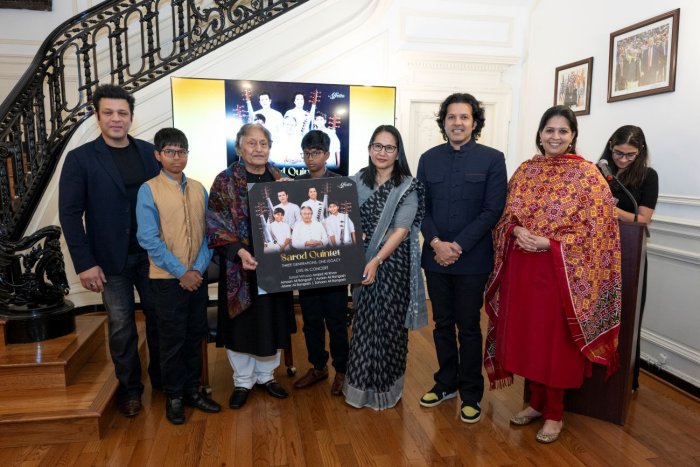 Photo courtesy: The Indian Embassy While Khan Saheb has performed internationally since the 1960s, this concert was extraordinary for its familial dimension, with five members of one family on stage together. The event was further marked by the launch of their latest album, 'The Sarod Quintet', launched during his reception at the Embassy, the evening before the Kennedy Center concert. In his brief speech, Khan Saheb dedicated the performance to the Prime Minister of India, Narendra Modi, on the occasion of his 75th birthday, which coincided with the date of the concert. Speaking about his grandsons, Zohaan and Abeer, Khan Saheb's pride was evident. He was quick to attribute their training to his younger son, Ayaan. "It was during the COVID period that Ayaan began teaching them seriously," he said. "Whatever they are playing today is due to their Taalim (training) and Riyaaz (dedicated practice) under his supervision." His words carried the unmistakable pride of a grandfather, tempered with the humility of a teacher who recognizes the importance of discipline and dedication. Khan Saheb also reflected more broadly on the challenges facing children today. With schools emphasising heavy academic workloads, he lamented that young students are left with little time to pursue the arts. He made a heartfelt appeal to school principals everywhere: "Identify talented children in your schools and nurture their gifts before they fade away. It is the responsibility of educators to encourage god given abilities, for they form the foundation of future cultural legacies." Our conversation turned to the matter of legacy and individuality within his own family. Recalling the wise counsel of the great tabla maestro Pandit Kishan Maharaj, Khan Saheb said: "He once told me not to train Amaan and Ayaan as a permanent duo like Pandit Rajan and Sajan Mishra. He advised me to let each of them develop as soloists as well as perform duets. That way, their individuality would also flourish." This advice has clearly shaped their artistic journeys, for both Amaan and Ayaan have excelled as soloists while also performing memorable duets together. With time, he hopes that Zohaan and Abeer will also step onto the stage as independent artistes, carrying the lineage forward in their own distinct ways. As the evening drew to a close, I was left deeply moved by the conversation. The Sarod Quintet is more than a family ensemble - it is a bouquet of traditional values, nurtured with love and discipline, blossoming through the next generation. In the hands of Zohaan and Abeer, guided by Ayaan, inspired by Amaan, this bouquet is certain to bloom in all its fragrance and color. And at its root stands the evergreen tree of Indian classical music, personified by none other than Ustad Amjad Ali Khan - a musician who continues to embody grace, humility, and artistic brilliance. As I thanked Khan Saheb for his time, I could only wish that the Sarod Quintet continues to flourish, each member blossoming in their own right, even as they carry forward the shared heritage of one of India's most treasured musical lineages. 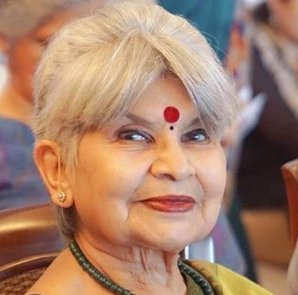 Manjari Sinha is a musicologist and an acclaimed classical music and dance critic. She has an MA in Sanskrit from Allahabad University, MA in Music from Vikram University, Ujjain; Sangeet Prabhakar in Hindustani Vocal, Tabla, Sitar and Kathak dance from Prayag Sangeet Samiti, Allahabad; and further training in Sitar under Guru Pt. Arvind Parikh in the lineage of Ustad Vilayat Khan. She has authored a book on Ustad Bade Ghulam Ali Khan, commissioned & published by Roli Books. She has contributed the chapter on Kathak for 'Indian Dance: the Ultimate Metaphor'. Her articles in English and Hindi on Music, Dance, Art & Culture are regularly showcased in a variety of leading journals and periodicals. Post your comments Please provide your name and email id when you use the Anonymous / blog profiles to post a comment. All appropriate comments posted with name and email id in the blog will be featured in the site. |
