
|
    |
|
|
|

 A conversation with Dr. Neena Prasad- Sunanda Narayanane-mail: narayanan.sunanda@gmail.com Photos: Olivia Moon Photography October 18, 2025 (Republished with permission from Global Indian Artist) Dr. Neena Prasad is a rare artiste - she possesses not only a remarkable breadth of experience in the classical arts, but also a depth in each domain that is simply astonishing. She has trained with doyen Gurus in the classical dance forms of Kathakali, Mohiniattam, Bharatanatyam, and Kuchipudi and has awards and accolades that are a testament to her excellence in each of these forms. Dr. Prasad is also a lauded academic with doctoral and post-doctoral research on dance, and several articles and papers on a variety of topics to her credit. She runs two esteemed dance schools in Thiruvananthapuram and Chennai and has created new pedagogy, compositions, and productions in Mohiniattam, cementing her legacy as a pathbreaker in this art form, while adhering to its core with deep conviction and integrity. It was an honor to have a relaxed conversation with her about her training, performing experience, new choreographies, and upcoming recital in Boston. It was an honor to have a relaxed conversation with her about her training, performing experience, new choreographies, and upcoming recital in Boston. It was an extraordinary opportunity for the Boston audience to witness an artist of Neena's repute in a performance with live orchestra. This interview was conducted on the request of Rasik - a grassroots initiative to curate and present classical dances of India in their traditional form by artistes of diverse backgrounds with the goal of integrating them into the wider cultural landscape. It was for Rasik's performance series in Boston that Dr. Neena Prasad performed recently. Here are some highlights from our conversation. You have trained with the best gurus and in depth in Bharatanatyam, Kuchipudi, Kathakali, and Mohiniattam. When did you first start dancing and in which of these styles? What made you pursue training in these multiple art forms and how did you manage what must have surely been a very intensive learning process? How did you reconcile the sometimes contradictory demands on your body in the pursuit of these dance forms? I started dancing at the age of three. My mother was waiting for the day when I could commence dance lessons since I was a meek child who did not show much interest in regular studies. She enrolled me in both Bharatanatyam and Kathakali classes in Thiruvananthapuram. I had my Kathakali arangetram at the age of 11, and it was unusual because it was a performance of Kuchela Vratham, where my brother played the role of Kuchela and I played Krishna! Subsequently, I assumed minor roles in many Kathakali plays and also witnessed long performances in 3-acts that would start in the evening and run late into the night. When I was in 10th grade, I was selected to be the lead actor in All India Radio's children's Kathakali group. Thiruvananthapuram has a strong affinity for Kathakali and even the children of the royal family used to train in it. In this manner, I continued with some minor training in Mohiniattam and a primary focus on Kathakali all through my school years and I won many local awards. I was keen to go to Chennai to learn Bharatanatyam and Kuchipudi, and since my father was a professor in the college I enrolled in, he was able to arrange to allow me to study remotely for the most part, only coming to Thiruvananthapuram to write exams and such. I stayed with my aunt in Chennai and enrolled with Guru Adyar Lakshman for Bharatanatyam and Guru Vempati Chinna Sathyam for Kuchipudi. The first few months of training were miserable for me because I lacked proper technique in Bharatanatyam and my Kuchipudi showed a heavy Bharatanatyam influence. Many times, I was in tears and ready to give up, and I wrote to my mother asking her to abandon any dream that I would develop into a good dancer. She wrote back encouraging me to seek enjoyment in my dance, and to celebrate small wins in my practice. I took this advice to heart and continued working hard in my classes for the next three years or so, spending all day every day with my two Gurus. Slowly but surely, I made progress and started getting performance opportunities in both Bharatanatyam and Kuchipudi. 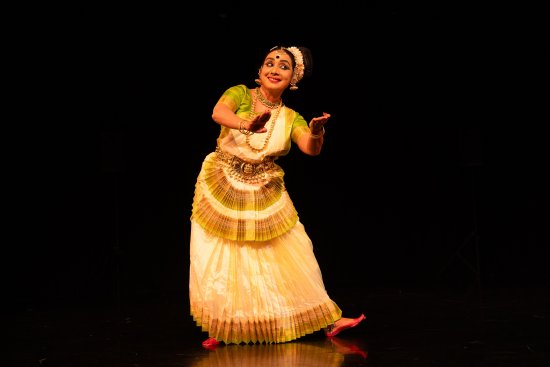 When and why did you pick Mohiniattam as your main art form? On one of my trips home, I watched a Mohiniattam performance by Sugandhi teacher, and I remember feeling renewed respect for the art form. I obtained a senior scholarship from the government to pursue training in Mohiniattam and I took lessons with Sugandhi teacher in Ernakulam. In 1994, I was invited by the Tamil Isai Sangam in Madurai to do a performance that was half Mohiniattam and half Bharatanatyam. Serendipitously, I had a chance to meet and work with musician Madhavan Nampoothiri at that performance and I feel that the opening piece we performed on Saraswathi and the warm audience appreciation somehow cemented my relationship with this style of dance. Between 1994 and 1998, while I was working on my PhD in literature at Rabindra Bharati University in Kolkata, I continued training intensively in Mohiniattam with Guru Kshemavathy, who had a very intellectual approach to her choreography. In 1998, I was invited to dance at the Soorya Festival and Madhavan Nampoothiri helped me create new pieces including one on a modern take of Sakunthalam. This performance was a landmark moment in my career with the press carrying prominent reports and calling it a pivotal shift in the presentation of Mohiniattam. After that, there was no looking back and even Adyar Lakshman sir who taught me Bharatanatyam, advised that I focus on Mohiniattam, which seemed to be the most natural fit for me. More milestone concerts and press acclaim followed in Chennai and I received the best dancer award at the Music Academy festival in Jan 2001. From then on, I received invitations to perform from organizations all over the country. Apart from your Gurus, who are the people who have supported your pursuit of the arts? Were there dancers/musicians in your family before you? All my four grandmothers danced, but informally. My family had many musicians, and my grandfather was instrumental in starting the first Sabha of Thiruvananthapuram. I came from a middle-class family where my father was the primary breadwinner, but my mother took a very keen interest in our training in the arts, and she was my driving force. When I was doing my PhD, I met art historian Mohan Khokar. After watching me dance, he encouraged me to stick to Mohiniattam because he felt that I was uniquely equipped to advance the art form. Eminent art critic, Subbudu, voiced the same opinion after watching me perform in Delhi, and he urged me to work with Carnatic music rather than Sopanam music. I was also praised by art critic Leela Venkataraman. These words from eminent connoisseurs came at a formative time in my dance career and boosted my confidence that I was on the right track in terms of my approach to Mohiniattam. Can you elaborate on how your proficiency in Literature informs your presentation of dance pieces today? Since my father was a professor of literature, we often interacted with eminent writers in Thiruvananthapuram and I was an avid reader from childhood. I was the first person to obtain a PhD in dance from Rabindra Bharati University (2002) and followed that with a post-doctoral fellowship at the University of Surrey, England (2005) where I studied Post-Colonial Identity of Mohiniattam. In 2008, Kalamandalam turned into a deemed University and I became the first research officer there. I have always had a deep interest in research, and that impacts how I think about dance pieces and how I choose to portray various characters in role play. For instance, when I chose to first present Ashtapadis, there was a hue and cry about whether it was necessary to explore pieces that were so heavily sringara based, given the troubled past of Mohiniattam. I had done in-depth research into Ashtapadis, and I felt I could present them in a way that would resonate with the audience. I must say that it was a very successful experiment despite the initial doubts. 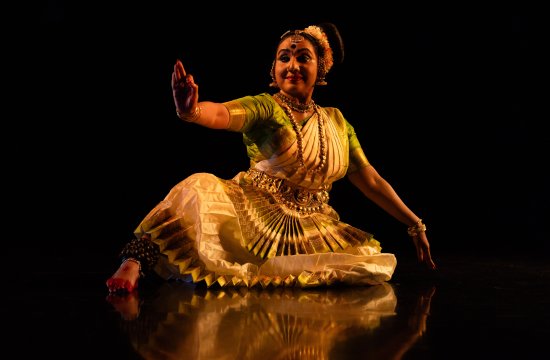 Did you also train in classical music? How does that help you today? I did have training in music in my teens but never felt I was particularly suited to singing. During my training with Lakshman sir in Chennai, he encouraged me to try singing and doing nattuvangam at the same time. It was very challenging initially, but I became adept at it after a few months of intensive practice. I also took music lessons with my sister and sister-in-law with Vaikuntapathi Iyer and Madhavan Nampoothiri and learned the intricacies of manodharma (extemporized) singing. I may not have pursued singing, but I am a keen rasika and can appreciate the nuances of traditional Carnatic music. I have also formally trained in mridangam playing and my ear is always drawn to percussion when listening to music. I have a talent for creating jathis (solfa syllabic rhythmic sequences) and I can guide mridangists who accompany me on how to embellish different dance sequences. Can you briefly share your role at Kalamandalam in the revival of Mohiniattam? In the 1990s, there was a lot of dissension within Kalamandalam regarding the instruction of Mohiniattam and specifically about items that were suitable for teaching/presentation. While one faction wanted to explore new compositions including those on Shiva, the other faction wanted to stick with traditional pieces that were primarily on Vishnu. Slowly, it became acceptable to present pieces on a variety of themes, especially since the audience response for them outside of Kerala was heartening. On one occasion, when I danced for Dr. Kanak Rele, she questioned me on a technique issue, which I realized was not quite addressed in teaching the basics at Kalamandalam. With Sugandhi teacher's encouragement, I developed a full adavu pedagogy with distinct nomenclature for each movement. For instance, it is the torso movement called Andolika that gives Mohiniattam its identity. I gave each instance of this a unique name and technique to match. My pedagogy received accolades from none other than Dr. Padma Subrahmanyam, who told me that this is exactly what the art form had been lacking until that point. I also helped codify the hastas (hand gestures) that are drawn from the Hasta Lakshana Deepika. Can you speak about your new choreographies? I have choreographed many new compositions. My landmark group production was Sitayana - it is based on Sita looking back at her own life journey. For the music, I introduced elements of chorus singing. I consider myself a humanist first and only then a feminist, and therefore did not assign blame to Rama for Sita's fate. There are many moments of poignance born of the depth with which we depict characters in this production. I found a beautiful padham in Kambodhi that captures a conversation between Sita and Rama, where each of them reminisces on their time in the forest with very different emotions. This makes the characters seem relatable as husband and wife to the audience and it was extremely well received, with many in the audience shedding tears watching my portrayal of Sita. What are some special pieces that we might look forward to in your upcoming performance? One piece I want to present in Boston and that has been extremely well received in general, is my work on Bhoomi. Dr. Pappu Venugopala Rao helped me with the lyrics for this piece. Our planet has contributed to our life in generation after generation, and every aspect of our life is a gift of the Earth. We didn't come into existence bearing even a needle point of material. Consider the Protector Vishnu - his workspace is Earth and his role would be meaningless without Mother Earth. Even your cell phone is produced from the Earth in terms of the silica and mica that go into it. My piece will touch on all this and more. While the narration is contemporary, the vehicle will be traditional Mohiniattam. Ultimately, dance is a musical form and one's aesthetics must be strong to create new works with conviction. You have often spoken about the notion of Bani (strong, inherited style of a dance form with a distinct identity) versus an individual school's style (one with relatively minor modifications to a bani and that stem for an individual's aesthetic leanings). In Bharatanatyam, the notion of Bani is becoming increasingly blurred as audience response oftentimes shapes artistic output, as compared to some decades ago when adherence to a Bani was considered a sacred duty. For instance, as power, intensity, and endurance emerge as audience priorities, the movement vocabulary and choice of pieces has shifted perceptibly. Has this happened in Mohiniattam as well? What is your opinion on whether this shift is healthy/necessary? Bani is getting blurred in every classical art form including music. I do not want to think of Bani as something rigid, but as a guiding framework. As someone that people watch and look up to in the realm of Mohiniattam, I feel a responsibility to maintain the core aesthetics of the form even as I explore new compositions and ideas. There is a push to incorporate faster spins and dramatic movements, but I am not sure it is required. A performer has to have the conviction that they can still charm the audience within the framework of their tradition. It is only when this trust in the impact of your tradition wavers, that one starts to experiment outside of its boundaries. When doing this, one needs to question if this deviation is truly necessary. Also, an experimentation that works for a very senior artiste at a certain stage in their life, may not apply to a young artiste who lacks similar life experience. If your experiment has substance and can make the audience learn something from your presentation, then it serves a purpose. It must make the audience think. 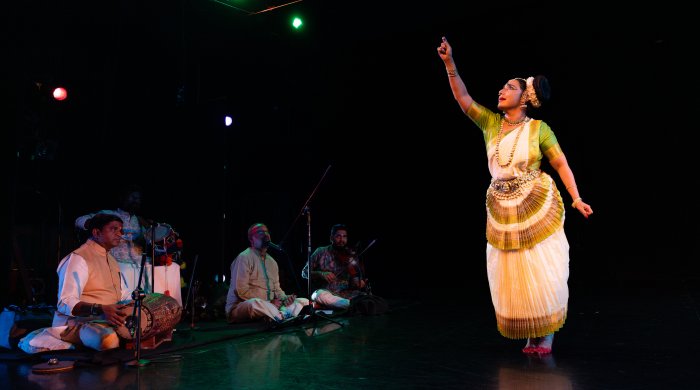 You direct centers for dance training in Chennai and Thiruvananthapuram. What are some of the unique attributes of students of dance today as compared to when you trained with your Gurus? Pros/cons? The students from then and now are quite different. A mind that is accustomed to reading books and a mind that is accustomed to seeking a phone for information is quite different. When poet Kalidasa wrote about the descent and flow of the River Ganga as akin to the undulations of a waist chain, he had no aerial view that he had seen of the river to inform this metaphor. It was simply born of his imagination. Somehow, this ability to create poetry in movement has diminished in my opinion. There is more technical virtuosity in the current generation of students though. The increased focus on technique can shrink imagination and creativity in the long run. Can you speak about how you work with your co-artistes on stage, especially when you create manodharma (extemporization) sequences? To indulge in manodharma on stage, the artiste must be okay with some flaws in execution. Those 'flaws' do not impact a performance negatively and the artiste must trust the audience to be okay with it. The musician and dancer must have a deep understanding and rapport but not over rehearse. The spontaneity on stage is essential, especially when one narrates from the mind. I have a deep understanding with my co-artistes where they follow my intent on stage to create a seamless experience. Mohiniattam is a visual music form - there is a certain feel to the music and where you become a part of it. This is a magnificent gift of God and I want the audience to experience it with me.  Sunanda Narayanan is an acclaimed exponent of Bharatanatyam based in the Greater Boston area. She has performed extensively in India and the US for over four decades. She is the director of the Thillai Fine Arts Academy in Newton, MA and she is also an instructor at the Harvard University Dance Center. Narayanan has presented several solo and group productions with her students and has conducted lec-dems and workshops at museums, schools, and colleges in the U.S, Canada, India, and Brazil. A graduate of the MIT Sloan School of Management, Narayanan works at WGBH, Boston. Post your comments Please provide your name and email id when you use the Anonymous / blog profiles to post a comment. All appropriate comments posted with name and email id in the blog will be featured in the site. |
