
|
    |
|
|
|

 RAMLI IBRAHIM - Lalitha Venkat e-mail: lalvenkat@yahoo.com Jan 2001 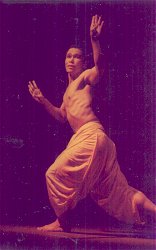
Ramli Ibrahim is the dynamic force in Malaysian theatre and possesses open-mindedness for both the Old and the New. Trained in classical ballet, modern dance and Indian classical dance, Ramli is a creator and a visionary in the arts who sees unity within the diversity of all of Sutra's artistic endeavors. In Malaysia, Ramli is acclaimed as a pioneer dancer and choreographer of international standing in the major fields of dance that he has mastered - Bharatanatyam, Odissi as well as Contemporary Dance. As a teacher of Bharata Natyam and Odissi, he has groomed some of the finest dancers to have emerged from Malaysia and at the same time placed Indian classical dance in the context of the Malaysian experience. Ramli studied Bharatanatyam under Adyar K Lakshman and Odissi under the late Guru Deba Prasad Das. As Artistic Director of Sutra Dance Theatre, which he started in 1983, Ramli Ibrahim has always envisioned his creativity as a total experience, one that transcends national boundaries. He has created more than 40 original dance repertoires in the traditional and contemporary idioms. For Ramli, theatre is the all-encompassing universal vehicle for his creative vision: it expresses life itself in the richness of all its myths and rituals. What made you take up dance as a career? There is no particular point in time that I can refer to. It was always there in me. Even as a 3-year-old, I used to like to dance. I used to dance in the fields instead of walking..it was innate in me. I guess, even then there was the 'entertainer' in me. I'm a qualified mechanical engineer but I pursued dance alongside my academic activities. I learnt Malay folk dances and ballet and have performed with the Sydney Dance Company in Australia, New York, London and Europe. I learnt Bharatanatyam from Adyar K Lakshman and used to perform Indian classical dance under the name of Ramachandra! But when I saw the Odissi dance, I told myself, "Wow! This is an absolutely wonderful dance form". My attraction towards Odissi as against the structured, too steeped in tradition Bharatanatyam prompted me to go to Puri and learn from a disciple of Guru Deba Prasad Das. But I soon found that I was not learning what I wanted to and became a direct student of Guru Deba Prasad Das. Coming from a conservative society, were there any obstacles to your taking up dance as a career? Fortunately for me, not very many go to the theater in Malaysia. The question of a Muslim doing a temple dance is not relevant. Time has passed and we have to get on with the artistic aspect and not the seemingly controversial aspect. I was part of the avante - garde work in Australia where the body is perceived as beautiful and I've been instrumental in bringing that feeling in Malaysia. What were your idols and guiding forces during the early stages of your career? Picasso, Japanese poetry, books on myths and mysticism, works of Carl Gustav Jung, ..... I always ask people whom I have high regards in their fields to recommend me the 5 best books to read. What are the cherished memories of your guru Deba Prasad Das? The intense guru-shishya relationship that Gajendra Kumar Panda had with Guru Deba Prasad Das inspired me to write 'Adorations' which culminated in many performances. Deba Prasad was a very intense person. His passionate character made him later on very controversial and difficult to get along with. He was the youngest of the 3 gurus to revive Odissi. Though he was very much traditional, he was part of the Jayantika, which was the revivalist group. But he pulled out of it later on as he disagreed with some of the new innovations that were made by the Jayantika. Deba Prasad used to do all kinds of stuff. He believed that in classical, the folk and tribal must also come out or else the classical work will be like white sugar...looks good but has no value. How tough was it for your dance company 'Sutra' to attain the sort of recognition and patronage that is so essential for the advancement of the arts? Financially, my company Sutra has been totally unsupported since the beginning. It has taken years of hard work to bring Sutra to its current status. Now, no one can ignore us, as we have achieved recognition in Malaysia and abroad. 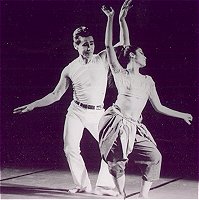 Ramli Ibrahim & Rathimala in 'Pallavi' You are trained in classical, folk and contemporary dance styles. How do you strike a balance between them? We learn various art forms and perform them as per our choreography. It is the critics who attempt to compartmentalise and put our style of presentation into various slots. In some items, the music may be Odissi like in 'Pallavi', but I have deconstructed it and given it a contemporary layering. We can define contemporary aesthetic now from an Asian point of view and not from a Euro - American stance. 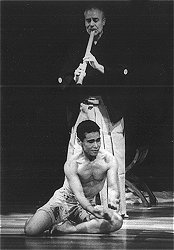
Ramli Ibrahim & Christopher Blasdel in 'Mukaiji Reibo' What is your focus now at this stage of your career? Choreography is and always will be my main focus. In the many beautiful Odissi dance items, I find scope to exercise my own choreographic interpretations unlike the structured Bharatanatyam items. All my Odissi productions are commissioned works. My contemporary choreography is influenced for instance by the performing arts genre like Makyong and Menora, Malay martial art form of Silat, besides Indian classical dance idioms. I am involved in a lot of networking and cross-genre work as I travel a lot and meet many artistes from different countries. The dance items that pertain to Sakuhachi reflect the meditative quality of music. In 'Mukaiji Reibo', a zen monk is on a punt adrift on a misty sea. He hears the mellow tones of a flute, played by Sakuhachi flautist Christopher Blasdel, and is drawn towards it. The story is of Japanese Buddhist origin but I take the point of embarkation from the divine flute player, which is Krishna himself. How would you describe some of your innovative productions? To make new rules or break them in order to do something new, you have to know your stuff. The balance happens then. In contemporary work, you are the sum total of your experience. If you want to express something, what comes out then, modern, classical or folk have to come out. Then you have achieved the challenge of choreography. Or else the audience will see through it. In this, you have to trust the intelligence of the rasikas and critics. The choreographer does what he is supposed to do. He creates the work. He's not going to categorize it. He'll just go ahead and create. Let the critics categorize it. But a critic has to be compassionate. An artiste's graph will not go up all the way all the time. That's when I realize critics and audience are cruel to performers sometimes. You participated recently in 'The Other Festival' in Chennai. What is your opinion about such festivals? The Chennai Festival, meaning the December season, is very valid. You should be proud of this festival. But it has to look into the future and attract new people. The dance should express the contemporary environment. That's why 'The Other Festival' is so exciting. I'm excited to explore this part of South Asia as South Asian dance is crossing boundaries all over the world. 'The Other Festival' is the festival to explore ultimate creativity. Like Dionysus, the God of wine, it should be intoxicating, creative and chaotic, and not showcase only the permissible, trite and post popular. Given the complicated movements and demands on the body, fitness is very important to a dancer. Yes, fitness is very important to a dancer. Not that a slightly heavier built person does not make a good dancer! For instance, Balasaraswathi did not possess a great figure but she was an inspired dancer. So it did not matter if she was thin or fat. She was an icon. As the person ages, the body rebels against certain movements. Yet, Kelucharan Mohapatra has achieved the impossible...to have become better as he's grown older. He probably performs much better now than in his younger days. Even his physique is more interesting now and he glows. Although being fit is important, mind over matter is important too. Certain people have transcended the physical. So it's not true that as you grow older, your dance suffers. Some of the things that impress us are not virtuousic but give us a glimpse of truth and beauty that transcends the physical. And we find that in Bala and Kelucharan Mohapatra. Leela Venkatraman and I observed the same glow in Leela Samson. Beautiful as she already is, she has now reached that stage and she's positively radiant. Fitness is always important but, how do you call Bala as fit? Some of the old dancers of Bali, the Kudiyattam dancers of Kerala, the old living national treasures, are not fit in the youthful sense, but they have transcended the physical, understood the essence of art.... they have given us a glimpse of the wonderful in art. In the west, once a dancer grows older, he / she looks the age because of their strenuous movements. Maybe Asian art does not concentrate on the body so much. Fitness is important, but not most important. At its highest level, art transcends mere physical fitness. How do you keep yourself fit? What advice do you give your dancers on fitness? I dance all the time, I do yoga in the morning. I am moderate with my food. No overindulgence in food. I guess that keeps me generally fit. One of the things to keep myself relatively free from dance injuries is the good habit of warming up and preparing myself physically before a performance. I get livid if my dancers do not warm up. But people like Bala did not work out. Maybe their work then was not that strenuous. Eras change and an era reflects the society of the time. Time then was slower, life was slower. But now, if dancers do not take care of themselves, they will pay for it later. Problems in knees, ankles, hamstring, tummies...those who are interested in life, take care of themselves, or the Muse, your 'shri' will leave you. What book are you working on at present? For more than 9 years, I'm working on a book called MOVING BEINGS. I was awarded the Fulbright Distinguished Artiste in Malaysia in 1999. The thrust of the award is towards researching Malay shamanism. 'Main Petri' and 'Makyong' are 2 Malay traditional performing arts genre that also touch on shamanism and performance healing. Surprisingly, a lot of the archival material on it is not in Malaysia but abroad. Have you ever been overwhelmed by anything in your dance career? I'm overwhelmed by youth...the boundless energy.... What's your birth date? 20th May. What do you do for relaxation? I do a lot of things. I love to work in the garden. I cook. I paint. I have 2 dogs and 2 cats. I like to nurture things. I'm a nurturer. And I love teaching. I think I make a very good teacher. I sometimes see maybe a not so very good-looking dancer, maybe a not that graceful body, but I can spot his / her latent talent waiting to be extracted, to express itself...I want to nurture that talent. We have recently decorated the Sutra premises with some extraordinary furniture. Our technical director Sivarajah Natarajan and I collected blocks of old timbers around and we were stimulated to create furniture with original designs as we perceived it in those timber pieces and we now have some exquisite furniture. You say you love teaching. What kind of a guru are you? I don't like people diving at my feet! Whatever you do, you must start with a pure inner heart, not just an outward ritualistic show. When it comes to a performance or class, it they don't come up to expectations or make me wait, they get hell from me. That's the guru in me. If you do not have respect for your art or for your parents' money, why are you wasting my time and yours? That's why we have performed very few arangetrams. We do not recommend arangetrams unless the student is serious about making dance a very important part of his / her life. Otherwise, it has no relevance. For a lot of students, arangetram is the beginning of an end. Most of them start a kitchen class. Too many mediocre teachers and dancers around. Over popularizing Bharatanatyam has resulted in this. Ramli Ibrahim "Sutra Dance Theatre" 12, Persiaran Titiwangsa 3 53200 Kuala Lumpur Malaysia Ph: (60-3) - 4211092 Fax: (60-3) - 4232548 e-mail: ramlii@pc.jarlng.my |
