
|
    |
|
|
|


Musician / Composer, O S Arun - Lalitha Venkat e-mail: lalvenkat@yahoo.com Jul 2000 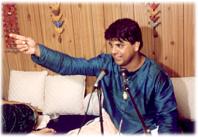 The prince charming of Carnatic music, OS Arun holds a Masters Degree in Carnatic music and Sangeet Shiromani Diploma. Arun's remarkable control over the music idiom and his astounding range of music in performance have often proved his remarkable ability to infuse traditional composition with new vigour and impact. You come from a family of musicians. Did you have any choice at all of following any other career? No. Hailing from a family of musicians, I always wanted to be a musician even though my family wanted me to pursue some other career. I never even aspired to be a doctor, chartered accountant or engineer even though my family wanted me to have job security. My father was always a teacher, so he was not in the commercial forum of performance. He had to support a huge family and hence had to face many hurdles. As I was the youngest, he did not want me to have a hard time. Once my family recognised my prowess, they changed tune and asked me to pursue a career in music. My eldest brother O S Ramamurthy as well as others have said they are very proud of me as I am a self made man. 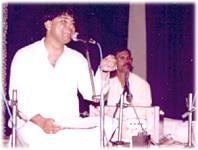 What sort of encouragement have you received from your family? My father is very orthodox and traditional and my brother is a puritan, but I do different styles of music - light music, classical music, bhajans, film music, dance music, fusion etc. But I get terrific support and encouragement from them because according to them, "Arun can do anything". When the cassette of my Tamil gazals were released at a function in the morning, my brother OS Thyagarajan who had his own concert in the evening made time to attend. He was so overwhelmed at the response that he took the whole family out for lunch. I had gone recently to Delhi to compose a song for Leela Samson as part of the 60th anniversary celebrations of Gandarva Mahavidyalaya. It was a special raga for Surya to fit into the theme of the performance. My brother O S Sridhar was so proud at the thunderous applause that he treated us to dinner. Despite my being the youngest, they appreciate my success and I feel good about it. Who are some of the senior musicians you have admired? Have you unconsciously followed a senior musician's style or voice? Unfortunately, the senior musicians whom I have admired left this world before I entered it. Madurai Mani Iyer, GNB, Alathur Brothers...My great regret in life is I have never been to a live performance by the great stalwarts. I listen to the old school of music, but when I sing I have my own individuality. I incorporate the components from them and integrate them in my singing with an original approach. I can't pinpoint an idol, music is universal. I listen to good music, take the positive aspects and infuse it in my presentation. What do you think are the main qualities that make an excellent musician? Good voice, good sadana, belief in God. When did you decide that you had to find your own identity? I always had my own identity. When O S Arun sang, it had the distinct stamp of O S Arun. Maybe thanks to my upbringing in the North, I had a flair for North Indian languages and was able to understand the poetry of my compositions. I also have an open mind and I am free to interact with local musicians during my visits abroad. This has made an immense difference in my career. 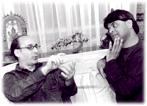 What were your initial explorations into non-conventional music like working with jazz musicians in Canada? I don't believe in conventional or non-conventional music. I think music is universal. When I attempt something new, for instance, my collaboration with jazz musicians, my rendering was still conventionalif I may say so, meaning I was still singing classical if that's what you mean by conventional. Except that I added more space to the music by using abstract music with musical forms such as ragam, talam, swarams. My collaboration with jazz musician Sylvain Gagnon (Cello) resulted in "New Friends". 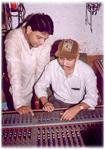 Do you find any difference in your collaborations with foreign and Indian musicians? In any collaboration, harmony is the key word. It has to be harmonious or it will show in the production. By god's grace, I have so far collaborated with good musicians who are also good human beings. I think both at home and abroad, musicians are professional, except that they have a different approach and different terminology. What are the strengths and weaknesses of a Carnatic musician from a traditional background? Has your technique hampered or inhibited you in dealing with world musicians? I feel if you have a strong foundation in Carnatic music, it's very easy to adapt to other styles of music. For example, when I was in Dublin, the tourism manager came with a cassette and asked me to sing an Irish composition 'Danny Boy' that day. I sang with my musicians (sarod, flute, tabla) and it was based on our Indian raga Mohanam. I could easily take the notations in my own way and my rendering was very well appreciated. We got a standing ovation. What got you interested in singing and composing for dance? When I was 18 years old, I started singing for dance. I remember, my first appearance was for Aruna Subramaniam in Delhi for a ballet, where I sang a few verses. She knew I was a singer and invited me because they wanted a male voice. Then other dancers started inviting me to sing for them. Very soon I became the most sought after singer for dance. Simultaneously I pursued my solo career. My first major solo classical performance was when I was 19 years old for the Yuva Mahotsav organized by the Delhi Administration. While I was singing for them, there were some dancers with very little knowledge of music. They would ask me to set music for certain slokas. That initiated me to start composing and I gradually progressed to more serious compositions. Which of your compositions do you think are your best? Each musical score for each production is different, so I cannot pinpoint. It depends on concept of performance. Some were totally traditional based (like religious themes), some were for children. Snow White and the Seven Dwarfs was my first experiment composed for Jayalakshmi Eswar. She was bold in giving me an opportunity to explore my talent. I felt motivated and knew I was good. 'Spanda' for Leela Samson is totally abstract while 'Adirohana' for Anita Ratnam is different. Some scores were contemporary. What do you mean by contemporary? The dance may be contemporary in form, but musically it is the classical raga that we use. We add more space with gaps and fillers. Why is it that many musicians of your generation still consider it beneath their dignity to sing for dance? I really don't think it's beneath dignity because singing for dance has influenced and improved my bhava in music. I care for poetry now, the poetry that I sing, the need to know the meaning so I can explore the variations and modulations. It's not necessary to feel like that and Idon't know why. Musicians have always been associated with dance, both in the past and in the present. For example, vidushis like M SSubbulakshmi, MLV have all sung for dance. Even vidwans like LalgudiJayaraman, Balamurali Krishna have all composed for dance. I believe even the stars of Madras like Sudha Raghunathan has been singing for dance in the past. And there are other musicians who do it discreetly either outside India or make a recording and send it to the artistes. Name some of the most challenging and explorative music that you have composed for dance? I find all compositions equally challenging. I don't indulge in a project unless it appeals to me. Currently, I'm in a position where I understand both nritta and natya. So when a dancer approaches me for composing, I adjust my music to his/her finer abilities. Some like leaps and jumps; some are good in abhinaya, some in contemporary movement. So my compositions vary in accordance with the dancer's abilities. Name some of the famous dancers you have worked with. Is there any particular dancer you most want to work with? I have worked with Sonal Mansingh, Yamini Krishnamurthy, Birju Maharaj, Leela Samson, Swapnasundari, Madhavi Mudgul, Radha and Raja Reddy, Jayalakshmi Eswar, Saswati Sen, Kanaka Srinivasan and many upcoming dancers. I have sung for dancers in the age group of 6 to 60. Since I've worked with almost all senior dancers, I have no such particular ambitions. It has often been said that your music over shadows the dance. Your comments. Nothing intentional or deliberate. I get deeply involved when I sing. My variations of sangathis do not disturb the footwork of the dancer. In abhinaya piece, my variation sometimes convey more than what the dancer could convey. But I do not understand, if I am overshadowing the dancer, why am I the most sought after and why am I recommended for any major dance production which involves or demands major musical inputs? I don't want to name anybody but the same people who think that I am dominating or overshadowing the performer still aspire to work with me. If some of the critics have felt this way, why do they recommend me? There are some critics who feel and have openly quoted that dance music has become elevated after my singing for dance. Initially when I began my career, people felt that my singing was too much like concert singing. Then I worked hard in such a way that I developed my variations such that it did not disturb the dancers' interpretation. At the same time, the audience could also enjoy music, my music. The result was, in Delhi especially, there would be people who would attend a dance performance to hear O S Arun singing. Then the critics would recommend me for any production that would require a singer/composer. Then organizers would approach me directly to sing for a dance or they'd request the dancer to take me as the singer. So where's the question of my trying to overshadow somebody. Music makes or mars a performance. Your opinion? Definitely. Some singers are able to understand the rasa and deal with the compositions. Some singers just sing with reference to the counting and repetitions of the composition. On the other hand, when the singer sings in a mundane level, they say the musician is below par. When the singer is involved and tries to be a part of the performance, he's trying to take the limelight. Is there anything special you do to take care of your voice? Nothing special. Is there any particular discipline that you observe on the day of your concerts? I stay cool. I have utter faith in God and I am hard working. Arun O S G-A, Aishwarya Apts 4th Seaward Road Valmiki Nagar Chennai 600041 Ph: (044) - 4455718 / 4425469 Fax: (044) - 4425469 e-mail: osarun@eth.net |
