
|
    |
|
|
|


THE LIVING TREE Interview with producer, choreographer, costume designer and dancers - Lalitha Venkat, Chennai e-mail: lalvenkat@yahoo.com April 2001 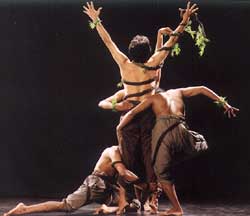 The Living Tree is a folk tale set in a village. It is about the relationship between a girl who lives in a rural home and her beloved tree. Sensing that the tree is a kindred spirit, she waters it faithfully. Under her loving care, the tree grows large and provides shade, fruit and firewood to the villagers. But the girl's sister-in-law, annoyed that the girl shows more devotion to the tree than to her household chores, eventually persuades her husband to arrange a marriage for the girl that will take her far away. Before leaving, the girl entrusts the care of her beloved tree to her sister-in-law, not realizing that the latter has no appreciation of the tree. Before long, the tree begins to lose its leaves and wilts. Mysteriously, the girl's brother falls ill at the same time. There is a drought and the selfish villagers who were thriving on natures bounty, are suddenly reduced to fighting for survival. The girl, sensing impending disaster, rushes back to her home. She sees the dying tree and runs to find water for it, first giving some to her brother. Magically, the tree is revived, and the brother too is restored to health. Clearly, man and nature share a common soul and each depends on the other for survival. Produced and sponsored by Cleveland Cultural Alliance, The Living Tree was premiered in Chennai at The Music Academy on March 16, 2001. This was followed by a benefit show for under privileged children on 17th March. The production will be on tour in the US till mid June 2001. Narthaki Online speaks to the producer, choreographer and some of the artistes. 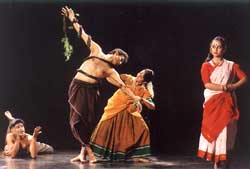
UMA GANESAN, Cleveland Cultural Alliance There's been a long gap between Abyaasa and The Living Tree.... The production had been in my mind for more than 2 years. 2 years ago we had staged 'Abyaasa'. I didn't do much after that, just got my thoughts together. The book The Living Tree by Shel Silverstein inspired me. A lovely story, we could do so much with it. We found a parallel story The Mango Tree, an ancient Indian tale. I loved the idea of interdependence of man and nature, the value of caring and sharing. In this age we have somehow lost these values along the way. Through my production, I wanted to try and get the message across to the people as well as give young people a chance to work and show their talent. Lucille Gruber is a musician and educationalist from Cleveland. We realized that the Upanishad was a great source of inspiration for us. Every being has one common soul. Dr.Gruber went deep into it. We structured it - the characters, the events that happen under a village tree, activities to do with nature like ploughing, sowing, and reaping. What we need to put back, is the moral. How did you go about building up this team? Narendra auditioned the dancers. I felt he was the best to choreograph this piece. We wanted the production to be entertaining and recreated characters and events from simple childhood. He needed 6 months time to work intensively on the production, choose dancers who could work as a team and commit a lot of their time to this production. He recommended V S Narasimhan as the music director. We wanted a combination of classical and folk, a flow between the two. I asked him to represent the idea as per his imagination. So, Western, classical and folk all meld into each other beautifully. Choreography and music was worked on for 5 months totally. As producer of The Living Tree, can you tell us what's special about this production? From the angle of producer, we have worked for a year to raise money for the tour. The dancers had to be paid for all the months of rehearsal. Though I cannot choreograph, I can see from the audience point of view. The best outcome of this is, the people are enthused by this idea. This production has been very satisfying, very enjoyable and rewarding...a total team effort. We used eco-friendly paper for brochures and publicity materials, except posters because we could not print photos on them. This actually turned out to be more expensive but we wanted to make our point. Even the sets were minimal, made out of cotton by the youngsters. The whole cast has been utterly disciplined and coordination has been amazing, no problems of ME or I, no ego, no hassles. I am so proud of this team; they epitomize the spirit of the production. I have worked for 10 years on different productions, but this is the most amazing team. Given a chance, I will work with this group every single time. The dancers range from 22 to 35 years of age, no age bias, no gender bias. The music director is such a wonderful, modest person. I have learnt so much from the youngsters. I hope they learn more about administration, how to run a dance company, back stage management, technical knowledge...then they will become complete artistes. But dancers constantly look at themselves, to know how they appear on stage. I will go nuts if I had to do that!! But that's their profession, they have to do it. You did a special show for under privileged children. Will you be doing more such shows? In the US, I have organized a lot of lec / dems in schools. We premiered our show on 16th March in Chennai. We followed this with a free performance for under-privileged children on 17th. Though expensive, this to me was most rewarding, as the children were absolutely riveted with the show. I feel we must do more such shows for these children, how else can we educate them? I love interacting with them, they are not judgmental and they are a good target audience. All the dancers performed for free, I only paid them conveyance. We had recorded music, just 10 to 12 days of beautiful recording; it was utter bliss, no necessity to deal with the famous nakras of musicians. They get paid 3 times what a dancer gets, why keep the dancers out of pocket? Except for solo recitals, we can manage with recorded music! G NARENDRA, dancer, choreographer As choreographer, what challenges did you face? More than anything else, I believe in this theme, it's real. That has come out in my dance. For the past 2 years, I have been thinking about it. To make a 4-line story into a full-fledged dance drama needed lots of work. On and off, I'd been making notes, but for the past 5 months, this has been my life. I can do only one thing at a time. I couldn't have done this if I had been doing anything else. I shut off even my personal life. Tell us something about your team building process. Without the support of so many people including Uma and the dancers, it wouldn't have happened. All the performers have been so cooperative, that's why such a good production is the result. I had to keep my cool; my dancers did not give me a chance to lose my temper. This surprised my dancers since I have a reputation for my bad temper! I gave the dancers the opportunity to work on the stage props, costumes are by Joy and Mahalakshmi, the story and concept had lots of inputs by Uma and her husband, the music has everything from classical to folk. We chose the best dancers. This group is different from that of Abyaasa; depending on what type of dancing we do, we choose the dancers. As choreographer, do you have any message for your audience? I want the audience to see the program not as something choreographed by a Bharatanatyam dancer, but to come with an open mind in order to enjoy it better, not to assume that since I am a classical dancer, the choreography will be in the classical style. Depending on the moods, there are different styles of dancing. In the 2nd half of the show, where there's the mood of separation between tree and girl, the emotional moves are abstract, contemporary dance. Maybe the audience could not relate to it, though most people enjoyed the show. Isn't the show a little too long? The production could have been shortened, but the audiences in US like it that long and we need the extra 10 minutes for costume changes, that's why we have not edited some parts. Some members of the public were for the extra 10 minutes, said they got mental relief from the emotional scene. Sometimes, choreography is changed here and there as a production is staged a few times. Would you change any of the choreography over the coming months? One disadvantage is, the music is already done and recorded. So, it would be hard to change the timing. I believe in what I have done, I like everything about this production and I've arrived at this choreography after umpteen changes over the past few months. So, I don't think I want to alter anything. I'm perfectly happy with what I've done. What has been the most rewarding aspect of this production? The children loved our show on 17th. I love to work with children and I'd like this kind of work to go on but one needs opportunity and lot of money for such work. Given the opportunity, we are ready to do it. C A JOY, dancer and costume designer How did you go about the costume designs? Doing the costumes for the 14 dancers was a challenge as there are frequent costume changes in between scenes and very limited time. I had to be very careful and choose patterns that would be easy to get in and out of fast. All are basically handloom cotton fabrics, but they are very easy to iron and maintain. The story is a village setup; it can be any village in the world. Because ours is an Indian production, we restricted ourselves to an Indian village setup. How different has your involvement been in this production? It has been a very exciting and challenging experience. Very different from a normal dance program that we usually do. It's more of folk than classical. Usually the lay people do not go for this type of program, but most of the people who attended our performance enjoyed it immensely. All 14 of us have been very cooperative, more than any other group. Apart from regular rehearsals for the past 5 months, Narendra who is the chief choreographer has been working with Mahalakshmi and me from as long back as September itself. We have all set apart a lot of our time on this production. T K THIRUCHELVAM, dancer Isn't this the first time you are participating in a CCA production? Yes, it is. There are a lot of things I have learnt from others. We are a mixed group of senior and junior dancers, but together, as a group, we have done a great job. Everybody is creative in their own way. It's a nice experience to know how a 2-line story of sharing and caring can be elaborated into a 2-hour dance drama and at the end of it, the audience will definitely begin to love nature. That is our mission. It is 100% Narendra's choreography. It's a great feeling to work with him. The Living Tree is a hard subject to choreograph, but even a small child in the audience can understand a small eye movement, so much attention has been paid to details. It may seem like a simple choreography, but a lot of hard work has gone into it. How did you get to be chosen for this production? Narendra wanted young and upcoming dancers to be given the opportunity to participate, so initially 12 male and 12 female dancers were chosen. Some had prior commitments, some quit. In the end, only 7 each remained, I am one of them. As for taking part in other productions, we had to inform well in advance, so it did not clash with our rehearsals. Since it is a group work, if one person is absent, the total group work is affected. The co-dancers were very flexible, cooperative and adjusting. How has this production enriched your work experience? CCA has organized everything so well; each and every detail is well taken care of. Working with CCA has been a good experience to learn how well organized an artiste should be. There has been no politics, no ego hassles, only the one mission to get a message across to people. We have helped each other, corrected each other's mistakes, so the good reviews we have received has been for our collective work. MAHALAKSHMI, dancer You have a long association with the CCA.... I have been working with CCA since 1994 in such varied productions like Jaya Jaya Devi, Jungle Book and Abyaasa. I find them very professional and well organized. I have been working with CCA, Leela Samson and the Dhananjayans for many years since I know then that it will be the best, every single thing is so perfect. If any other company were to approach me, I'd think twice about accepting. That apart, Narendra and I've been teaching in the CCA summer workshops in Cleveland from 1994 - 1997. I have stopped now, but Narendra continues to teach. As one of the main dancers, how do you feel about being part of such a big production? For the past 5 months, I do not know anything other than The Living Tree. The idea for the whole choreography is Narendra's, but he choreographed it on Joy, Deepa and me. It was taught then to the other characters. I have also been helping Joy with the costumes, in choosing the colors, so they don't look jarring, the patterns to go with the theme. Most important was, the patterns had to be comfortable to dance in. Joy came up with different patterns and we chose the best, most comfortable fit from them. For me, the Living Tree is not just a dance production. It took a long time for us to get totally immersed in it, it will take an equally long time to get out of it and do something else. I dance for my soul. I don't dance for people basically, my efforts in any dance program is the same whether the audience is 15 or 500. You dance for your atma, not to impress others but for the basic soul of the production. I felt it in this production. Most of the dancers felt that. It will take a long time to do something else on my return. That's why Narendra, Joy and I did not take on too many commitments. Usually choreographers lose their tempers, but till date Narendra has been extremely patient, never lost his temper even once. Utmost discipline was maintained. Uma took 2 years of thinking and Narendra put in a year of hard work. Inspired by Uma's involvement and Narendra's dedication, I've been driven to do my best. |
