
|
    |
|
|
|


A JANARDHANAN - Lalitha Venkat, Chennai e-mail: lalvenkat@yahoo.com Jun 2001 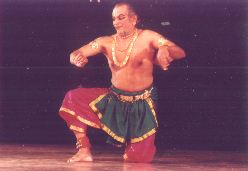 Prof. A Janardhanan, son of veteran Kathakali exponent Chandu Panicker from whom he learnt the dance form, also learnt Bharatanatyam under Rukmini Devi. He received the Govt. of India scholarship for a 2-year period for advanced training in Kathakali and during this period, he had his training under Kalamandalam Krishnan Nair also for more than one and a half years. He has taken post - diploma in Kathakali with distinction in 1966 and has been working in Kalakshetra since then as a Kathakali and Bharatanatyam teacher. He continues to participate in all the dance dramas produced by Rukmini Devi in major roles since 1959. With the Kalakshetra troupe, he has performed all over India, Eastern and Western Europe, Nepal, Australia, Sri Lanka, Russia and China. He assisted Rukmini Devi in the international ballet competition held in Moscow in 1981. He has performed major roles as Rama in Ramayana, Buddha in Buddha Avataram, Bheema in Damayanti Swayamvaram, King Nagaraja and Nanan in Kannappar Kuravanji, Mahabali in Kurma Avataram, Vajrasen and Utiya in Tagore's play Shyama, the Brahmin Ajamila in Ajamilopakhyanam and most of the male roles in Kathakali dramas. He has been invited to be an external examiner in dance by various universities and art centers in India and abroad. He has choreographed two major dance dramas for Kalakshetra called Karna Sapatham in Malayalam and Sri Purandara in Kannada. Simple and unassuming, he talks to Narthaki Online in an exclusive interview about his life in Kalakshetra College of Fine Arts, of which he became principal from April 20, 2001. How does it feel to be the new principal of Kalakshetra? I don't feel anything new. I have grown with the institution, maybe my post is a little elevated, but I remain the same. I have always been associated with Kalakshetra, I've worked for it tirelessly and maybe this is the fruit of my efforts. Even if I had not been made principal, I would not have been upset. My aim is to continue to work for Kalakshetra and I would have been quite happy to remain an artiste. Are you daunted by the task of carrying out your duties as principal of such a legendary Institution? This is a big question. To be head of an institution is always prestigious for any individual. As I told you, I grew up with the institution. I am delighted at becoming principal, it has enhanced my feelings. At the same time, I do feel a little daunted. The duties of a principal of Kalakshetra are not ordinary, like that of any other institution or college. It is unique because there is not only office work to do, but also to mingle with faculty members, students, to promote Amma's dreams and visions without deviating from her idealism. Unless it's a combined work, the task cannot be fulfilled. How did Rukmini Devi's guidance influence your outlook on life and the arts? She was an example. I would compare her with Rama in Ramayana. Her life was exemplary, not only as an artiste, but also as a human being who loved animals as much as human beings. She lived a life of simplicity; she was never for glamour, never for compromising. Whatever she did or spoke was with meaning. She inspired everybody and I was inspired by her. She was like a mother, she loved everybody. Even though she did not visit Kalakshetra everyday, she knew everybody personally. She could recognize talent in people. She was like a foster mother to me. She was responsible in molding me into an artiste. She encouraged me in every way, she entrusted the whole responsibility of executing her work to me, whether it was dance drama or any other activity of Kalakshetra. She gave us a free hand to work in the dance dramas. Any work was encouraged by her in totality. I would call her a divine mother who encouraged everybody. It's the highest quality in a human being. Artists are very emotional and sentimental. Only she could understand the differences between artists and she embraced everyone without discrimination. She was my guide. But for her, I would not have achieved this status. She made me a refined individual. So, I'm content with my life. 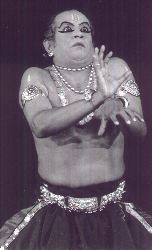 in "Purush" 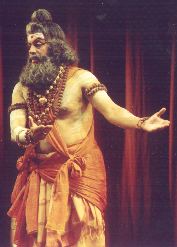 in "Akka Mahadevi" What are your early experiences in Kalakshetra? It was a golden period for us because we were all surrounded by the giants of different fields. In every corner, we saw only the topmost exponents in music, dance and Bhagavatamela dance dramas like Balu Bagavatar, Mylapore Gowri Ama, Mysore Vasudevachariar, Veenai Sambasiva Iyer, Thurayoor Rajagopala Sarma to name a few. Even though my father was a Kathakali exponent, I knew nothing about the art till I came to Kalakshetra and got initiated into Kathakali and Bharatanatyam. My father was 85 plus (I was about 14 then), when I joined Kalakshetra. The people of my village Kunhimangalam compelled my father to bring me here as there was nobody to continue his art. He was very hesitant as he was very old. Then, I was offered a scholarship by Rukmini Devi in 1958 and I came to Kalakshetra as a student with my father. At that time, Dhananjayan, Balagopal and Kunhiraman were all here as seniors. They were learning Kathakali mainly, besides Bharatanatyam, not directly under Rukmini Devi but from her disciples like Sharada Hoffman. Similarly, I also started learning Kathakali and Bharatanatyam simultaneously. We were all fortunate to have such facilities to learn two art forms, one in the morning and one in the evening. We knew how not to mingle the two styles because our teachers were constantly supervising us apart from teaching. That was the time Rukmini Devi started 'Seetha Swayamvaram' where my father contributed a great deal of his services to assist her in the production. Kathakali formed a major part to portray the heroic roles in the Bharatanatyam dance drama. We continued the same trend even after my father died. How different and vigorous a schedule did you follow then as a student? For Kathakali, it was compulsory to take lots of physical exercises. My father wanted us to undergo the sort of training he himself had gone through. So, we had to be up at 3.30am, during winter too. Rukmini Devi arranged a specialist to give us the usual oil massage. By 6.30 or 7am, we would be done. Then it was off to classes at 7.30am up to whatever time it ended, maybe 11.30am or more. They did not go by any particular timing, even though there was a prescribed syllabus. The teachers taught us with total involvement, so we students had no other option but to go along with that. After lunch, from around 1.30pm started our afternoon training. It would go on, sometimes up to midnight if we were working on a dance drama. Rukmini Devi used to sit with us for that. So we never bothered about timings. We worked tirelessly the whole day. My father never gave me preferential treatment as his son. He was hard on me. He was never satisfied, no words of appreciation. Even after a performance, his verdict was always 'not satisfactory'. This was his knack of getting better performance from us, so we did not get smug and think we had achieved it all. He would however commend our work to others. That's what helped us do better and has made us strive more even now. I still don't feel I'm up to the mark. To have undergone this rigorous training under this genius was initially a bitter experience for me at the time of learning. But when I realize that one can't dream of getting such training ever again under such stalwarts, it gives me a warm feeling. They were all such sincere teachers. Rukmini Devi's approach was quite vehement too. Her comments were not too receptive. After every performance, we were scared to face her. We did not know what comments she would have in store for us. With their blessings, we are still in the field. Did you have any relaxation at all? The word did not exist in our dictionary at that time. Even on weekends, we had to practice before my father. To memorize sahityas, practice expressions. He would talk about the subject too in detail. So, literally speaking, all the seven days were working days. Unless we went out for an hour or so, our only relaxation was at night. No afternoon naps. The words of wisdom our superiors followed diligently was that there should be no pleasure except that of dedication to knowledge. They lived as they preached, so we followed their example. My only relaxation was when I went home for the summer holidays. Even then, I had to get up early, do my eye exercises before my father. I used to hate him. After I lost him, I realized how tremendously fortunate I had been to have had him as a father. He was a real teacher. In the class, he was a roaring lion, outside it, he was an affable human being. What about your mother? Do you have brothers or sisters? My mother is now 87 plus and lives alone in the village. She wanted to come here, but her health does not permit it. She never had the opportunity to join my father during his service here in Kalakshetra. He used to send us money for our survival. Only when he passed away did my mother stay with us for a few years. But she returned to her village due to health problems. My elder brother has just retired from South India Corporation. He's not a dancer, but he appreciates art forms, especially Kathakali. I don't know if he wanted to be a dancer. My father did not want me to become a dancer either. He knew the problems. Did you ever consider any other career other than dance? Maybe I would have been a villager still, looking after my mother. I had just completed my eighth standard in education when I joined Kalakshetra. I wanted to study further but could not. I have no regrets because the education I received in Kalakshetra is better. We were given education in totality, the in and out of art. I've equivalent knowledge though I do not have a degree, which is so important these days. Rukmini Devi always said she was not a graduate, she had studied only up to eighth standard. If you want to be an eloquent person, you don't necessarily have to go to a university. You can acquire knowledge from your friends, colleagues and teachers. We had a gurukulam here. We had the opportunity to be associated with the genius of that period. By mixing with these people, we acquired more knowledge, better than anything. 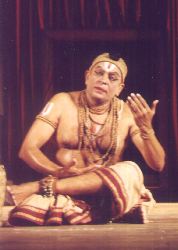 as Perialwar in "Andal Charitram 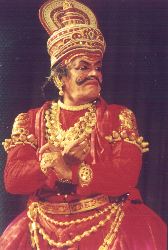 as Ravana in "Seetha Swaymvaram" A lot has been said about Rukmini Devi's ability to understand and like what is beautiful…. She had an eye for color. In fact, she had an eye for everything. Even for the stage decoration, a simple stool was transformed to a throne under her artistic direction. She maintained simplicity and elegance in everyting. In angikam, vachikam, aharyam and abhinayam, whatever applied in daily life, how to speak and behave, extended to the stage. According to her, the learning and refinement starts in daily personal life, which gets converted onto stage persona. Know yourself first and you can transform yourself. She wanted everyone to be an ambassador of Kalakshetra, to be a sincere citizen. Everyone admired her and followed her values. Being with Rukmini Devi, no one failed in their achievements. Everyone associated with her are enjoying the fruits of their lives. How has the outlook of the institution transformed over the years? Kalakshetra during Athai's time was to always remain an institution for the public to be benefited from the art forms, mainly Bharatanatyam and music. She wanted Kalakshetra to be like a temple, as if devotees go to a sanctum to feel a kind of relief, but not to come as a person who witnesses an art for enjoyment or recreation. She wanted Kalakshetra to be a universal institution where people have all the freedom to come and learn the arts. After her demise, her dedicated band of disciples who were looking after the day-to-day work of Kalakshetra, carried on her ideals and to preserve her work intact. I don't feel there's any change in the way of functioning. Her presence is not there, but her invisible form is guiding us in carrying on her message. The change is from the administrative point of view. It was Rukmini Devi's institution until she passed away. When the govt. took over on October 10, 1993, the administration had to follow certain rules and regulations stipulated by the govt. Once the govt. enters the scene, one can't expect more, the nature of functions is totally different from a private body. Some of the buildings are now being built with govt funding. During the days of Rukmini Devi, it was all thatched because not only did it lend an ambience, that was all she could afford. It's now difficult to maintain. Also, we have to swim with the currents. That's the only change I can feel. But Rukmini Devi College of Fine Arts continues in the same spirit. People say the standard of Kalakshetra has come down over the years... We always advice students to preserve what they have learnt. To convey their message through dance, not to treat it as a recreation. Newcomers may not know Rukmini Devi's message that we are concerned with the art form, not money or entertainment value. Now, the accent is more on the latter, not for all, but for some and that is enough to invite such criticism. All the five fingers of your hand are not the same and cannot be compared with each other. Likewise, teachers are different individuals. People can comprehend differently. It varies from person to person. Even when Amma was here, she did not teach herself all the time. Different teachers taught according to their understanding of Amma's values. In general, Amma was there to guide and streamline everything. She's no more with us. It's possible to say Kalakshetra has changed its way of functioning, hence the standard of teaching has come down. But that is not correct because I've been working in this institution for the past 43 years. I don't feel any drastic change has taken place as far as teaching is concerned. There could be a minor error from a teacher's side that can be easily rectified and corrected among ourselves, who were once upon a time students of Kalakshetra ourselves. The standard of Kalakshetra remains unshaken. I can boldly say, as a Kalakshetrian, the style is unchanged. For instance, take the major productions. I was responsible for handling them. I'm now shouldering the burden under the shelter of the chairman and management. So, we are still preserving what Amma wanted to achieve through her productions. It's sad to listen to people say Kalakshetra has gone to the dogs, it's the beginning of the end and so on. If they can specify where we are lacking, we will rectify. Nobody's perfect. We are bound to make mistakes. Suggestions are welcome. Kalakshetra should maintain its identity. It's not one person's property, but belongs to everyone. People are welcome to criticize but only if it's relevant. Will your duties as principal allow you to continue teaching? The responsibility of being a principal is higher than a teacher. So, I cannot actively take part in teaching. I'm over all in charge, supervising to see that all is going well, maybe teach in a colleague's absence. But I can't be a full time teacher like before. Kalakshetra is like my family. I love to teach, to be with the students, to impart 43 years of experience. Now to be away from it, I feel like a fish out of water. |
