
|
    |
|
|
|

 DURGA CHARAN RANBIR Rahul Acharya interviews the doyen of Odissi, Sri Durga Charan Ranbir on male Odissi dancers. e-mail: rahul_acharya@rediffmail.com Jul 2001 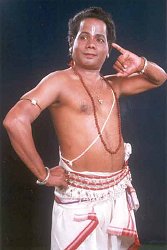 Durga Charan Ranbir, disciple of the late guru Deba Prasad Das has done a lot to propagate the school of Odissi his teacher specialized in. His vast experience as a teacher of Odissi for the past 25 years includes work in institutions spread over many places like Bhubaneswar, Cuttack, New Delhi, Calcutta and the USA. He was a visiting professor in the Delhi University Cultural Council, has taught in Jawaharlal Nehru Youth Center in New Delhi; Utkal Sangeet Mahavidyalaya, Sangeet Niketan, Vani Vihar in Bhubaneswar; Lalit Kala Pitha, Alaka Kala Mandap in Cuttack; Satabdi Nrutyayana in Calcutta and Lotus Arts in New York. He runs his own institution Nrutyayan in Bhubaneswar. Many of Durga Charan Ranbir's students have been awarded the Sringar Mani title. His disciples have also earned fellowships from the Central Dept of Culture, Govt of India certificates for excellence and the Mahari Award. Does a male dancer get fewer opportunities than a female dancer? Yes, but not necessarily always. Perhaps in Odissi, like in other forms of dance, especially Indian classical dance, female dancers are preferred to male dancers. Apart from the normal preference for female dancers, most of the Odissi male dancers are inhibited by their economic background and low level of academic qualifications. Majority of them come from poor families with hardly any schooling. As such, very early in their dancing career they take up dance teaching as a means of livelihood. To my mind, these are the two most important causes, which prevent them in ending as good performers. In contrast, most of the female dancers of the Odissi form either of the past or present have been / are invariably from economically very well to do families and very often highly educated. While money is not a limiting factor for them in acquiring the best of dancing skills and creating opportunities for sufficient exposure, their academic acquisitions help them work with understanding and imagination. All the same, a good male dancer in Odissi has also his standing and in many cases it is seen that he has been preferred to many female dancers in the live. It may be revealing here that Gotipua form, from which Odissi as a form of classical dance is stated to have evolved, is basically a male dance form. Presently also many male dancers in the field are happily from rich families and have high academic qualifications. Do you think a lyrical dance form like Odissi is well suited for a male? Of course. This dance form is divided into both Tandava and Lasya aspects. Tandava deals with the vigour of masculinity whereas Lasya deals with the aura of femininity. Excluding Pallavi, all other phases in Odissi are suitable for males. Items like Sabda Swara Pata and Sthayee have been specially choreographed keeping the male torso in view. One has to choreograph the items very carefully so that the male dancer is able to maintain his masculinity. For example, my Guru Late Shri Deba Prasad Das had choreographed items like Ashta Sambhu, Sthayee, Sabda Swara Pata, Chhanda and Champu typically for males and following his footsteps I also have choreographed items like Suryashtaka, Dashamahavidya and Ardhanarishwara. Even in Pallavi, if Bhangis like Pada Balaya, Abhimana, Kunjarabakta etc. are replaced with Mardala, Parshwa Mardala, and Benu along with Suchi Pada then this also is suitable for males. Keeping this in mind I have experimented with a Pallavi based on Raga Chakrabaka. Why aren't there many male dancers in Odissi but there is never a scarcity of any male teachers? I have given the answer earlier. When Odissi got its classical status in the late 1950's, Gotipuas were in full swing. Slowly these Gotipuas left their troupes and individually started imparting lessons. These Gotipuas were from poor families and thus did not get enough scope to study. As a result they were neither able to explain what they were teaching nor were they able to communicate with the outside world. Thus they began accepting girls from rich families as their disciples and placed them at the forefront as their representatives. Slowly this became a trend where males were teachers and females were performers. Besides this, since the higher strata of society looked down at male dancers, rich males could not enter this field even if they wanted to. But now time has changed and well - educated men from good families are coming forward to learn and preserve their rich cultural heritage. Can you do something for the upliftment of the male dancers? Yes, why not? At present I am training many male disciples. But to place them at the forefront, special choreographies are needed and for this adequate supply of funds is a necessity. It is a proven fact that males were a priority because of the Gotipua tradition. I do not deny the fact that Odissi also hails from the Mahari tradition. But who has seen a Mahari's performance? People have seen Gotipuas. Besides, specific traditional male choreographies are present in the Odissi style. Only people have to come forward and join hands to help these men preserve their dying culture. If I receive necessary help I can certainly contribute a lot for the upliftment of the male dancers. How many of your male disciples are performers and not Gurus? At present I have four leading male disciples out of which one of my major disciples Rahul Acharya is a performer only. He is also my youngest disciple. But another disciple of mine, Sanatan Nayak is a performer cum teacher. Some of my disciples at Delhi like Sushant Raut and Dilip Mohapatra are prominent as performers, but they are also into teaching line. Only Rahul is strictly a performer and representative of my style. Do you think any of your male disciples is worthy of carrying your style after you? I think so, yes. I always try to be optimistic but that too depends upon the grace of God. Let's see what destiny has in store for me. How many of your male disciples have gone abroad like you and propagated Indian culture? Only one of my male disciples has gone abroad accompanying me and has conducted workshops at different colleges and universities. There has been a lot of talk about corruption/ distortion of Odissi by male performers. How would you react to this? All male performers are not distorting the dance. Some of them, having learnt Odissi, shift to Chhau, trying to make their dance more graceful. Only a spectator understands how awkward this blend looks. If one is sincere enough to stick to the classical aspects of this dance form, then he has to refer to the treatise on dance like Natya Shastra, Abhinaya Chandrika, Abhinaya Darpana etc. along with verdicts from the Guru, then only there will be no place for distortion. Do you think your responsibilities as a Guru has hindered your progress as a performer? I fully agree with this statement. When one becomes a teacher, many responsibilities dwell on his head; as a result practice is hampered. For being a performer one has to concentrate on practice only and do Sadhana. As my Guru is dead, to keep the Gharana running, I was bound to take up the teaching profession and thus ceased to become a performer. Besides, there is not much scope for a dancer in Orissa. What is your message to other male performers of Odissi? I have to tell them that they should maintain a puritan approach keeping the basics without any distortion. They should, without any adulteration, do enough Sadhana and thus try to emerge as cultural ambassadors of the pure and traditional Odissi dance form. Durga Charan Ranbir "Nrutyayan" Plot # 107E, Acharya Vihar Bhubaneswar 751013, India Ph: (91 - 674) - 540312 |
