
|
    |
|
|
|


Book Review of "A Yoga of Indian Classical Dance" Interview with the author Dr. Roxanne Kamayani Gupta Dec 2001 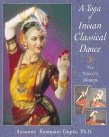 Roxanne creates this book by combining her experiences of living in India, learning classical dance and yoga from some of the great teachers. Her style of writing is exquisite and authentic. I grew up in Hyderabad speaking Telugu language. Reading about her experiences from Hyderabad, I felt like I'm back home. While in India, Roxanne mastered the Kuchipudi dance style and studied with yoga teachers of the hatha and kriya yoga traditions. She incorporates some of the dance movements and hand gestures into the yoga exercises she recommends. She clarifies to the readers how classical dance and yoga are interrelated. Any dance teacher would benefit greatly from reading this book. Padma: What inspired you to write the book, A Yoga of Indian Classical Dance? Roxanne: My Guru Ganesh Baba. His voice came to me while I was meditating in front of his picture in La Vieux Salidieu Yoga Center run by my guru's family in France. He said, "You really ought to write that book on Yoga and Dance now." He had told me many years earlier that I would write such a book but I never believed him, never took him seriously. This time I listened. Padma: Why do you have such "connection" with India, its dance, religion and Yoga? Why India? Roxanne: Many of my Indian friends insist that I was an Indian in my past life and that is why I traveled, at the age of 19, half way across the world to find my spiritual "home." I do not reject that explanation for there was nothing in my background remotely connected to India. But perhaps there is no need for any metaphysical explanation. Anyone who looks closely at India will find it one of the most fascinating cultures on the planet. In my book I write about the unusual set of circumstances that led me not only to India but also to my dance teacher, and my spiritual guru as well. Padma: You are very open and honest in the book about the times you spent in India. Sometimes, you went through very difficult experiences. But you still go to India almost every year. How do you explain this? Roxanne: Who says that because something is difficult we should avoid it? To attain anything worthwhile we should be able to sacrifice ourselves. The problems I encountered in adjusting to difficult conditions in India were the most valuable lessons of my life. It has led to a certain freedom from the need for extreme comfort. Besides, I am deeply connected to so many people and places in India I could not live without them, no matter what obstacles I might encounter. I am not alone in this—many westerners, and even born Indians living in the west, have something of a "love-hate" relationship with India. Perhaps it is a reflection of our love-hate relationship to life itself. We are born into limitation: It pinches. India pinches, sometimes it gives you a real thrashing! I always say that the same amount of karma it would take you to work out in ten years in the west will be taken care of in a year in India. The life and death realities that we face in India speed up our spiritual evolution. Padma: You perform not only in US, you go to Europe and other parts of the world. You do have a lot of Western audiences. Are there any differences on how Indians and non-Indians receive your performances from the cultural difference point of view? Roxanne: I have found that Western audiences are more appreciative of Indian classical dance than Indians often are—or perhaps there is simply a difference in the way they express their appreciation. There is no question that an artist can perform better if the audience is focused on what she is doing. In fact the artist feeds off the energy that comes from the audience. The Natya Sastra clearly states the role the audience must play and it specifies who is fit to attend a performance. But today we live in different times—in India, the Chief Guest walks in ten minutes late just so he can look important. People often talk out loud during the performance and get up and walk out in the middle of a dance. Western audiences do not take the art for granted. Even people who have never seen Indian dance understand its spiritual dimension intuitively and they show it respect. Also, Indians sometimes have the attitude that art should be free—my Indian artist friends feel very taken for granted in this regard. This has to do with the low status of traditional artists in India—except for a few big names, artists are practically a starving class. I long ago gave up performing for Indian audiences because it simply wasn't worth the trouble for me. Nonetheless, whenever I dance there are at least some Indians in the audience and I am always very grateful for their presence and their feedback. Padma: You have done in-depth research in anthropology, culture, dance and yoga. In your experience, what can dance and yoga teachers do to improve the awareness of these forms around the world? Roxanne: I believe that everywhere in the west, the interest in yoga, and in Indian classical music and dance is on the rise. In India as well, dance and yoga are both alive and well, so there is plenty of awareness that I can see. It does seem ironic to me that the most creative approaches to yoga are taking place in the west whereas in India yoga seems to be formulaic and rigid, the exact opposite of what it is intended to do—make one more flexible in body and outlook. In Pondicherry I saw a "yoga competition" with prizes handed out! In the west we have the opposite problem, so many kinds of yoga are springing up everywhere that one wonders if the tradition is not somehow being compromised in some way. But all in all, yoga is a system that should be adapted to human needs. Padma: In your book, you integrate yoga and Classical Indian dance. You create connections between them. Why do you want to integrate them? What kind of benefits will this fusion offer to us? Roxanne: As I state in my book, I developed this, a particular yoga program through the years to help me to become a better dancer. From the beginning I was fascinated with the connections between Indian dance and yoga, as both were spiritual disciplines that led one in the same direction. Yet one embodies eroticism and the other asceticism. My life has been a dance between these two poles of existence, which is why for many years I was a devotee of Lord Siva, the "erotic ascetic." Now my spiritual life is centered more on the Goddess Herself, a reflection, I believe, of my attempt to integrate these two aspects within myself. Of course wherever there is Shakti, there is Siva and vice versa. The subtitle of my book is "The Yogini's Mirror." The Yogini represents the fact that on the planet today, the overwhelming majority of yoga practitioners are women! This represents a definite shift on the earth-the Yogini is the embodiment of integration between creation and liberation, between spirit and nature. Padma: As Professor Gupta, what do you teach to your university students? Do you teach religion, dance, yoga or anthropology? Roxanne: I teach at Albright College, an undergraduate institution in Pennsylvania. I teach a variety of courses in the field of comparative religious studies, including Asian religions, and Yoga: Philosophy and Practice. I also teach a course in Goddesses East-West. Padma: You have followed you passion all through your life and achieved many goals. What are your plans for the future? Are you planning to write more books, perform more ...? Roxanne: I always have many projects cooking at one time including my dance performances, workshops, and writing projects. These things will continue by the grace of gods and gurus. Roxanne Kamayani Gupta holds a doctorate in Anthropology of Religion from Syracuse University and is currently Assistant Professor of Religious Studies at Albright College in Reading, Pennsylvania. You can visit her web site at roxannegupta.com Padma Chebrolu is the artistic director for Cultural Centre of India. She writes and produces videos related to dances of India. You can visit the web site at culturalcentreofindia.com |
