
|
    |
|
|
|


Convergence - the music of Oikyotaan Lalitha Venkat meets Bonnie Chakraborty, the leader of the band Oikyotaan, in Chennai September 14, 2003 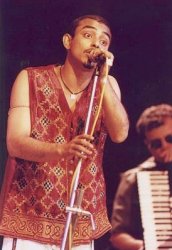 Bonnie Chakraborty was a professional musician and lead vocalist with Krosswindz in Kolkata till 1998. He has been involved in acting and creating the music for two diploma films at the Satyajit Ray Film Institute of Technology, besides doing freelance assignments in the corporate and film industry both in Kolkata and in Chennai, where he is currently based. He has sung for famous music directors like A R Rehman and Yuvan Shankar Raja. His dream of forming an indigenous platform to experiment with folk music took shape in Chennai when he met with like-minded individuals. Founded by Bonnie 2 years ago, the group Oikyotaan seeks to permeate folk sounds from West Bengal and Bangladesh with a new, indigenous genre of music that reflects the traditional and yet breathes of the contemporary. It has incorporated from folk music like Bhatiyali, Jhumur, Bhavaiyya, Baul and Lok Geeti, and interpreted each with an additional ensemble of sounds and textures to offer a distinctively new spectrum of music. The band has performed in southern and eastern India and does a wide repertoire of songs from Baul, Murshidi, Fakiri and Dehototto. 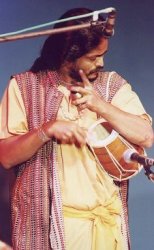 Kartick Das Baul is a well-known Baul singer from Guskara, Shanti Niketan in West Bengal. Oikyotaan collaborated with him on a project of Fakiri songs for The Other Festival in December 2001 in Chennai. Currently Oikyotaan is working on a project of Dehototto and Fakiri songs to be presented at the Sacred Music Festival in Berlin where Karthick will perform vocal and khamak with the group. After a 2-week workshop with Karthick, Oikyotaan gave a performance at the Alliance Francaise auditorium on August 8th in Chennai. The concert was a prelude to the series of concerts to be performed later this year. The band included Donan Murray on rhythm and lead guitar, Paul Jacob on the bass guitar, Kartick Das on vocal, ghungur and khamak, Saravanan on thavil and Bonnie on vocal. What got you interested in Bengali folk music? I have grown up with it. Since an early age, I have been exposed to a lot of Bhatiyali music. My father's side of the family is from Bangladesh and everyone used to sing these songs to me. They grew up with that cultural space. I was a musician from 1991 to '98 with a rock band called Krosswindz in Kolkata. We also worked on 4 Bengali albums during that time. Basically after going through 8 years of mainstream music, I wanted to get back to a form of music I could brand myself with and create an identity for myself. I left Kolkata in 1998. It was my dream to have a contemporary folk band. Only after coming to Chennai, I realized that there are so many classical musicians here, so many percussion players, violinists and so on. Their tradition is so strong that they can easily fit into the folk format, be it Bengali or Rajasthani. It's the same idiom, the same language. You don't have to explain to them. That's why it is easy to work with classical musicians, like Saravanan who is a very strong thavil player. What does 'Oikyotaan' mean? 'Oikyo' means unity or coming together, like a confluence. 'Taan' is a universal melody. So, Oikyotaan is like a milan (coming together) of a 1000 taans, something like a universal language. The idea of Oikyotaan is to make folk music accessible to the audience. Who are the band members? Oikyotaan does not really fit into the group kind of a thing. It's basically a kind of platform for various musicians to interact and have a dialogue with a traditional form of folk music. Paul Jacob (of Bodhi Records) and I produce as well as perform the music. Donan Murray adds this layer of guitar to the sound; Kartick Das Baul and I are on vocal and percussions. Balu and Saravanan hold the rhythm together with an ensemble of different percussion instruments. There is no band format. The whole idea is to work with sound. I want to work with different formats, with different artistes and incorporate sounds in different ways. For 6 months, I was working with Lazare when he had come down from Paris. He's trained in western classical music and plays the Irish fiddle. His sounds were incorporated with Oikyotaan's. I have been working with Kartick for 3 years now. His work is being documented and archived by Oikyotaan. I would like to maybe release something through Bodhi Records in a very independent way. I also have plans to work with a Qawal from Uttar Pradesh if things work out. What exactly would you be doing? The plan for the next 2 years is to work with the 2 traditional artistes, Kartick and the Qawal and then perhaps develop the sound of Oikyotaan, something contemporary but rooted in the traditional folk forms. The idea is to finally develop a sound that is independent of any traditional artiste's sound. Working with a traditional artist is a very tedious and detailed kind of work to put in and cannot be done for long periods of time. That's why when I am working with Kartick or anyone else, I have to put that extra energy and effort to develop an original sound for Oikyotaan. For now, I am doing 2 workshops. The one with Kartick will be over in December. What exactly did you evolve in the workshop? I've been working on preparing a sound and format to be presented at the Sacred Music Festival organized by the House of World Cultures in Berlin in December. They promote sacred and religious music, traditional and authentic folk forms. I am looking forward to attending the performances by folk units from Teheran and experiencing their music. It will be a very interesting interaction. We are also working on a 3-song album to be released through Bodhi Records. It will not be available in the general market. The plan was to get Kartick down for the recording and also have a workshop at the same time. When he performed with us at The Other Festival in 2001, it was a completely different thing. I would call that music a kind of pop folk. Now, I have completely moved away from that. The exercise of this workshop is to take Kartick's sound, feed off him, create a sound in and around him, which is based on minimalism and which tries to support his music. The textures of bass and guitars are different, more melody oriented. The exercise here is to develop a sound, which relates to Kartick, creating one more melody from his theme. It's kind of earthy. The 2 formats we are attempting are very serious forms of folk music - the spiritual kind like the Dehototto (the 'gift of the divine') and the Fakiri songs. This is the sound I am concentrating on for the Berlin festival, these songs and 5 originals from the Oikyotaan repertoire. How did you get to work with Kartick Das? In Kolkata, I was exposed to some forms of Bengali folk and interacted with a few Baul musicians. I was introduced to Kartick through a friend of mine in Kolkata, a filmmaker who had used Kartick to make 2 documentaries on Bauls. In fact, Kartick does a lot of work for Channel Four. He has worked in the Kumbha Mela and with many production units who come from abroad to shoot. He works as an artiste as well as assists them. Kartick is a traditional Baul singer who does shows in and around West Bengal, in Delhi and now in Chennai. He is based in Shanti Niketan from where he operates. He has been in this tradition for 25 years. He's a performer through and through. He can play anywhere. Whenever he feels like it, he takes a train and sings for 2 hours. Twice or thrice a year, he goes to Europe and Japan to conduct workshops. The dynamics are very simple. For him, a performance is a performance. He says, "For me rehearsal is different, studio is different, live performance is different. There is a certain energy which happens at each of these situations." We are trying to make a format, which does not hold Kartick back or cramp his style. The aim is to project the traditional sound of Dehototto and Fakiri by Kartick, with the contemporary sound of Oikyotaan. For purposes of documentation, I will not be able to bring the traditional touch the way Kartick can. Have you trained in any form of folk music? I started doing western music when I was in Class 10. But from my childhood, I have been exposed to a lot of Bengali folk and Hindi music, the music of S D Burman and R D Burman. I have always believed that 70% of film music has been taken from folk formats. Even today, many popular Hindi film songs like 'Nimbuda' have the folk element. Though people are conscious, they really have no idea of how much folk material has come into film music. Down south, the kind of work done by Ilayaraja (music director) is amazing. What happened to your band Kashti? Kashti was a 3-year deal with Zee music. We were given total freedom and a good working budget. We did a video and also a couple of shows. We cut a CD with 8 songs. It came and went and nobody noticed except perhaps the music circles of Mumbai. It was more a musicians' album. I think a band should play live and be visible to catch people's attention. That's an integral part of marketing music. Neil Mukherjee (a band member) had other plans and Oikyotaan was taking off, so we decided to move on. I am playing it by ear now. The CDs will be available on the net through Bodhi Records. I am targeting a few world music centres in Europe. Paris is a very good market. Some friends of mine in Kolkata are also doing some festivals. There's a lot of activity happening there. Contemporary folk is getting popular. So you feel there is enough promotion for indigenous folk music in India? Do you mean folk music itself or folk music with a contemporary sound? Traditional folk artistes like Kartick are much sought after. There's a record company in a certain district of West Bengal, which releases lots of tapes of such music. There's the other type of music where Kartick is being used by pop bands in Kolkata. In the last 2 to 3 years, there has been a mushrooming of such bands in Kolkata and everyone is doing folk with a certain sound. There's a big market, so it's very popular. It is a completely parallel industry. Lots of bands have come up like Indian Ocean, which is working with folk. But per se contemporary folk music is not a very vibrant scenario. It does not have a lucrative market in terms of mass or mainstream if you want to sell that way. One has to push, look and search. I would say everything is on the net. One just has to seek and search to get in touch. I am not attempting mainstream market, so I don't have the need to go mainstream. How would you describe your music? The whole exercise of Oikyotaan is to use a contemporary sound and create a wall of sound that is completely stripped of any western chordal movement. There's no chords or use of any pop elements like keyboards or accordion like we used at The Other Festival. The idea is to keep the sound minimal. It's a different kind of route. I would say it's more difficult to work with melodies instead of thoughts, formation or movement and yet retain the folk quality. It's melody oriented, where all instruments weave and interweave a counter melody from the theme. The whole point is to reduce the parallel slick pop element and retain a sound that is raw yet contemporary. After singing pop numbers, how do you find singing Baul and Fakiri music? Obviously the tonal range and scales are phenomenal in this. It was quite a switch but not too difficult because I have been singing that kind of music for quite some time. After I came to Chennai, I did some work for films. At that point of time, I was singing folk. Now I am doing lots of freelance work. I have sung 2 main songs with this folksy influence for Tamil films 'JJ' and 'Touch' for music directors Ramani Bharadwaj and Deva. JJ is shot in Kolkata, I've sung the main track in it and Kartick plays the khamak. Do you have a manager? Not really. We operate from the Bodhi Records office. The organisation provides a platform that promotes any indigenous movement. Earlier, they were a band called Funky Bodhi. Now they do documentaries and film music too. Bodhi is working out the entire Oikyotaan production. I plan to use Bodhi as a record label also. It's a production house, they are already networked, they function in a corporate scene, source art shows, and source out talent. They have been promoting lots of things in the last 6 years. They promoted a group called Safar, a 19-member dance and music ensemble, which came down from the US. In short, Bodhi is the production house from where Oikyotaan is working from. What instruments do you play? Basically, I am a singer. I have trained in Latin American percussion of different kinds. I specialize in Latin congas, but I don't use these sounds in our music. I also play the drums a little bit. At your recent performance at the Alliance Francaise, the guitarist sounded out of place though the thavil and Kartick's khamak blended beautifully. At The Other Festival performance, the music blended though you had elements of jazz thrown in. That's because the guitarist played on nylon strings. It was a very pop sound with chords and everything. This is different because Donan is actually hardly playing; he is just adding another layer of sound. If you hear the CD, which will be released soon, you will have to search for it. It's like trying to feed off Kartick's energy and musicality and reacting to it in a different way. The bass and the thavil formed the backbone of the sound at Alliance Francaise. It's a little difficult to frame it around the melody and I have to put in a lot more time and effort to refine it. The effort will be worth it because I know at the end of the day that no one is doing this kind of work with folk music. I am confident that I am creating a new sound. In your most recent compositions, are you incorporating only Baul or Fakiri style or are you incorporating other Indian folk styles too? The sound we are giving Kartick is based on Baul and Dehototto. We are using elements not only from Indian folk but others too, like elements from Latin folk in terms of percussion or maybe Afro folk when Vikram plays the djembe. Or I may incorporate a kind of folk singing, which is similar in terms of melody but from another language. In the album we are doing now, I am trying to merge the 2 styles of singing when I am doing an Afro scat kind of a thing while Kartick sings in his own style. That does not happen everywhere in our album, only in a few places. Because I am working on a traditional format, I have to be very careful when doing such things. The switch should be smooth. Oikyotaan has performed in Chennai, Coimbatore and in Kolkata. How did the audience react to your music in these places? I had 8 years of rock music experience in Kolkata. One good thing we did was, we released 4 Bengali albums and 3 were with this group called Mohineer Ghoraguli fronted by Gautam Chatterjee, one of my main influences. Mohineer Ghoraguli was a pioneering group of Kolkata from 1977. After 20 years, we released their songs, which had a lot of folk influence in them. That was a very big parallel movement there when I was doing rock music. I have done a lot of work that's done well in Kolkata. We are known there. So, when I went there with this project, there was a lot of inquisitiveness about what work I was doing in Chennai, what work I was doing with Karthick Das Baul and so on. I did the show with just a guitar, Kartick and myself. The Kolkata audience took it very well. In fact, we did a workshop at the Music World store. I want to go with a full set up and do something bigger. But I am basically trying to target an audience, which I know is finally in Europe. I want to perform in world music festivals, like the Sacred Music Festival. It's a bigger stage and I will be presenting a sound from India. It's very professional, pays respect to musicians and their rights in terms of authenticity. This kind of infrastructure is missing in India in terms of coordination of shows and so on. After the Berlin show, what next? Apparently next year, 3 of the biggest world music organizations are targeting India - Kolkata, Bangalore and Mumbai - for music like Bengali folk. In Kolkata, there are at least 150 to 200 odd groups working with folk music in a blind manner and it's taken off in a big way. The end result is an uninteresting kind of contemporary sound based on rock or pop. I have a feeling there's going to be a sudden explosion and one may find everybody jumping into folk music, in a haphazard manner to target the world music space. Which will be really bad for this genre of music. This genre I feel is always over exotified and receives great attention from the people who do not understand it. But maybe one day one will find a balance in terms of creating a sound, which is rooted to its place instead of aimlessly plagiarising the west. Contact: Bonnie Chakraborty 31/15 Melpadi Muthu Street Valluvar Kottam High Rd Nungambakkam, Chennai 600034 Ph: 98841 63300 e-mail: kbonnie17@hotmail.com Notes Baul is not only a kind of music, it is basically a Bengali religious sect. The members of the sect are themselves called Bauls, and the songs they sing are called Baul-gaan (Baul songs). The Bauls are wandering musicians and traditionally mystic singers. The ghungur (A garland of bells tied around the ankle - played with rhythmic movements of feet) are always used in conjunction with Krishna Lahiri or Khamak (A rhythmic instrument with one or two strings attached to the head of a small drum. The strings are plucked with a plectrum and they are alternatively tightened or slackened to generate an amazing array of rhythmic and tonal variations). The Baul costume consists of a half-dhoti and an alkhalla (saffron robes). They have a distinct hairstyle. They don't cut their hair, but coil it neatly on top of the head in a bun. They also wear a kind of necklace made of beads formed from the stems of the basil plant (tulsi). Among the three B's of Bengali folk music - Baul, Bhavaiyya and Bhatiyali - Baul is distinguished from the others textually as religious music. The texts of Bhatiyali and Bhavaiyya, though they may concern Radha and Krishna, are mainly about the problems of love in separation or unrequited love. In Baul-gaan, however, though songs of similar nature occur, they are thought of as allegories on the state of separation existing between the souls of men and the spiritual ground. Baul singers may be Hindus or Muslims, but once they take to Baul culture, they refer to themselves as a 'Baul' and dedicate themselves to spreading the message of peace, brotherhood and goodwill through their songs. Baul singers normally have no religion. Most of them worship Ma Kali, because, for them, Ma Kali is a source of inspiration. One of the greatest Baul of all time Lalon Fakir, was a Muslim. Muslim Baul singers call themselves Fakirs or Sufis whereas the Vaishnava singers coined the word Baul. Fakiri is the equivalent of Sufi music in Bangladesh and West Bengal. Based on Prophet Mohammed's life their themes are based on religious beliefs. Bhatiyali is the riverine folk music from East Bengal. Murshidi is basically a variation of the Baul theme and is largely influenced by the Sufi philosophy of the Islamic tradition. |
