
|
    |
|
|
|


Collages - art, dance and storytelling by Lalitha Venkat, Chennai e-mail: lalvenkat@yahoo.com Photos: Lalitha Venkat November 30, 2003  Artist, musician, stage and set designer, costume designer, critic...V V Ramani is a multi-faceted personality. IMAGES, his creations of collages on exhibition at Lalit Kala Akademi from November 21 to 27 clearly displayed the inter-connectedness of his art with dance. Recently, for The Hindu's 125th anniversary celebrations, Ramani and his wife/colleague Hema decorated the foyer at the University Centenary Hall and a décor using only jasmine flowers and green leafage for the banquet honoring the Indian Prime Minister Vajpayee. It was appreciated by one and all and led to N Ram, the Editor-in-chief of The Hindu, inaugurating this exhibition. There was a good representation from the dance community (with whom Ramani has worked through the years) with the presence of Kalanidhi Narayan, the Chandrasekhars, Lakshmi Viswanathan, Alarmel Valli, Gopika Varma, and Indira Kadambi. Singer Aruna Sayeeram, friends and upcoming dancers were also present. Sour note: There was a conspicuous absence of fellow artists. In making the collages, the bits of paper are so cleverly used that not only are the images life-like, the colors are also striking, like the various shades of blue juxtaposed with black for the Krishna images. Kali's demonic aspect is highlighted by her dark blue face and a bloodstained red tongue hanging out. The Ravana portraits are made up of warm, earthy tones of ochre, reds and greens. The Ganesha portraits are bright and cheerful. Being involved in so many diverse activities, where did Ramani find the time to create so many brilliant pictures, the colors blending harmoniously, the images so simple, yet so dramatic? Ramani talks about his career choices and what inspired him to come up with this solo exhibition. 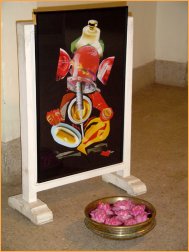 "After finishing my schooling, I studied painting in the College of Arts, Chennai. That was my first introduction to what I am doing today - collages. I was introduced to it in my 2nd year at college by one of my lecturers Alphonso who directed me to start off with bits of paper or any material. That's how the collage caught my fancy. Then I diversified into painting. After completing college I trained in textile designing. This taught me a new dimension in art because I knew nothing of textiles. So, I started on the textile-designing phase of my career. After quitting that, I got a job in Coimbatore, since it was close to Madras, but I returned soon because of the difference in attitudes there and started freelancing. It led me to so many things. My interest in films, dance and music took me to various performances. That triggered off my stage work. I used to attend lec/dems at the Krishna Gana Sabha. Sitting at the back, I would look in awe at all the dancers. Even though I used to do vocal accompaniment for some dance performances, I never even imagined that I would take to the stage in a different way. 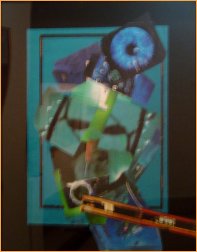 Once, I took my paintings to Gomathi.Vishwanathan, wife of Enfield Viswanathan (Kalamandir Trust ) as he was known. I told her they were presenting music and dance, so why not visual art too? She agreed and along with the dance festival, I had my painting exhibition at the Narada Gana Sabha foyer. It was strange to see the dancers just walk past without even glancing at my paintings! The next year, they held a festival called Devata Vandanam. She asked me to do the stage décor for that and I hadn't the faintest idea of what I was going to do. Fortunately, whatever I visualized must have been a hit because my stage design career took off from there. In the textile field, I designed sarees and ready-mades for Radha Silks. My stage work led to theme decorations at weddings and other functions. After doing all these things, I came to a stage when I wanted to get back to my roots. That's where you get full happiness. You are not answerable to anybody, you do what you want and there are no restrictions! So, I started to do painting and collage. I did not want to combine the two. I wanted to focus on collage. Once some interesting work started taking shape, I thought I would exhibit them". 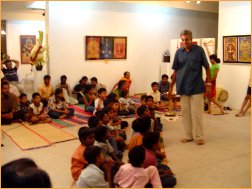 Did you have any particular theme in mind when you started work on this series? I basically started with the idea of doing things close to my heart. My association has been basically with music and dance, as also a childhood fancy for Krishna. I wanted to do a complete series on Krishna, but once I started, a whole lot of ideas came to me. So, I moved away from Krishna to other things. How do you go about your creation? Do you choose the design according to material or the other way round? Sometimes I start off with some image in mind. Other times, a small visual in a paper triggers off a complete new image for me. The whole thing becomes like building an architectural piece. I have to source the parts that fit in, like in a jigsaw puzzle. You have done 10 images of Ravana, depicting the nava (9 ) rasas. Why 10? Yes, Ravana is a childhood fantasy. I did my schooling in Delhi. Every Ramlila, there were these huge effigies of Ravana everywhere. That image stayed on in my mind. This was planned as Ravana having different emotions - the navarasas. Otherwise I would have just done 10 portraits. The navarasas comes from my love for dance and my association with dance and dancers over the years. I framed everything separately and placed them in a row with shantam on top. Whether it is Ravana or anybody else, one finally aspires for shantam, so it's navarasas culminating in shantam. In the Kaliya image, the inverted car was what set off my imagination. When I completed Kaliya, I did not want Krishna to upstage Kaliya's powerful personality. I wanted Kaliya to be the hero. Even a small image of Krishna's face would draw attention only to Krishna. So, after a lot of deliberation, I depicted only the back of Krishna's head. There is no distraction and the focus is on Kaliya. In the image of Krishna with flute, the 2 eye-pieces gave me an image of someone enjoying blissful music. Since the color was also blue, the picture took the form of Krishna. In everything I do, I look for the images because everything has to fall in place, the color has to coordinate and the composition value should definitely be there. 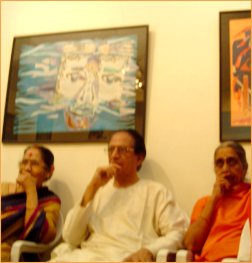 What prompted you to present Srikanth's dance and Anita's story telling at your exhibition? I did not want this to be only a show of paintings. I felt it was incomplete without music and dance. I am an artist who is not associated with only painting. I am also associated with every aspect of art, and music and dance are part of my life. I have sung for dancers, I have done the stage for them, done their costumes. I wanted to make my presentation complete. At my exhibition in Bangalore, dancer Praveen Kumar presented an interesting program on collages. It was so fascinating; I wanted to try it here in Chennai too. Srikanth's dance gave a different dimension to the theme. And I knew Anita's story telling would be another wonderful interpretation. If there had been sculpture, she may have woven her dance around it. This has been such a wonderful experience that people want to know if there would be some entertainment every day! Maybe in my next show...it will be like a festival! The ultimate compliment came from Alarmel Valli. In October, Ramani did the stage for Alarmel Valli's function to honor her gurus. Though she has known Ramani since she was 7, she found the exhibition an eye opener. "What a multi-faceted artist he is, absolutely brilliant. In a collage, you have to take a piece out of somewhere, put it in a context and visualize the end product. Just like dance, which is a collage of movements. I have seen many facets of his art, mainly as a designer, totally in tune with aesthetic tastes. I find his work very arresting. He's a fine artist and a fine human being. His talent takes different directions, but is hidden under a bushel. He has not had the opportunity he should have had. He has immense talent for this work and deserves the right recognition". 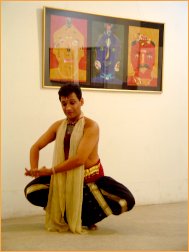
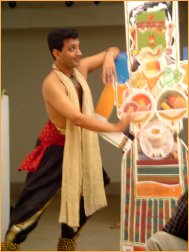
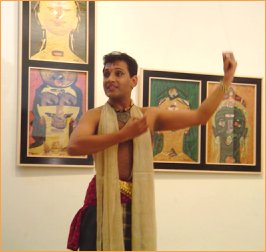 Following the inauguration of the exhibition, Srikanth presented Collages through Dance, starting with Ganesha for which Ramani lent vocal support (another of his talents), then Ravana and ended with Krishna. The items were chosen to complement the images on exhibit. "Ramani asked me to do something using collage as a theme. I love Tamizh as much as I love dance. I am very confident about my prowess in Tamizh. So I did one piece in proper Bharatanatyam on Ganesha. For Ravana, I wanted to do something different. I took Ravana's pralapam (soliloquy), as a great Shiva bhakta, a great Vainika, a great king and so on. Everything comes to naught because he covets the wife of another man and the good qualities get lost and only the demonic traits take dominance. I wrote the Tamizh text myself with assistance from Mr. Raghuraman. For the 3rd item, I wanted to do raas in folk style, next to the puppet. So, I took Ramani's idea and mixed raas movements with puppet movements." "I eagerly awaited this performance as I sang, spoke and danced, all together, in this show. It was very challenging and I enjoyed it immensely. This is my first experience of performing at an art exhibition. I look forward to doing more such shows. I also want to do programs based on Tamizh. I want to do Ravana as a full-length production. Next year I plan to do a full length production Nirmalyam based on M T Vasudevan Nair's award winning film of the same name". Srikanth participated recently in the Summer Residency Course in teachers training conducted by Kala Bharati and Mamata Niyogi-Nakra in Montreal. Teachers from across USA and Canada attended it. Guest lecturers were S P Sundaram of Sruti, Devesh Soneji, Vincent Warren and Sarasi Raj to name a few. Srikanth represented 'Tradition and Beyond' since he's from the Bhagavatamela tradition and is a regular performer in Bhagavatamela natakams. He presented a paper on Bhagavatamela, what are the changes that have happened, what are the elements that will never change - like girls not being allowed to perform in Bhagavatamela natakam and so on. During the Chennai December season, Srikanth has 4 solo programs, something to be proud of, as male dancers seldom get such opportunities. 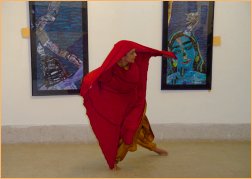

 One knows Anita Ratnam as a dancer, choreographer and speaker. She has now ventured into the world of storytelling. She entertained children and adults on November 22nd with Collages of Stories taken from folk tales. She started with how Vinayaka was born, how he came to have only one tusk, followed by a story on Kali with Ramani doing a background alaap, and other tales. She used an array of interesting props and instruments like the 'sad flute', the 'happy flute', the sparrow's chirp, the silambam, a Vinayaka mask made of woven palm leaves and so on. When did you develop this interest in story telling? My love of life itself started when I was 4, when my kadhai vaadiyar (story teacher) used to come home and tell me stories of Balakantam and Ramayanam. I used to listen with my mouth open and eyes wide as he changed voice for the different characters. I used to sit on my grandmother's lap, listening to her stories. My generation grew up without TV or Amar Chitra Katha, so it is all about listening to stories, the oral tradition. I have always felt that as a single parent, I have never had the time to tell my children stories that I had listened to. Amar Chitra Katha came along to fill that need. Then came the great Ramayana and Mahabharata series. For me, storytelling is a natural extension because as a parent, I worry when I look at my children growing up in a very disjointed and disconnected world. Even though living in India in Chennai, they are caught between academic pressure, the school and the trend in consumer aspirations like branded items and exotic holiday destinations. No matter which economic group you come from, this brand consciousness has become so high that a lot of our children are self-conscious about talking in Tamizh, or doing anything that is Indian. I think storytelling is a wonderful way of connecting and holding their attention. We must remember that the TV has become today's kadhai vaadiyar. We obviously don't have proper Indian stories to tell them, so they look at Cops and Robbers or adult serials like Friends and we have no idea what's going on in their heads. Even in our education system, we don't have storytelling, either compulsorily or as an option. Do you plan to take up storytelling in a big way? As a dancer also I'm a storyteller. I'm communicating some idea or a story or a mood. That's why my work is so visually theatrical, because I like using props, cloth, and lot of portable instruments that I have been collecting over the years from around the world. So, my work is becoming visual in terms of sound because of the very diverse systems of sound I use. I don't know about the future, but I like to collect stories. For example, my works Gajaanana and Andal have become to me, a compilation of stories. It never ends. In my current production Utpala on the lotus, I am still collecting stories. Do you have any preferences? I try to collect from different religions, from different parts of India - folk and classical. Folk forms have more humour in them and there are a lot of things you won't find in classical literature. Our folk stories have a very interesting way of even making our gods human. I feel every one of us has a reservoir to tap into within ourselves and I think storytelling is a wonderful way. I discovered how much I enjoyed it through Daughters of the Ocean when I started finding my voice in 1998. It hasn't stopped since then. I don't know about continuing performances as a storyteller, but I continue to think of myself as a storyteller in whatever I do, even in the speeches I make. Do you have any such performances in the near future? In terms of performance, we are taking Gajaanana to a couple of cities because Gajaanana is in a sense, in a kind of katha style, less story of course, than movement. Essentially, it's Parvathi's story and her connection with her son. But in terms of pure story telling, I haven't devised a show yet. We are thinking about it. In the Katha series in January, we are thinking of presenting 2 stories. I am very interested in a kind of supper theater cabaret feel, guitars strumming, drums beating, a deep voice like Ella Fitzgerald crooning... I have this feeling that it's a part of me I have not explored - western singing and telling stories! Lalitha Venkat is the editor of narthaki.com |
