
|
    |
|
|
|


Revealed by Fire - interweaving the personal and the universal by Lalitha Venkat, Chennai Photos of performance: Lalitha Venkat December 10, 2003 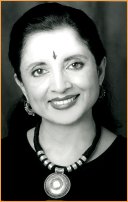 At a point in life, all of us feel the need to reverse gears and re-live those moments that have impacted us so intensely; episodes that even the merciful passage of time has failed to diffuse. Some amongst us who travel back in time find an artistic manner of expression to find meaning to events past. The Kanishka airline disaster of 1985, to many of us, meant little; just those 5 seconds of horror, outrage, and sadness, on reading the day's headline. Lata Pada's day began differently. We, the unaffected, can only try to imagine the emotions brought on by a phone call. The death of her husband and both daughters hurled her into sudden nothingness, a time of no meaning and no understanding. Time passes, and so does life. I caught up with Lata in Chennai where she performed 'Revealed by Fire', a production that encapsulates parts of her happy and tragic memories.... 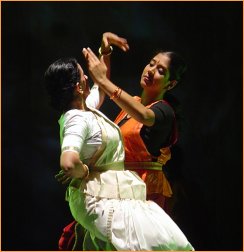 You have finally realized your dream of bringing Revealed by Fire to India. What challenges did you face during your India tour? Despite the fact that this production has been highly successful, in North America and has received critical acclaim, I have had a great deal of apprehension about bringing it to India. That has been on several levels. One is the technology, the requirements for the show that have been pretty challenging even in North America. I knew that theatres in India would not necessarily be equipped with the kind of lighting inventory or with the projection capability, or the kind of flooring that we need. Both for the dancing and the lighting, for the lighting effects to be maximized, I was apprehensive. Secondly, knowing that the theatres do not have the level of professional crew that work in it that we are accustomed to. But knowing of course that wonderful productions also happen in India, I was somewhat confident that under the right direction of a very capable person, it would happen. That's why we contracted Mithran Devanesen to be our technical director and lighting designer for the full India tour. This involved being in touch with him over 8 to 10 months ago, sending him the lighting plot. It apparently completely floored him because a lighting plot for about 250 lights was what was in the original design that we had used in Canada. He knew that would be absolutely impossible and he actually wrote back to me and said, "I don't think I can do this show!" I assured him I was not expecting him to duplicate the same effects that we had in Canada, but at least to simulate the wonderful ambience to some extent. Now that we have 4 shows behind us, I must say I am totally floored by Mithran's capability of managing with an inventory of 50 to 60 lights, that is one fifth of what we had in Canada, to create an exciting environment for the production. We also had huge challenges in trying to locate the right type of DVD projector that would be able to handle the visual design. It really resulted in Picture Productions going to Singapore and buying a projector for this particular production. On all these levels you can understand my anxiety on the other end. 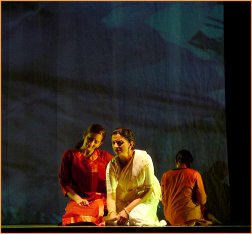 How did you adjust your technical requirements for your India tour? Having Mithran on board was very, very important. We also saw the value in investing in a pre-tour for Mithran to go to each of the theatres. So, in September, he checked out the capabilities and any particular challenges of which there were several. Some of the theaters did not have fly bars. The projection material is hung on fly bars, so we had to actually rig and erect and construct fly bars to be able to hang up the projection panels. Some theatres don't have a light and sound booth at the appropriate place. And the talk back system. All these things had to be brought in and I believe that in India, for a price, everything is available. To quote Mithran, "everything is feasible, but not everything is possible." It's not that we had an unlimited budget, but we have spent a huge amount of money on the lighting inventory, on putting up a dance floor because that is what is comfortable for the dancers and also for the lighting to show up. 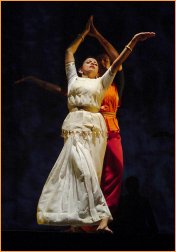 How did you plan and put the tour together? We contracted Arts Umbrella in Bangalore headed by Geeta Rao and her team to do the entire tour management. That in itself is a logistical challenge because we are based in Toronto and so much coordination must go on between each of the venues and in India, you need all kinds of permits to be able to get a theatre. In Canada, if you contract a theater, you just pay for it and everything is covered. But here, there is lot of additional paper work to be done and additional expenses that you are not prepared for. For example, the idea of hiring a generator. I am not comparing, I am certainly aware that India has a different environment and it's not fair to expect the same thing. This being on a DVD projection, you can understand that if the power was interrupted for any reason, the DVD would go back to zero. And that would throw the whole choreography off. I was having a nightmare about these things. 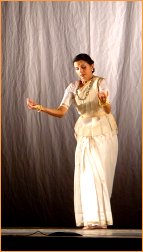 We also tried desperately for corporate support and that was a huge challenge because I am not so well known in India. The production did not seem the right fit for many of the corporate bodies because in India, I understand that corporate bodies do not want to be associated with high art. They prefer to support pop, fusion and bollywood type of things because that is what the general public wants and whenever there is a serious work of art, they are somewhat reluctant to support that. We've been very lucky in getting the support of the Govt of Canada and the Dept of Foreign Affairs and International Trade and the Canadian High Commission in Delhi has supported this tour. The ITC group of hotels has been extremely supportive in Bangalore, Mumbai and Chennai. Working with a professional company like Arts Umbrella is a very important thing to recognize in planning a tour for any group because there are so many details to be looked at that the artist cannot take care of and places a huge burden on the artist. So many technical things to be coordinated, crew and personnel things, accommodation, travel, media...just planning the media campaign and getting the word out is an enormous challenge. We have had enormous media attention. It has largely to do with being well prepared for it, thoroughly professional with the press kits being prepared and sent out to the media in advance. 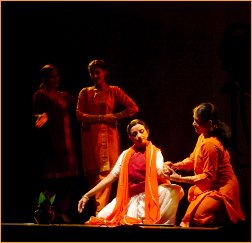 Did you have any apprehensions about presenting this work here? My personal apprehension was how would this work be received in India. When Anita (Ratnam) saw Revealed in Canada, she said this sort of work must be presented in India, where you are really taking a personal journey and portraying it on stage and this really requires great courage because you are completely vulnerable and fragile and to show that within the Indian ethos a work of this nature can be created, and how it can have a very strong universal message. Anita has always inspired confidence in me, and at her insistence I decided to give it some serious thought. A school of thought has described this production as self-indulgence. I haven't heard that criticism. You might have heard that from an odd individual here and there. Never in the press. The response from the audiences have been over-whelming that it's been done with great restraint and dignity. Even Leela Venkataraman from The Hindu has written that this work has a strong core of truth in it and integrity. People are free to take away from the show, whatever feelings that they may have. I have not heard that criticism, but yes, I have had apprehensions of that when I did the work. But from all the media responses and the audiences, this has never been an issue for me. Bringing it to Chennai, which is the last stop on our tour is very exciting, even though Chennai is considered the stronghold of Bharatanatyam and there are lot of people who do not really appreciate too much deviation from the classical repertoire. For a work like this, I think it's a city that appreciates new directions that Indian dance has taken. It could be largely due to the ground breaking work that Anita has done in her own work and in the setting up of The Other Festival, where audiences in Chennai have come to understand that some of the new work that emerge out of the classical forms are as valid as the classical repertoire in today's world. That apart, what other message do you seek to convey? Every one of us, even though we live in a very strongly traditional society like that of Chennai, is influenced by the outside world and we cannot deny the fact that we really are a globalised society today. The influx and impact of the technology, of media is transforming our lives day by day and I think we are all becoming highly sensitized to issues, especially this work. It speaks about a particular personal journey, but it includes broader issues of how important art is to communicate or to really express larger societal issues and it is really so submerged in the work that if one wants to read into it, one can see that this accident was caused as an act of terrorism. It is a silent reminder to all of us that we are all very fragile, we live in a very vulnerable society due to global terrorism and it can occur at any point unexpectedly in any one of our lives making us victims for no reason at all. I think that is a very important message that one can hopefully draw out of this work. It being a multi-disciplinary production, can you elaborate on the artistic collaborators of Revealed? It is truly an inter-disciplinary work. It has been created in collaboration with several wonderful artists, Cylla von Tiedemann being the primary collaborator who traveled with me to India. It's her images that have been created into a very stunning and evocative visual design that forms the background for this work. It's not just the background but as participatory in this work as the choreography is in itself. It speaks and intends to communicate as much emotion as the choreography does. The music is an incredibly successful synthesis of music from the east and the west, where the sound design was created by Timothy Sullivan, a western composer who has contributed to the composition of certain western harmonies and classical sections. A digital technology based design of creating and integrating many sounds of the environment make it multi-sensory and multi-phonic. Another important collaborator is the dramaturg and playwright Judith Rudakoff who actually took my words, my text, my memories, my spoken words and integrated it into the powerful text. As dramaturge, she also took on the responsibility of ensuring that the work never lost its focus, and at the core of it communicated what its intent was and how the universal could be communicated through the personal. My other collaborators were my dancers who have contributed to many of the movement passages that were created in the studio though improvisational process. And of course the costume designer and the lighting designer... it is really truly integrated and so it's important to remember that such a piece happens because of this great synergy between many artists and I am very grateful to all of them. Isn't it strange that the Kanishka disaster probe is right now in the news? It's actually very coincidental. I believe it's synchronicity in a way that the Kanishka Air India trial is actually unraveling, is happening in Vancouver, British Columbia, as we speak. So it makes this piece relevant and even resonate at a stronger level. The trial is going on and there are 2 main accused and we are hoping that it leads to conviction of these 2 accused. It adds a different level of importance for me personally for this work because 18 years is a long time. The crash took place in 1985 and it's natural that it fades quickly from public memory. It's important that this work also ties in with a reminder that terrorism is truly a global phenomenon now and we can only hope that the trial will result in a conviction and hopefully be a deterrent to such acts happening anywhere else in the world. Note: The performance was dedicated to the memory of the 329 lives lost in the 1985 mid-air explosion of Air India Flt 182 over the Atlantic Ocean as it was enroute from Toronto to Mumbai on June 23, 1985. Contact: Lata Pada "Sampradaya Dance Creations" 1946, Lapad Court, Mississauga ON L5L 5R1, Canada Ph: (905) - 608 - 2475 e-mail: lata@sympatico.ca web: sampradaya-dance.com Lalitha Venkat is the editor of narthaki.com |
