
|
    |
|
|
|


Swati Bhise, an ambassador of Bharatanatyam in NYC by Lalitha Venkat, Chennai February 7, 2004 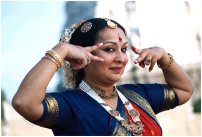 Swati Gupte Bhisé has been performing Bharatanatyam extensively in the United States and India to much critical acclaim, and is regarded as an intelligent performer with a keen sense of aesthetics. She had her debut in New Delhi under the auspices of the Center of Indian Classical Dances (CICD) founded by her guru Sonal Mansingh. Since 1981 she has also studied under Guru T S Kadhirvellu Pillai. Her recitals in India include performances for prestigious institutions like the National Center for the Performing Arts - Mumbai, Sahitya Kala Parishad Delhi Administration Cultural Department; SPICMACAY, Bharatiya Kala Kendra, House of Soviet Culture and others. Overseas, she has had several concert recitals in the Far East, Europe, and North America. A notable performance was at the United Nations where she was given the honor to perform for the General Assembly for the 40th anniversary of the United Nations. Apart from being a concert performer, Swati has taught extensively and conducted workshops at several leading institutions including Columbia University, New York University, University of Austin Texas, St. Marks Academy (Dallas), the Dalton School, Brearley School, Chapin School, the School of Practical Philosophy, Brooklyn College, the Bronx Museum and Brooklyn Children's Museum. Since 1988, she has performed and lectured for the Education Department for the American Museum of Natural History on topics such as "Rasa in Theory and Practice", "The effects of European Colonization on Ancient Art", "Role of Women in Hindu Mythology". Since July 1997, a series of schools from the Bronx, Queens and Manhattan have been exposed to dance and lectures by Swati with her orchestra under the auspices of Symphony Space's Curriculum in Arts Program. 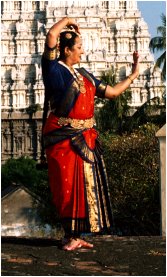 Let's start from the beginning, from when you migrated to the US. I had not gone out of India till 1982. After I got married, we moved to the US. Coming from a very traditional Maharashtrian family, it was a culture shock for me in many ways. The Indians there had changed their accents, their looks... What amazed me in New York was that I met artistes who danced at cocktail parties and cafeterias. I had to audition with people who had never really danced, who had been trained for a few months a few years back! And I was auditioning for people who did not really know how to judge the dance. Being Sonal Mansingh's first disciple, and having performed extensively at prestigious venues in India, I could not adjust to this. I've known my husband since I was a year old, he knew how totally involved I was with dance. So, till 1987, I ended up spending 7 months in India and the rest in US! When was the turning point? In 1987, I performed for the American Museum of Natural history. Off and on, whenever I visited the museum, they would invite me to perform. Evelyn Albert, the head of the well-known Brearley School, a prestigious educational institution with stress on traditional education, saw me perform. She approached me to work with the students and that's how I started teaching in the school. They were all American students from Kindergarten to 12th grade. I started a course on Indian history in the context of the Chola period, Pallava period and so on, on temple architecture. Not the religious aspect, but in trying to help them understand the ethos of Indian culture. I gave workshops and slide presentations. Working in an area where the institutions have no reference to the culture, religion or ethos of the art form, must have been a challenging task. For the KG level, I used to interpret poems through dance, different aspects of Krishna's life, Surdas' work and so on. I never did any shringara for them. At the middle school level, I would portray mugdanayikas. For the higher level and for an adult class, I would do all the items. I tell them that Sanskrit is the root of our languages, just like Latin and Greek are the foundation of western civilization. That really caught on very well at the school. Now all at Brearly from KG to the 12th grade chant Saraswathi Vandana, Aangikam bhuvanam, Brahma Guru Vishnu with the correct pronunciations. I have shown the tape at the Habitat Centre, Delhi 2 years back. Slowly, other institutions like Symphony Space, a big institution in NY, started a program six years ago called CAP - Curriculum in Arts and Education program. I would have been quite happy doing about 10 programs but their funding depends on the artiste agreeing to do a certain number of concerts. They are not agents, but they are given the money by the Board of Trustees for the artiste who is in demand for those institutions which are comfortable working with the artiste in question, so the students get the full understanding of Indian history and culture. I have traveled with full Bharatanatyam makeup with a coat on top, with people / cops looking with raised eyebrows! How do you go about it? How do you introduce American kids to India through dance? I work very closely with my musicians. I am always accompanied by my vocalist Savitri Ramanand who is one of the Bombay Sisters and Murali Balachandra who is my mridangist. Together, we interpret a padam or a thillana, stress on the importance of music in dance, show them the misram or adi taal and counting with us, show them the metric cycles, doing sollukattus on the spot. I visit over 50 groups of students in the tri-state area schools, as well as those in Westchester County, at Rochester, Delaware and Binghamton Universities. The CAP program has a large focus on inner city school children, something like our municipal schools. In such schools, metal detectors are commonplace and we are frisked for security measures. Getting through to that audience is tough because they are completely unruly. It was a big challenge for me to get through to them and make them understand. I would perform the same varnam, the same padam, the same thillana, explaining through program notes and slides. I appeal to the rhythm sense of the African Americans in the audience. Reciting jathis is like rap to the kids. I show them that Krishna playing with the ball can be them playing in their backyards. I try to show them that stories may emanate from various regions but the emotions remain the same. For one child, using a cellphone symbolized pataka hasta! Daily activities were translated into different rhythms and movements and they realized it was not a religious dance only done through pantomime acting. This removed the first barrier that you don't have to be an Indian or a Hindu to understand. These students have witnessed this art form and participate actively once they have been involved in the workshops. The ensemble also performs in a variety of public schools in the Bronx, Brooklyn and Manhattan - many times where classrooms have had to serve multiple purposes - such as the cafeteria being used for classrooms. The program has been very successful. In schools, where topics such as "teen pregnancies", "unwed mothers", and "drug abuse in schools" are the norm, these Bharatanatyam performances are being received enthusiastically. What about the exclusive schools? We have the exclusive Manhattan schools, such as Brearley, Chapin, Dalton, and Browning, which only has an average of 3 - 4 students of Indian origin in the student body. Granted, we have a sizeable Indian population, but we should get across to the American audience too. That's why I went into education teaching KG to 12th grade, not to do an arangetram, but for students to learn it as a culture and to appreciate the art form. I feel I am in some way imposing my culture on a community and maybe 10 to 15 years later, they will remember they had done Bharatanatyam in school and travel to India. I always tell them not to say 'Indian dance', there's no such thing as Indian dance. I give detailed notes a week earlier and the teacher discuses with them. The notes have background on the poet, which area of India he came from, what was the socio-economic condition at that time, how the sculptures of that period were, who were ruling then, the temple architecture of North and South India and so on. All this involves a lot of research work. We end with a Q & A where a lot of misconceptions are cleared. In the western culture, they are told not to use their hands because it is impolite. Our culture is all about hands. I identify each individual part, how I can express and how it is used theatrically. I am happy to teach students who take my traditional training to a different level. They incorporate their new knowledge in whatever work they do and evolve whatever they already have. How do they experience the cultural aspect? One day in the year, after completion of their course, I take the students to the Hindu temple in Queens, where they have to write a project after looking at the various deities, gleaning from what they have learnt through dance and art programs. Nobody has ever accused me of imposing Hinduism because it's done in a way where it is pure education, like Sanskrit slokas and so on. For the entire 3 months before they do the show at the end of the year, they all walk around the school in tha ka dhi mi. During the entire period of Diwali, on the 2nd floor of the school, they make footsteps, each one puts their name, color it as they like, and stick them on the floor leading to the classroom, hop over them and call them their Lakshmi footsteps! I tell them the related stories, take them to the temple and that way they study about a festival. Parents and teachers also accompany us. In all these years, from 1988 onwards since I became active in this line, I am happy to say I have never had a single educational institution bringing up an issue about this activity. The universities? For the Yale repertory of Drama, for the Sanskrit classics Dept, I used Barbara Miller's Gita Govind. I would sit with my musicians and choreograph it. Those who had studied the work, would have their questions ready and ask how to interpret this, what is the meaning of that, how is dance relevant to this etc. Thus we started using dance in theatrical productions. The dialogues would be my English interpretation of the Sanskrit verses. Music was traditional classical. I have performed at Binghampton, Rochester, Suny Stonybrook and it's all been through the classics dept, theatre dept, Sanskrit dept. They send me what they are studying and I choreograph based on that. How do you get the audience for your performances? One is word of mouth. Then, over the years, our mailing list has grown because we keep a book outside our venue. Over the last 6 years, we have even had sold out concerts in Manhattan, which for a Bharatanatyam performance, is a real surprise. We cannot create an audience unless we create that awareness everywhere. Like in the schools. Sometimes there will be 2 to 3 shows a day and I have to go from school to school. The children have a good time because I make the show interactive. This makes it interesting for them and before they know it, the one hour is over, they have tried out different rhythms, different hand movements, different instruments. Sometimes, the Parents Committee requests a workshop because 'the children enjoyed whatever you did.' So, we do workshops, performances, post show interaction. When my students want to see me perform, their parents escort them. Students from the university level attend in order to study and analyze the art form, and to participate in the question and answer session that follows the performance. Having previously studied the dance style through videos and notes, they receive an in-depth exposure to the art form. That's how we have created an audience in Manhattan. I wish one could allow people in India to have a glimpse that the view of the rest of America is not necessarily that of NYC. They are exposed to so much out there that they have to battle to have an audience. Over the years, our work has become so popular that even Montessori schools wanted me to work with them. So, I created stories with animals, stories of Mowgli. I have them create stories they can identify with, stories with some relevant social message. Basically, traditional stories told in a way the American audience can understand. What's your favorite line to the children? It's not one curry powder. There are so many masalas. In every home in India, the food will taste different though the same spices are being used. Likewise, each dancer of each dance form gives a different element, so there's a different style, a different school of thought. Some like more poetry, some more rhythm. The kids can identify with that. What projects do you do for the Lincoln Center? The Lincoln Center had me as artist in residence and for several years, I have been performing for them because they are the ones who started the program. What is non-verbal communication, how important it is to have discipline in any art form, and how to bring Indian dance into western theatre today. And it does not necessarily mean wearing a Bharatanatyam costume. I, of course, dance in the traditional costume and one of my pieces that my audience in NY has enjoyed is thaaye yashoda. They find it so touching, so relevant, whichever culture it is. In my opinion, it's a misconception to say 'where's the audience to see the old traditional stuff?' They enjoy the rhythm and the metric cycles of the thillana, but they also appreciate the emotive element. One has to experiment, but I am happy to stay away from it. I have to thank Lincoln Centre because they have commissioned me in the last 3 years several times to do certain works. The last work I did for them was Shrishti from Kalidas' Shakuntalam. I took the benedictory verses of Ashtamurthy and did all the different elements. We covered a total of 45 to 50 programs. I'm happy we actually got funding for that and it's exciting to get paid, that means that much funding has gone into the program. For the next year, we are all set with Met, CAP, American Museum of Natural History and the Lincoln Center Institute. A conscientious purist of Indian classical dance, how did you bring Indian dance into western theatre? I did the ethnic dance choreography for the Thomas Mann musical "The Transposed Heads" at Lincoln Center for the American Music Theatre Festival, the Electronic Opera "Mass for the Dead" by American Chamber Opera Company where I played the lead role and "Daddy meets Durga" for Mabou Mines (directed by Judy Tramor). I performed in my classical attire. I've often told them it will work. And it has. I could not change; I was too set in my ways. As I was evolving, I realized I was only comfortable with this as my forte and I knew I would find my audience. You have performed at the Smithsonian Institution (1998), the Brooklyn Museum, the Delaware Institute for the Arts in Education, and the San Diego Museum. What sort of performances did you present at these venues? Vidya Dehejia of the Smithsonian invited me to do an interpretation for an entire 2 evenings on the "Role of Sakhi" in the Gita Govinda". Everything in the exhibition was on that and we did a full performance of 3 hours in Washington at the Arthur Sackler Auditorium. When Amy Poster in Brooklyn had an exhibition of Indian miniature paintings, I did the ashtanayikas through the Natya Sastra. I give detailed notes, the western solfa syllables, the context, the sthayibhava, the terminology at the end and interested people actually take the notes home. On March 28, we are performing at the Metropolitan Museum at the Grace Rainey Roger Auditorium for the opening of the South Asian Sculpture Wing. Most of the lectures they are having this year is on Shaivism, very few on Vaishnavism. My 2-hour presentation with slides and dance is based on Muthuswami Dikshitar's Ardhanariswara, aspects of Shiva, Hara and Hari. The 700 seating hall is already sold out and we are very happy about it. You performed at the General Assembly of the United Nations. How did you get the opportunity, what was it like, the feeling... It was in 1986. They were looking for an Indian classical dance performance. There were 4 people from the UN on the panel and I told them I was interested in performing. They asked me to audition. One of them said, "I love Indian dance. I watch it off and on. I have tapes. There's Balasaraswathi..." I was stunned!! After my audition, they said, "Ok, it's done." I could not believe it, they did not know me, I had no pull anywhere and it was a very prestigious program. Since I was shunting between India and US at the time, I requested them not to publicize the fact in case they changed their mind later. That perplexed them. The program was in Sept. A month earlier, I got a call from a panel member saying I had been absolutely right to be apprehensive. After they announced my name, there were many Indians who had connections in the foreign office who were recommending a niece or a sister who could dance! He assured me they were convinced of my talent. Do you know who that person was? Kofi Annan! I hold that incident in the highest regard because he was a man who had kept his word. Years later, in fact, about 2 years back, Babli Sharma who's the wife of the ex-ambassador invited me to dance again for the delegates of the various countries. Mrs. Kofi Annan attended the show. She said she had seen me perform all those years ago and had come to watch my performance. These are some memories I really cherish. Over the years, I've had wonderful recollections of meeting people after a several year gap. Have you done any different kind of shows? The famous jewellery store Tiffanys contacted me when they were going to showcase the new designs of Elsa Piretti and Paloma Picasso. The theme was mesh, like the Jaipur style and they had a 24-carat mesh bra. Well, I could hardly wear that, it was totally out of the question!! The audience was to be all their best clients and the event took place at Tiffanys under heavy security. I am always particular that no one can have food and drinks when I am performing; they have to be seated. Apart from my Bharatanatyam costume, I wore a pair of their designer jewellery on show and conceived an entire evening on shringara and dressing, both from the nayika and nayaka point of view. We proved you don't necessarily have to wear jewellery to depict it. Without exception, everyone in the room was in black, including black jewellery! I stood out in what I call my alfonso colored flaming orange costume. I was unaware of her identity then, but Ivana Trump came up to me and remarked, "What a gorgeous creature!" If I had not done what I did, she would not have been introduced to this art. Today, she's a great supporter for a lot of Indian activity. I am happy I did that show because it opened up avenues I did not think could have opened up, especially teaching in the schools. That is what made me decide to move totally to NYC. I got tired of living in a culture that always viewed a very wrong ideology. Not being in politics, I wanted to make a statement of giving the real India that we are. I tell my Indian friends, by giving up your culture, you are actually a nobody. Today, I have done well because I'm first an Indian, my heritage is there, I'm happy to learn the good qualities from other cultures like discipline and time ethics. Your art can survive extremely well when you impart and become a true ambassador and bridge the gap between two cultures. What about the television medium? When I was expecting my first child, I could not perform, so I was invited by IBN (India Broadcasting Network) to compere some shows. I agreed to only do interviews of artistes. I did interviews with Amjad Ali Khan, Sashidaran Nair, Protima Bedi and Sonal Mansingh to name a few. The focus was on what message they had for the younger generation, what path they should follow, what had changed their lives. In 1989, I was asked to perform for the National Gay and Lesbian Task Force in Maryland. It was a different experience for me. I learnt a lot about the people. One of the people prominently involved was an Indian girl, a brilliant speaker and lawyer. In 1991, when I was doing these programs, I did a talk show with her. It went off very well. I have acted in the TV serial Mahanagar with Shreeram Lagoo, but I discovered my forte, my love and passion was in education and dance. My parents were very supportive once they realized that I was not merely dabbling in dance. My husband, even my children are very understanding and extremely good about it over the years. Is it not easy to get by in a new country by making compromises? I must thank my parents for my strict upbringing. I have never once compromised on any program. If a cafeteria were to become a performing space, then there is no problem, but no dancing on tables or doing Bharatanatyam weaving in and out of a crowd drinking wine. I don't want people eating, dinking and walking around during my performance. One should not cheapen one's performance. Some do it, because any exposure is good for them. I get lots of offers to do many projects, I do whatever I can since I do not have that much time to take on everything. My team and I happy that we are performing everywhere to good, sizeable audiences, more so because none of the programs are free. Do you also present artistes? Not really. Long back, we presented an abhinaya workshop by Ritha Devi, and once by Sonalji in 1985. Then a music performance. I live in an apartment, so it is not possible to present even friendly performances! A workshop sometimes, that's all. I want people in US to see the best of our talent and at the best of venues. My guru Sonalji was there recently to perform for the Asia Society and I was sold out on my mailing list alone a month before the show. She presented traditional Odissi and it was a treat for the audience. How do you rate the criticism for Indian dance in NY? There's so much happening in NYC but there are no Indian critics there. Nala Najan used to write till he became too ill to attend concerts. I feel dancers should not write. We are so set in our styles that one is never able to be totally objective. What valuable lessons have you learnt from your stay in the US? I'm from Lady Shriram College in Delhi. Our educational background in India is so strong. We only did not know the art of packaging, which is so well done in the US. Today, I have learnt what I can take the best of, to project my own heritage and culture in the true light. Don't bend your values, they will come around. Going to US opened my eyes to a lot of things that I may not have tried because there was a wall and I was trying to break through that wall to tap things that I would not have maybe done if I had not been faced with a lack of appreciative audience. One generation of people from KG to 12th grade have not just seen me perform, but have studied under me. It's rewarding when they can identify the things I have taught them. Working with various schools, universities, with varied people, I am happy because I feel I have grown as a person and as an artiste because of the art, because of finding ways to convince the people about my art. What advice do you have for the younger generation? Every person has to find inside oneself, an incredible strength to achieve one's goal. Just 15 minutes is enough for a good dancer to make an impression. You don't have to inundate the audience for 2 hours. Be careful to whom you hand out your cards. Many are lured by the chance of performing here and make the mistake of making hasty decisions and landing in the soup. Come with a good organization, which has some kind of credentials, who you have checked out. Don't try to undercut anybody else. There is incredible consumerism in the younger generation. They are in a lot of hurry. Everything takes time. Like fine wine, it takes time to get better and better. The more I teach and interact, I feel the more there is to learn. The youngsters must have patience. It's not like today is tai chi, tomorrow is Bharatanatyam, day after that is riding, then it's tennis and so on. Stick with your passion, stay with it, and see it through. Read books by senior dancers. Believe in what you are doing, not just what looks good on the resume. Watching and learning is the best education. Contact Swati Bhise "Center for Indian Classical Dances" 1065, Park Avenue New York, NY 10128 Ph: (212) - 427 - 2203 e-mail: swatidance@verizon.net |
