
|
    |
|
|
|


Her Majesty Richard Turner interviewed Leela Samson during her August 2003 visit to London, where she rehearsed with students at the Royal Opera House Photo: Nick Gurney March 10, 2004 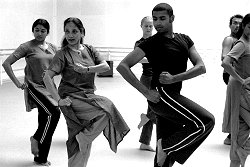 Hailed as 'One of India's most dynamic and technically brilliant dancers,' Leela Samson trained in Bharatanatyam with the great twentieth century revivalist of the form, Rukmini Devi Arundale. Joining Rukmini Devi's Kalakshetra institution in Chennai as a youngster, Leela served her guru for ten years before going on to teach there herself. She also toured as a member of the Kalakshetra Repertory Company. A distinguished soloist and choreographer alike, Leela is also respected as a writer on dance, most notably for her book Rhythm in Joy (1987). She is a recipient of the Padma Shri and Sangeet Natak Akademi awards. Leela is based in Delhi, where she teaches and directs her own dance company, Spanda, which is named after a Sanskrit term for the pulse. She is Dance Royalty. It seems only natural that rehearsals for a UK show, Past Forward, take place at the Royal Opera House, Covent Garden. Arriving with only a few minutes to spare, I proceed briskly through the security formalities at the Stage Door. Interesting times? These are downright dangerous. It has come to something when American foreign policy affects a London theatre, be it ever so prominent. Despite the affable young security officer's detailed instructions, I am rapidly lost in the twisting corridors backstage. With a growing sense of panic, I return for revision and finally locate the lift. Phew! I note the smart, modern appearance of a building that was renovated, with great controversy, at the expense of the English poor. The Royal Opera House was among the first recipients of substantial National Lottery funding. With ticket prices in the new season topping 130 pounds each, the ROH still has some work to do to shake off the 'elitist' tag. Fifth floor. Out of the lift, around the corner and, suddenly, there is Leela Samson. The rehearsal studio is large, light and airy, with views across the rooftops of Covent Garden, towards the Thames, which is denoted by the slowly turning London Eye. It's a grey day, but the light is still piercingly brilliant and clear. I study the contrasts in Georgian, Victorian and modern architecture, while Leela concludes the rehearsal with a chanted mantra. The age-old rhythm of the Sanskrit verse somehow freezes the moment. It seems a gentle blessing on a city, which relinquished imperialism some time ago and is beginning to find a human face again. Leela reassures one or two of the slowly fragmenting group of students, before approaching the expected journalist. She is polite and efficient in her manner, leading me to the nearby canteen, where she chooses rice and beans ('I haven't had rice for two weeks!') from a somewhat healthily austere menu. I settle for a cup of sweet tea. Leela wants to do the interview on the terrace, but we are driven back indoor by spots of rain. Richard Turner: First of all, can you explain how you came to be teaching at the Royal Opera House, of all places? Leela Samson: I'm just delighted to be here. I grew up in the sixties admiring western ballet dancers like Margot Fontaine and I loved reading magazines about the dance scene in Europe, so the chance to work here, in these clean, modern studios with their space and privacy is wonderful. We haven't got anything like this in India. Sadly it's only for two weeks. But I'm absolutely thrilled and it's a huge encouragement to the dancers. Working in this environment, you stretch yourself that much more. Akademi arranged for me to teach here. Maybe it was easier because of Mavin [Khoo, whose Parallel Passions combines Bharatanatyam and Ballet]. That might have paved the way for me. And perhaps this is the coming of age of Indian dance in Europe? I hope so. RT: How has your experience of developing your group Spanda informed your approach to dance education? LS: You know, I've been in teaching since 1975 and I started Spanda in 1995. It's been a wonderful seven years of good work. They are young dancers and we work as a group. I think to be a soloist, you have to be of exceptional quality. There are some very, very good dancers who are maybe not with the imagination to work as soloists. They are at an interim period in their development. I have an urge within me to see movement expand itself, to feature more than one dancer. While I was teaching just now, I could see the potential of the group to make the work more direct, to make it stronger. RT: Your books Rhythm in Joy and The Joy of Classical Dances of India offer quite a conservative view of classical dance, yet your own work as a teacher and performer in the last decade or so seems to have been more about development and innovation. May we now expect a postscript? LS: No. Actually, those books were requisitioned. If you take Rhythm in Joy, when I wrote it 15 years ago there was a particular type of book I call '60-40'. It was 60 percent photographs and 40 percent text. I wouldn't agree to write that kind of 'coffee-table' book now. The second book is a textbook for children, a paperback costing 20 rupees. I've got a book ready on the theory of dance. It's for students of dance of the age range 9 to 21. I want to make it a fun look at the shastras. But that's on hold. RT: Many readers would be disappointed if I went without asking you to describe Rukmini Devi the person and Kalakshetra as it was in your youth... LS: Well, as a person Rukmini Devi always filled you with so much awe. You always felt that she was in the prime of life and you could feel her personality in the air. She never let up and had such a concern for the art, for textile, temple and ceremony. She was a builder of institutions and a great educationalist. She taught us the atmosphere of the art. All of us continue to teach in tiny little spaces. She created the space for us all. Kalakshetra was like an ashram, a simple space for lofty thoughts. Rukmini Devi was the mother of contemporary Bharatanatyam. She not only revived the style but she stretched it. For example, she was the first dancer to look at the text. And she was constantly evaluating it. She was not just another performer. RT: Lastly, are you content with the standards and direction of dance education in India today? LS: There are great performers who still inspire, but there's also a lot to be unhappy about. Dance should not be put into a straitjacket or performed to a formula. The idea of a formula goes against the artistic spirit. What we're seeing is often a hotch-potch. Connections are already being broken. Here's this thing with so much potential, and yet there is a preoccupation with importing the ready-made and the foreign. We need to see more of an organic growth. One thing that's really missing is models who can inspire and are not victims. There are committees but they are not institution builders. They have no foresight and no dreams. There is nobody to inspire. Artists are not great managers. In India we have so much money for the arts but it is not being distributed properly. The arts are always seen as small and singular - as separate from each other. Some people think you can become a role model just by stepping on the stage, but it's a tough journey. Everybody wants part of the cake. That's the wrong emphasis. Spectacle is very different from art. Leela's biography of Rukmini Devi should be ready for release by the end of 2004. With thanks to Chitra Sundaram and Sharan Dass. This interview was first published in the September 2003 issue of veena Indian Arts Review. |
