
|
    |
|
|
|


Devayani : India's French Cultural Ambassador by Mateen Khan April 14, 2004 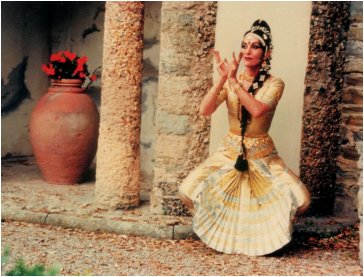 Anne Chaymotty, a French girl is a thing of past! Today she wants only to be known as Devayani. Her love for Indian art and culture had branched out in the form of her chosen vocation - Bharata Natyam. Devayani has been performing since 1977 in various parts of the world with her unique enthusiasm and passion. Her presence on the stage exudes an air of love, passion and joy, which makes the spectators mesmerized. Devayani now lives in Delhi and declares that it was the mysterious and full-of-life Indian eyes, which triggered her pursuit to find her own self through Bharata Natyam. It is amazing that an artist who has been featured in numerous International Festivals even next to the legendary opera singer Luciano Pavarotti is not chosen by the ICCR to be a cultural ambassador. Excerpts from an exclusive interview by Mateen Khan You are French and you learned classical Ballet, Jazz and Modern Contemporary dance and today you are a master of Bharata Natyam! How has this all come about? Well! Yes, I was born in Paris and I learned European Classical Ballet and Modern Contemporary Dance. It so happened that one day I heard Pandit Ravi Shankar on a radio channel called France Culture. It was wonderful! An out of the world experience, full of mystery and power! This was perhaps the beginning of today's Devayani. As I presented a dance drama in Paris, which included a sequence on the Radha-Krishna theme, I got an invitation to present it at a festival in Brussels. However the real revelation came through a film titled Calcutta by Louis Malle. Though it had no dance sequence, I saw India in it for the first time. Amazing! I was touched by the depth and mystery in the eyes of Indian people. Bharata Natyam followed soon; again it was through a film by the same director called Phantom India. It had a beautiful Bharata Natyam dance sequence shot in the renowned school of Kalakshetra. I was so impressed that soon I started learning Bharata Natyam under Amala Devi. Later I learned under Malavika, who was a French lady and a very good teacher too. Side by side I applied for the scholarship from the Ministry of External Affairs in Paris. After some delay I was awarded the scholarship and finally on an auspicious day of Mahashivratri I arrived in India. 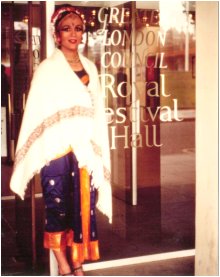 Why not any other Indian classical dance? Why only Bharata Natayam? Bharata Natyam came as a revelation and remained my first love. It was so compelling that it never gave me a chance for a second thought. I found my real self through it and secondly it suited my personality perfectly. Though I did learn some Odissi and Kuchipudi, I found Bharata Natyam more evolving in nature giving more scope for creativity because of its original complex grammar. It has most complex footwork, elaborate facial expressions and numerous mudras and extremely beautiful gestures. Due to its limitless choreography patterns even ballets are created in Bharata Natyam style. Does this all just happen to you or you had actually planned to become a dancer? I wanted to be a dancer when I was five. I have pursued this chosen vocation with all my energy and efforts throughout my life. I always knew that I wanted to be a dancer. However what I didn't know was that one day I would become a Bharata Natyam dancer. Bharata Natyam was a revelation and was more like chasing a dream. What obstacles did you have to face in making this dream come true? Many….Even they are as old as my dreams. It was a long arduous climb. When I was just five and wanted to be a dancer, my conservative parents refused bluntly. When I was eight I was not allowed to dress up as a ballerina for a fancy-dress competition. They were even more narrow-minded than some Indian parents. There were too many cross-cultural pressures at every stage when I came to India. Everything was different for me in India; culture, people and life style. However today I only want to be known as Devayani and India is more like a home away from home. From whom did you learn Bharata Natyam in India? My teacher from Paris, Malavika took me to her guru K Ellapa Mudaliar in Kancheepuram. He had a lot of depth in his voice and used to sing for the famous late Balasaraswati but unfortunately he died just nine months after I had started training under him. My second guru was Muthuswamy Pillai who belonged to the Devadasi caste. His bhav or facial expressions were particularly awesome; he was responsible for most of my training. He helped me develop speed, imagination and sense of choreography. I also studied under Kalanidhi Narayanan - she was an outstanding abhinaya teacher and taught me how to improvise; that's why today I feel so comfortable to improvise on the stage. In the meanwhile I also attended Kuchipudi classes under Vempati Chinna Satyam, which gave me an opportunity to act as a heroine in a film America Ammayi. What was the film America Ammayi about? Any regrets about not continuing with the films? America Ammayi was a Telugu film. As a main heroine my role was that of a foreigner who took to Kuchipudi dancing. The film was a big hit. It made me famous overnight throughout South India. Certainly, it was a wonderful experience and a lasting memory. I was asked to dance in the temple of Chidambaram; play veena, sing and perform Kuchipudi. After the film was released I received many offers to act as a heroine with Kamal Hassan and Girish Karnad amongst others. Well! Films indeed add an additional dimension, broadening your horizon. Honestly, today I would certainly say yes to any offers in films. However at that time I was highly idealistic and just wanted to concentrate on my primary vocation, Bharata Natyam. I wanted to promote Indian dance and culture internationally and today I feel happy about my international career. It is beyond my wildest dreams. Dark eyes, dark hair you have more Mediterranean looks. Can you share some thing about your family background? (Smiling) Not only the looks, I even posses a bit of Mediterranean temperament. This is from my father's side; he had in him the fiery Mediterranean Corsican temperament. I am often mistaken for an Italian or a Spaniard; people even think that I am an Iranian. My mother belonged to a religious family from a place known for French white wine, cuisine, castles and soft features. My father's forefathers were from Corsica, the southern island; birthplace of Napoleon. My father was an atheist, an opposite of my mother who was a catholic and brought me up in the same catholic spirit. What is fusion dance? You experimented in fusion dance, don't you think combining Western Ballet, Indian Classical and Arabic dance, each complete in itself, is somewhat injustice to each of them? I started fusion dance in the 90s when I was artist in residence in England. Fusion dance is actually combining two or more dance forms. Initially it was more a sequence of experiments but I thought that I was well equipped to go out of the way to undertake such experiments. It isn't an easy thing to do, actually apart from being an exponent of Indian classical dance I am well versed in European Ballet and Arabic dance which gave me this courage to present such shows. It was in 1991 when this idea actually struck me for the first time in England, then later in France and India I carried out experiments with the help of a composer John Marc Gowans. In 1996 I conducted a workshop and for the first time presented an Indo - Jazz show at "Dance World" in London at the Wembley Stadium Complex. Later events in 1999 drew me back to pure Bharata Natyam. Well, I never intended to do injustice to any of the dance forms. My intention was actually to create a new language with an enriched vocabulary to take Bharata Natyam further beyond India. For you it has been said "Gifted with a figure reminiscent of a Hindu Temple sculpture". How do you feel? How much you think destiny is a part of what you are today? Great! It's really wonderful to hear such things. I believe every artist counts on this encouraging appreciation. Frankly, I never thought that I look that fantastic as a European dancer. On the other hand in Bharata Natyam costumes I could not believe that it was me. It just fitted my personality the best. Although my acting was appreciated in the film, I liked myself as a dancer. No doubt destiny plays its part but I had a dream when I came to India and I pursued this dream against all odds and temptations. Indian art and culture were dear to you even before coming to India. What kind of India you imagined before coming here? How much of it was in conformity with your perception? The spiritual aspect and the Indian values; this was some thing which really fascinated me even before coming to India. India for me was a rich and mysterious land! However I was aware of this spirituality even before coming to India but after reaching here I found my dance becoming a mean to discover my real self. As I said earlier it wasn't just Indian art and Hindu mythology, which fascinated me; it was the Indian people and especially their eyes. There is so much depth and mystery in Indian eyes that "eyes as the mirror of the soul" sounds perfect for the Indian eyes. Interestingly, when I was coming to India I was told by friends and other people that Indians are money-minded! And indeed it's true, I found Indians more money minded. Yet being money -minded is not so negative altogether. It has its own benefits and the way Indian people handle it along with spirituality is unique in itself! On the other hand it's really unfortunate to see that many Indians have forgotten their roots and are chasing western materialism. I really feel pity…nowhere in this world is a wealth like the Indian values, art, culture and the Hindu mythology. A European against an Indian classical dancer! Don't you confront this conflict within yourself some time? How do you tackle the two contrasting passions? I am French and I love my country of origin. It is full of everything; mountains, sea, grasslands, forests and rich culture. Still Indian culture and my dance is more like a gateway to my own self. For me it is beyond my every obsession. My dance is my ultimate passion. I have cherished it as a dream from my childhood and that's why I don't find it conflicting with my original identity. I followed my passion and it revealed me to my real self. Beauty of an art is upshot of hard work you put into it! Don't you think dance in Hindi Films is losing the beauty with changing times? Yes I agree. In general, the quality of dance in films had seen better days and the obvious reason could be less hard work. Yet there are exceptions like Devdas. Its dance sequences and costumes are really wonderful! Especially the dance sequences choreographed by Birju Maharaj and performed by Madhuri Dikshit are breathtaking. I believe this new remake of Devdas is the best among other versions for today's viewers. India is so rich in arts and culture, so why do you think western culture is becoming more popular among the masses? What do you think is missing and where? First of all, it is really unfortunate that Indians seem to have forgotten their roots and are renovating to a superficial materialistic philosophy in a mad rush. It's not that Indian culture and values are lacking something; in fact Indian art and culture is an ocean. I believe the reason behind this adoption is defective urban Indian lifestyle. For me it is really surprising that people don't practice relaxation like going on vacation seriously and regularly here! In west it is a normal practice; a spell of hard work followed by a break from the work stress. I think the west has evolved the culture of relaxation, entertainment and pleasure very beautifully and this attracts everybody. Yet I don't think that Indian art and culture or Hindu mythology is going to get corrupted. It is immortal. I personally like Hinduism because it absorbs all the good changes and is open to anything good. As an artist do you think you got enough patronage from Indian Government for the development of Bharata Natyam? Is there enough appreciation of all your services? Indian missions abroad have aptly recognized my talent and have supported me in the promotion of Bharata Natayam. In India my talent is recognized well by the Ministry of Culture as an eminent artist. However I think it's not up to the mark with the ICCR (Indian Council for Cultural Relations) under Ministry of External Affairs. As long as I was holding an ICCR scholarship my dance was highly appreciated but when those eight years of scholarship ended things became abruptly different! I have been applying for empanelment with the ICCR. Once I was told that they only consider Indians living in India and not even Indians living abroad so I was not eligible! Once I received a letter from the ICCR that I was selected but then I was told that it was a mistake! It is really shocking. Since then I have applied twice in three years' time and I still wonder on what basis artists are empanelled! It is understandable if an outstanding artist is selected but there are certain names in the selected list no one has heard of! I believe some members of the selection committee have obscure prejudices. This is sheer injustice. Any artist needs this recognition to promote Bharata Natayam abroad in a more effective manner. Nevertheless I am not waiting for the ICCR to send me abroad. In any case I happen to dance internationally. And this is all what matters to me! The interview was published in the Sahara Times, magazine section of 15 February 2004. |
