
|
    |
|
|
|


Sudha Chandrasekhar - Dance is her pathway to heaven May 14, 2004 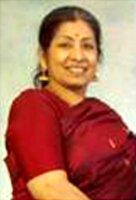 |
Sudha Chandrasekhar is the senior-most
student of the late great master Gurus Kuppiah Pillai, AT Govindraj Pillai,
and T K Mahalingam Pillai, as well as Sri Rajarajeshwari Bharata Natya
Kalamandir's current torcherbearer - Guru K Kalyanasundaram Pillai.
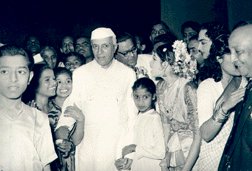 From 1945 - 48, she trained in Manipuri and Kathak at Rupatayan Institute, Bombay. From 1948 to 1967, she studied Kathak under Gurus Srivastava and Gopikrishna and Kuchipidi under Guru Korada Narasimha Rao of Elluru, Bharatacharya Sri Rama Acharyulu and Darpana Institute of Mrinalini Sarabhai, Ahmedabad. Alongside, she did intensive study in classical Carnatic music under the guidance of Bhaskara Bhagavathar and Vidwan Trichi Swaminatha Bhagavathar (both of Bombay) and North Indian Hindustani classical music under Professor Ginde of Bombay. In 1980-81, she did a short-term intensive course in Odissi under Guru Kelucharan Mohapatra and a short four-month course in Kathakali under Guru Krishna Pannikar. Sudha was hugely famous in the 1960s for her revival of the ancient Kavuthvams, her devotional abhinaya in the translations of Vedic Hymns (Nritya Gitanjali), Bhavayami Raghurama, and Guru Mahalingam Pillai's composition of the Dashavataram, as well as her technical perfection in the Thana Varnam and Naga Nritya. 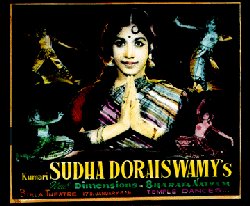 From 1967, Sudha is the artistic director of Hindu Temple Rhythms, a cultural and performing arts organization, director and choreographer of Vidyanjali Dance Troupe of Michigan ensemble, as well as Cultural Ambassador and Ethnic Presenter for the International Institute of Metropolitan Detroit. In May 1996, Sudha and her daughter Vidya broke their own world record in "72 Hours for the Heart", a 72-hour dance marathon in aid of the American Heart Association and Bharatiya Temple of Troy, Michigan. Sudha is now celebrating 37 years of Dance Education and performance in North America, and will be conducting her 50th arangetram performance on May 15, 2004. On the eve of your 50th arangetram presentation, how do you feel looking back at all the students you have trained? I feel greatly gratified and humbled. Each student has been a study in the many nuances and variations this great art represents. Many of them are professional doctors, lawyers, and engineers but have maintained their love for dance because it instilled discipline, self-confidence, and a will to do well in them. What does the arangetram represent to you? What memories do you have of your own arangetram? An Arangetram is the dancer's intimate offering of her dedication, hard work, perseverance, persistence, intensity of learning, her understanding of the inherent spiritual value of the art, its religiosity, and her search for the divine to Omnipresent God, her Gurus, and her parents. She shares this with her family, friends, and relatives who wish her success in her pursuit of perfection. My Arangetram took place at the beautiful Mahalakshmi Temple in Mumbai. I remember it vividly. It was Friday, and the devotees were celebrating the Vijayadashami Day- the tenth day of Navarathri. The Arabian Sea in the background with roaring waves lapping the shores, and thousands of devotees sitting up on treetops, on the stairs and everywhere place could be found formed the back drop for the event. I danced with all my heart. I was oblivious to the crowds, to the atmosphere, and felt I was in Heaven. I felt like I was the Apsara Urvashi performing my service to Goddess Rajarajeshwari in her Divine Court. Three and half hours just flew on. I remember an old couple inviting me after the aarathi offering, to their humble home and giving me a tall glass filled with the most delicious almond and pistachio ground boiled milk. I was so exhausted but they would not let me leave until I had partaken of the whole glass. They were simple folk but were in ecstasy over the dances depicting the play of God in his many aspects. I felt like I was the luckiest person in the whole wide world, and I still think I am because I have three daughters that resemble Goddess Mahalakshmi, Goddess Durga, and Goddess Saraswathi as seen in that wonderful temple in Mumbai. 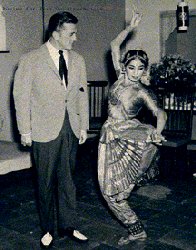 Since you left India in 1967 you have kept relatively elusive to the Indian dance scene. What activities are you conducting in America? Any plans to return to India? I arrived in Windsor, Canada on January 14th 1967 following my marriage to Sankarnarayan Chandrasekhar of Bombay. He was an Executive at General Motors. I began giving solo recitals as soon as I came here. The audiences were fascinated with the three-hour recitals, which were accompanied with appropriate explanations. At that time there were hardly any other dancers in the area. I traveled across the length and breadth of Canada. People still remember those days with delight. Bharata Natyam and Kuchipudi were both introduced in my programs. My parents arrived in Windsor three weeks before my first daughter Vidya was born. She was born on May 25th 1968 one of the happiest days of my life. I learnt about the miracle of birth and it changed my perspective about so many things hitherto unknown to me. From Vidya, I learnt how to smile from within. In 1969 my father organized under the auspices of Vidyanjali, a six-month grand tour of Kathak Nritya Samrat Gopi Krishna. Gopiji was my Guru Bhai as he was a Bharata Natyam student of my Guru Mahalingam Pillai. Gopi and I gave over 65 recitals in major cities of USA and Canada. It was wonderful. My first student here was Reeta Shama from Farmington Hills. USA. I performed her Arangetram in 1981 at the WWJ-TV Auditorium. Then I was invited to come and teach Bharata Natyam to a few students in Detroit, Michigan. My second daughter Anjali was born on March 24th 1975 and instantly took to dancing as that was what I continued to do on a continual basis. On July 29th 1977 I had my youngest daughter Anandini who quietly followed her sisters in continuing the tradition. In October 1978 the family moved to Oak Park, Michigan. I began teaching at the Bharatiya Temple, which was just being formed then. The next decade was spent in setting up the 'Nritya Sudha's Hindu Temple Rhythms' to present, preserve, and propagate the great art of Bharata Natyam and allied arts to interested students and spread an awareness about India's cultural wealth and traditional richness and its relation to spirituality. We celebrate our 25th year in USA and our 37th year in North America with our 50th Arangetram by Krithika Rajkumar on May 15th 2004. I do hope to eventually return to India with my three daughters and show the audiences back home how these three young women raised completely in America are maintaining our traditions with such dedication. In the 1960s, you were credited for the revival of the Kavuthvams, and the addition of bhajans and other North Indian language items in the Bharata Natyam repertoire. What inspired you to create such innovations in such a rigidly traditional art form? I cannot solely take credit for the revival of the Kavuthvams. My beloved Guru Kuppiah Pillai, 'Thatha' as I affectionately called him, actually resuscitated it from the cobwebs of negligence. He made me his chosen shishya to share the wealth of his knowledge with me. My mother Jaya sought him out after he migrated to Bombay to be with his family. With the Gurus Govindaraj Pillai and Mahalingam Pillai, and dear Karunambal Teacher I went to Tanjore and Thiruvidaimarudur, where Thatha was, and to Chidambaram and neighbouring towns too. I even performed at my Guru Kalyanasundaram and Mythili Akka's wedding in Tanjore. I heard my Guru Govindaraj play the Nadaswaram with such feeling and felicity at a temple celebration there. It was a dream come true. 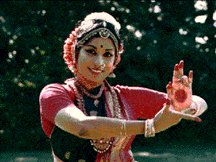 I won a two year Government of India Scholarship for continued studies in Bharata Natyam. My judges were the late Rukmini Arundale, E Krishna Iyer, and Dr. V Raghavan. That was 1958 to 1960. Hindi Bhajans were chosen because I felt that by performing songs in Hindi, Marathi, and Gujarati, the local audiences could develop a better appreciation of Bharata Natyam. I was greatly impressed by M S Subbalakshmi's portrayal of Meera in a movie by the same name. So, I talked Guru Mahalingam to choreograph the Bhajans. Eventually offers used to be brought to me and were presented on stage with the help of my Gurus. Dasavatharam by Jayadeva, Surdas Bhajans, Tulsidas Bhajans were all popularized by me in the 60's under the guidance of my Guru Mahalingam and Thatha. Nowadays there is a heavy influence of western fusion, such as modern dance, in Bharata Natyam. What do you think of these innovations, as compared to those you fostered in the 60s? Reminds me of my youth. College students and peers used to think up so many themes. I once composed a whole 90-minute ballet on the 'Birth of Jesus' when I was in College. It drew raves from the Catholic Church we performed it in. I was given 60 students to work with in a period of three months. I was 18 then, so confident and self-assured. Youth is great. People like to encourage you in whatever you do. It is like Bollywood now. Many youngsters think films are the best way to preserve one's culture. Is it really? Fusion is ok when you have an international group of students to perform for. It gives a glimpse of one's culture. That's all. To know more one has to dig deeper. Remember the story of 'Amritamanthana' - The Churning of the Ocean? The Devas and the Asuras had to work together to drag huge Mandara mountain into the ocean. Was that an easy task? Then serpent Vasuki had to be used as the rope to churn the huge mountain rod. They had to all be in the ocean to accomplish the churning. There was no base to hold the mountain, it sank. The Lord Vishnu had to assume the form of a tortoise on whose back the mountain was placed and then the churning brought out so many wonderful things and other harsh and poisonous things too. Many lifetimes have to be taken to really understand the realities contained in the great shastras among which Natyasastra is one. Innovations should be welcomed. They inspire practice, understanding, and creativity. They should have basis though. Modern dance is not really all that new. If you study Natya Sastra it enumerates so many kinds of body movements. The West borrowed some of the movements, which are aerial, light and structured and the east followed some that are more earthbound. Many indigenous dances incorporate a lot of these Angika movements. The body expresses in a beautiful and abstract way. It is wonderful to watch a trained professional perform modern dance. Have you watched the young men perform the Manipuri dances with their drums? Except for their costume they look like male ballet dancers. Innovations that were done in my younger days were meant to create a better understanding of classical dances when performed in a language that a particular audience could understand. There are sixty-four arts enumerated in our Sastras. Innovation is probably a category in those. However merely imitating dances from the movies, and gyrating the body in meaningless, or suggestive motions cannot be termed as innovations. If brought to the stage they look pretty vulgar and do not add to the understanding of anything traditional or cultural. 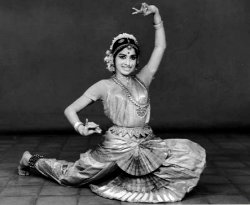 You have been the inspiration and revered Guru to 50 arangetram students now. How would you describe your relationship with your own Gurus and how did they inspire you? I was always in awe of my Gurus. I was taught to respect, love, and cherish them from the first time I met them, by my mother. She taught me how to understand them. It was hard at first but became easier as time went by. What my Gurus wanted in a student was a sincere desire to learn the intricacies as taught by them. They needed application. I practiced hard and tried not to make them tell me the same thing twice. I was ready for them when they wanted to experiment on a new theme, a step, a gesture, or an expressive thought. Everyone cannot be a Guru. I took what they taught me and shared it with my students. I tried to stay as close to the tradition as possible. However much we try to innovate, the best way is always the way of the Guru. My Gurus ways were simple, to the point, clear, and precise. Each step was embellished with grace, strength and ease of execution. The Tanjore technique is truly amazing. By my sincerity and passion I became part and parcel of my Gurus' home. I was Thatha's granddaughter, and a daughter to his sons and daughter. To this day our love for them endures. They have entrusted me with a mission and I must not fail them. That is why I continue to say and believe that all credit for everything I do goes to my parents, especially my Mom, and my Gurus, as also later to my dear beloved husband, and my children. I am indebted to them forever. You lost a great friend and supporter of your passion for dance in your husband when he passed away in 1992. How did you find the strength to continue? Sekhar, my most beloved friend, my intimate confidante, my dear husband.... I still cannot believe he is no longer on earth. He is very much beside me though. I can tell because everything is going the way he wanted it to be. He was so proud of everything I did. Admired every little detail. Gave me so much encouragement and support. "Whatever happens, never give up dancing because through it you reveal God" were his last words to me. I was teaching Summer Session at St. John's, Newfoundland then. I think the strength to continue came from my daughters. When I looked at their bewildered faces when he died, I had to fill in his shoes as mother and father. My loss was not as great as theirs. My youngest was barely 15. My second was in the final year of High school. My eldest was braving a taxing marriage. I was angry with God. He had failed me. I lived according to his injunctions. Why then did this have to happen? My dear friend Raji Murthy got me back to teaching dance within a month. You have to do it, she said. The students were so caring and loving. The parents got together and wanted me to continue. I went back to God. Swami Sant Keshavadas came over and gave us a very special talk. He advised me to be like Arjuna and do my duty. He made me read the Bhagawad Geetha and understand it. It took me seven years. I am fine now even though it can never be the same. My parents never quit my side. My Dad passed on in 1998. My mother continues to take loving care of me. My Krishna reigns supreme in our Gurukulam. 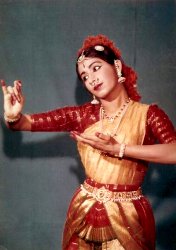 How do you compete with the frenzy of activities that Indian-American children are encouraged to participate in, i.e. academics, sports, music and dance, social/cultural clubs, etc.? How do you establish with your students the dedication necessary to complete their arangetram? As you grow older, you realize that changes are important to growth. Many children do complain that they have too many activities and they have no time to practice. I tell them, it is important to please their parents first because they want the best for their children. When they are in grade school, they have to try everything. As they get to Middle School, the arts activities become important. At High school they need to keep up with their peers. Once we understand this, I try and instill a reverence for the dance. It is a Mind, Body and Spirit exercise. It is Yoga form of relaxation. It will help with your studies and other kinds of stresses, I urge. Soon a group is formed and we work wonderfully. When they reach a certain level of understanding, and are technically sound, the parents and I get together, and discuss the arangetram. I have never met with any resistance this far. It is a smooth transition. I guess most of the inspiration comes from above. It's felt that today's generation is not interested in music and dance. Would you agree? Not really. Many of our dance enthusiasts are also learning Carnatic Music or North Indian Music. The Tyagaraja Utsavams have created a desire in these children to learn Carnatic music and perform them. I believe if the mother has an interest she can somehow get her child involved in that too. Kids want to be told that we expect something special from them. With encouragement they will eventually agree. Besides, our traditional arts have their own magic. The only time there is the so-called generation gap is when they go to university. With the newfound freedom, they want that little space. With a little understanding, that gap can be bridged. Then there is something called 'Fate' or 'Destiny' too. It's been said that Krithika Rajkumar, the student you are presenting in your 50th arangetram, is referred to by friends and relatives as a "mini" version of yourself. Are you reminded of your youth when you watch her dance? Yes, I definitely am reminded of my younger days as a dance enthusiast whenever I watch Krithika dance. She has the same energy, self-discipline, dedication, single mindedness, frenzy for perfecting something, challenging herself, and competitiveness I always had. She has popularity among her peers. She also wants to please me and her parents like I always wanted to. She even has the same speed and precision that I always had. She is brilliant in her studies too and has won a lot of trophies for her intellectual pursuits in addition to dance and music, and Thirukkural, and Bhagawad Geetha recitations. Amazing! I am so very proud of her and pray for her continued success in all she does. We all love her. You've spent more than 50 years dedicated to this art form, and now you will be 65 in the year 2005. How would you describe your journey? Any dreams/goals left to fulfill? Is it really that long? Hmmm! Well, I left India when I was 26. I was described as 'a gem among dancers' when I left there. I always wanted to be a devoted, obedient daughter, and my Mom now says I was that and made them justly proud of my accomplishments. I wanted to be a model student for my Gurus and I think I am one. I never liked to displease my mother, father, gurus, or my husband. I don't like to displease my children now. My passion for my dance has kept me close to God every moment. I am so grateful for that. Dance is my pathway to heaven. Dance is my bridge across troubled waters. Dance is my Bhajan to God. Dance has kept me healthy in Mind, Body, and Spirit. I have a dream to establish the "Tandav Center For the Arts" here in Michigan. Our Hindu Temple Rhythms will honor great artists who have dedicated their lives to the arts here. We will help our youth to learn the essence of the arts in a disciplined environment, use their creativity and knowledge to preserve the traditional techniques, foster the development of these folk arts through the Guru Shishya Parampara, develop spirituality, contentment, and peace and spread joy, unity, and peace through the study and propagation of these arts. 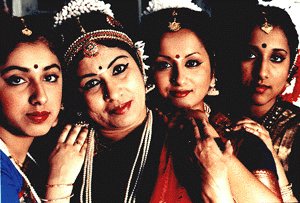 I dream of a world where no child will be hungry for food, lack knowledge, or be bereft of basic needs such as clothes, and shelter. Children should not want. Let us teach them the bliss of contentment, joy, helpfulness, and love. I know my daughters will help to reach these goals. The journey has been filled with happiness at times, painful, and sorrowful now and then, confusing, and bewildering at certain times, but...all along my faith in my Lord Krishna, and His many manifestations, and surrendering to His Will has pulled me through. With the Lord's name on my lips, and my heart singing His glories, and my feet ever dancing to His rhythms, I shall abide. This is the legacy I want to leave to my children and to all my students. Trust Him and place full faith in Him. He will be there always till the end and beyond. "Life is a beautiful journey, Dance through it sharing your joys with all, Helping everyone along the way, and Reminding one and all about the Supreme Omnipresent One." RADHE KRISHNA! Contact: Sudha Chandrasekhar "Vidyanjali's Hindu Temple Rhythms" 24611 Seneca Oak Park, MI 48237, USA Ph: (248) - 399 - 0259 e-mail: sudha@hindutemplerhythms.com |
