
|
    |
|
|
|


Prof. Kalamandalam Balasubramanian - evergreen presence in Kathakali July 30, 2004 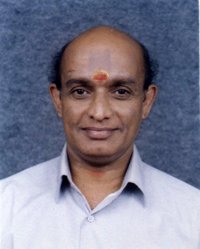 One of the first few names in Kathakali that come alive in the full glory of a pacha (noble) character is that of Prof. Kalamandalam Balasubramanian. Second perhaps only to Kalamandalam Gopi in essaying pacha characters, Balasubramanian has carved a niche for himself in the art. His characters follow the tradition of purity in technique as developed by Pattikamthodi Ravunni Menon who evolved the Kalluvazhi school, the most recognizable style that lends a distinct identity to Kalamandalam. The basic tenets of Prof. Kalamandalam Balasubramanian's art are solid training under Kalamandalam Gopi and Kalamandalam Raman Kutty Nair, an excellent sense of timing and rhythm and beauty of gestures. From Nala to Arjuna in Subhradaharanam to Karna, which is a relatively new entrant to the repertoire of Kathakali literature, Kalamandalam Balasubramanian has added his own dimension to the characters immortalized by greats like Vazhenkadu Kunju Nair. His effective portrayal of characters like Bhima in Kalyanasougandhikam excels in technical finesse. This gifted actor also has the flexibility to portray kathi characters as in Utbhavam. Apart from his invaluable contribution to the art as a guru and performer who has given shows across the globe, he has choreographed for Malayalam films and documentaries like 'What is Kathakali' by Kerala Kalamandalam, 'Vanaprastham' by Shaji Karoon, 'Desatanam' by Jayaraj. He was the main advisor for actor Mohanlal who played the protagonist in the film Vanaprastham. He has performed for various TV channels like Global TV, BBC, Asianet, for documentaries films like 'Mohiniyattam' by M T Vasudevan Nair, 'Krishna Kutty Poduval' by P V Chandran and 'Mahabharatha' by Milena Salvini. He received the David Bolland Gold Medal (Kerala Kalamandalam) in 1974 and is the recipient of several awards including the Kalahamsam in 2003 from Ernakulam Kathakali Club. He has published 'Kannum Poovum' (Eye and Flower) a unique informative book on Kathakali, Markandeya Charitam Attakatha (dance drama based on the life of Markandeya) and rewrote the poem Ekadasi Mahatmyam into a dance drama for Kathakali. Prof. Kalamandalam Balasubramanian is presently head of the dept of Kathakali (Northern school - vadakkan kalari) at Kerala Kalamandalam. He has recently been empanelled with the ICCR. On a recent visit to Chennai, he spoke to Lalitha Venkat about his work. 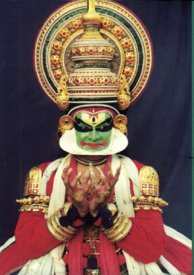
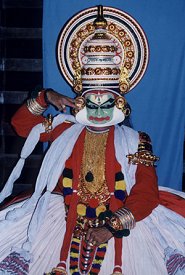 Pacha role - as Nala What inspired you to learn Kathakali? My mother Thankamani Mararasyar and father C V Rama Warrier both knew Carnatic music. My father was an accomplished Kathakali musician as well. He wanted to learn Kathakali, but my grandfather was against it. My father's uncle was an Ottanthullal artiste. After one of those rigorous massages, he developed complications that proved to be fatal and my grandfather did not want anything untoward happening to my father. Medical help in those days was not very advanced like now. Moreover, my father could not live for art alone, he had a family to sustain. Being a lover of Kathakali, my father wanted to fulfill his dreams through me. He was keen that I take up the art and asked me if I was interested. I had seen a few Kathakali performances, and I liked them, that's all, nothing beyond that. I decided that I would give it a try and I started my Kathakali training at 13. I joined Kalamandalam in 1968. The first 3 months were extremely difficult. I trained for 6 years for my diploma. After that, I studied under Kalamandalam Raman Kutty Nair on a 2-year scholarship from Human Resources Dept, Govt of India. I continued advanced training under him for one more year. What is taught in Kalamandalam? Vallathol first started Kathakali training at Kalamandalam, then Mohiniattam. Koodiyattam, Thullal, Panchavadyam, mridangam and Carnatic vocal were introduced gradually. As the art forms were losing importance, Vallathol and Mukunda Raja started the Kerala Kalamandalam to propagate and preserve the arts, especially Kathakali. In the Kathakali course, one learns dance and acting, vocal music, Chenda and Maddalam (percussion), make-up and costuming. Chenda and Maddalam are the two major percussion instruments used in Kathakali. Thus, after the course, an artiste will have a basic knowledge of music and percussion so essential to a Kathakali presentation. Study of Sanskrit, the epics Ramayana and Mahabaratha, Bhagavatam and puranam and history are also given importance. What is the eligibility to get into Kalamandalam? In my opinion, a student must possess an innate sense of talam (rhythm), then comes the mukha bhavam or facial expressions. Why he wants to join the institution is a very important factor, especially the family background. Students who hail from a family of practitioners already know about the art and are essentially aware of the rigorous training and involvement necessary for an artiste. The present younger generation is growing up watching some assorted Kathakali performances on TV and is quite unaware of what the actual training entails. When I was a student, one received a diploma after completing 6 years of training. Now it is structured like a university syllabus. Apart from Sanskrit, Malayalam, English and Hindi, the subjects include Aesthetics and Literature, Science, Mathematics and Humanities. Students join Kalamandalam after completing their 7th class school education. It takes 8 years to complete the course. Earlier students were not allowed to visit their parents for 3 months and many dropped out because they got homesick. Nowadays children are allowed to visit their families at weekends. Another factor for many quitting is the exacting training and tough physical exercises, especially body-massage treatment that involves strain and pain. What makes students stay back to do the course? Undoubtedly, the best place in India to learn Kathakali is at Kerala Kalamandalam. The most important factor is to get that first grip into the art form. If the student is able to establish a rapport with the teacher and has the ability to grasp what is taught and undergo the rigors of training, then there is no looking back. Kathakali training is very hard. Many are not able to take the pressure. A male's body changes from about 13 to 17 years of age. The first 3 years of training are particularly difficult and strenuous because that is the time the body is developed for the dance and the teacher pays great attention to this. Teachers will massage the students from head to foot in the early hours of the morning during June to August. This is essential for a Kathakali actor in order to perform hero roles that demand physical perfection. After that comes the development of thought. 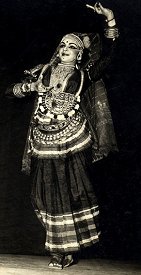
Anita Ratnam Photo: P Shyam Rao How strenuous are the massages now? Body massage is a must for Kathakali students/practitioners. Every year, every artiste must undergo 2 months of compulsory uzhichal (massage) from June 15 to August 15 during the rainy season since oil massage is very heatening for the body. To change with the times, I must say it is a little less strenuous now. How long have you been in Kalamandalam? I have been associated with Kerala Kalamandalam for 25 years. I joined as a professor in 1979. Immediately after I got my diploma and became a teacher, it will interest you to know that Anita Ratnam was my first student! (She is one of the first women to do a full Kathakali performance in 1978 in Chennai). I am proud to say that many prominent Kathakali artistes who perform all over the world have trained under me. There is criticism that Kalamandalam performances are becoming a little cinematic, more like playing to the gallery. For instance, the blood and guts spilling out in gory detail. Your comment. Kalamandalam has more than one troupe, so I cannot comment on that. Stories are of various types. We have the purely classical stories, then we have semi-classical stories and thirdly, very dramatic stories. There are 2 types of performances, a purely classical model and a drama model. In the former, there is no lokadharmi - that is, natural representation of characters and their actions. The artiste will portray everything through his actions. Audiences prefer the lokadharmi type. That's where the blood spill comes in. Though Kathakali is a theatre form, it does not have a director as such. The lead actor who is also the guru takes the role of director. Orchestral management is by the lead singer. Earlier, a person used to come and pour red liquid on the fallen character to signify blood spilling. Milena Salvini who studied Kathakali at Kalamandalam, was against artificial depiction of such scenes. She made the actor hide the color container in his costume folds and decant it subtly at the appropriate moment. She was also against actors moving props themselves on stage - like moving a stool and sitting on it for enacting the scene. Milena Salvini instructed that stagehands should do that and not the actors. The changes and refinements that were introduced by her in Paris came to be followed in Kerala Kalamandalam too. As a presenter also, she gave valuable inputs. About Kathakali actors not wearing costumes suited to their build, resulting in embarrassing moments on stage - your comment. Yes, I have also heard about the particular incident you refer to. It is up to the actors to personally take care of such matters and get the correct fitting costumes. What roles do you specialize in? I started off by doing female roles. But I was told my physique and bearing was more appropriate for tandava roles. I realized then that pacha and kathi roles suited me better, so I started doing roles of Nala, Krishna, Balabadran, Roudra Bhiman, Parasuraman, etc. 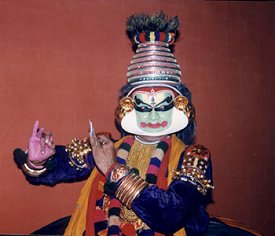 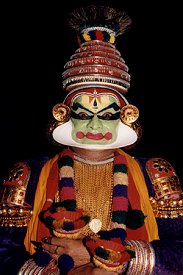 As Krishna (Photo: C V Sukumar) The mukha bhavam of Kalamandalam Krishnan Nair is outstanding. If he enacted a ball being lost somewhere, the whole audience would be looking for it, so convincing was his portrayal. He is the one who brought fame to Kathakali. And of course, my guru Kalamandalam Gopi. Tough as his training is, it has its advantages. I can say I am fortunate that my art has helped me to travel across the globe for performances. The only place I have not yet visited is China! Kathakali owes its present form to our guru Pattikamthodi Ravunni Menon. He dedicated his life to Kathakali. Originally, there were 2 styles, Kaplingadu and Kalladikodan. Ravunni Menon took the good elements from both strands and developed the Kalluvazhi sampradaya. Over 100 years, this form of Kathakali has evolved. Ravunni Menon laid the asthivaaram or foundation. He passed on his knowledge to Raman Kutty Nair, who passed it on to Kalamandalam Gopi, who passed it on to me. Does any particular performance/incident stand out in your memory? When we performed Panchali Vastrabaranam scene in Iran, the audience got very agitated. How can a woman be nearly disrobed on stage? We had to explain that it was a male doing the female role and after that, they settled down! 2 years ago, I did a workshop in Poland. I taught some Kathakali mudras to very young students. I also taught at the Warsaw University. It was amazing to see how quickly they picked up the mudras despite the language barrier. What future do you see for Kathakali? In the present day where people are always rushed for time, no one has patience to sit through long performances. Many dramas have been drastically reduced in duration to keep the art going. I am happy there is going to be a series of 3 all night performances at Paris in September. I feel the art form is gaining popularity in countries outside India, in part through films like Vanaprastham. It brought out the beauty of the characters of Kathakali, and put Kathakali on the world map. I saw the film at a theatre in Paris! It was such a pleasure to work with Mohanlal who put in so much effort to get the correct movements and expressions. Kathakali performances by visiting troupes also contribute to creating awareness about Kathakali outside India. In India, though artistes (like Maya K Rao, Anita Ratnam and Arjun Raina) are using predominantly Kathakali movements in their exploratory works, the art form itself is not growing. We must create awareness among the younger generation by conducting lec/dems in universities about Kathakali acting, singing, makeup, percussion and so on. I feel that perfection in Kathakali training is the hallmark of Kerala Kalamandalam. But how ever much one learns, one lifetime is not enough to master all the nuances of Kathakali. Contact: Prof. Kalamandalam Balasubramanian Dept Head, Kathakali Vesham (Vadakkan style) Kerala Kalamandalam, Vallthol Nagar Cheruthuruthy 679531 Trichur dist., Kerala, India Ph: (91 - 4884) - 262381 (res) e-mail: balasubramanian_kalamandalam@yahoo.com |
