
|
    |
|
|
|


They look Indian, but... Usha Raghavan talks to Richard Turner about the challenges and rewards of teaching Bharatanatyam in London August 30, 2004 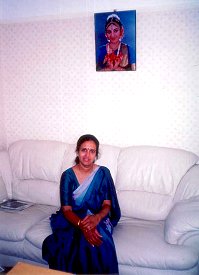 Usha with Srinidhi's portrait Usha Raghavan may at first appear a demanding teacher. Invited to attend a rehearsal for a forthcoming programme, I hover outside the room, awaiting a suitable break in proceedings. Usha's voice is raised in anger and a girl exits, disappearing into the Ladies. When she returns with a tissue, I follow her, with some trepidation, into what sounds like North Harrow's equivalent of Abu Ghraib. Perhaps the presence of a journalist will calm the situation? I needn't have feared. Usha and eight of her finest students are working briskly and impressively through choreography that is already well advanced. The small room echoes to Usha's woodblock, handclaps and the thud of the girls' precise stepping. The eight attractive girls divide into two groups of four, alternately, while the smallest details are perfected. I am at home with these Carnatic rhythms. Far from being the Iron Lady, Usha rises from her chair to demonstrate and is never lost for ideas. She adds precision to timing and, translating song lyrics, clarity to meaning. And the students are not cowed. There is dialogue and they are free to point out problems. Usha's approach extends to the philosophical: 'If you have it here,' she tells them, pointing to her forehead, 'You will forget. You must have it in your body.' Usha made her arangetram in 1969. However, it took another decade of experience, appreciation and encouragement for her to find the self-belief to turn professional. Initial inspiration came from her sister, Malathy Thothadri. In 1975, Usha was selected to represent Madras University on a tour of Asia. Five years later, as an advanced student of Adyar K Lakshman, she had the opportunity to teach and perform in Paris. This led to collaborative theatre work in Italy. By now, Usha was ready to escape the stifling 'job security' of a Chennai bank. 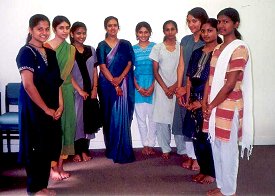 Usha Raghavan and students Usha moved to London in the mid Nineties, when her husband (also in banking) was posted here. A new set of problems presented themselves. 'It was difficult establishing here as a teacher. I could perform here and there but to teach you need a place. And it's not enough having a place, you need to have students. But where do you start? That's a difficulty in UK.' 'Some individual students came to me for private lessons, one-to-one lessons. These students spoke about me and, when they performed, others came to know about my work. Also, students from Italy came here. When they came, they told about me to others who were interested in Indian dance. So, through word of mouth. And then, in Harrow, they asked me to come and teach, for a Tamil school.' Usha's reputation flourished and she now has many students in a wide age range from five to 33. The members of her Harrow troupe are, remarkably, aged 14 to 18. Usha explains: 'Many of them come to me now because they like to continue with me. Initially, they were not very keen. But I had to motivate them. I had to encourage them. I had to make them appreciate. It's a lot of hard work because children here are not exposed to Indian culture. They look Indian, but... They know something about Indian culture, but it's not the way of living here. So I can't expect them to know... I can't expect them to be like Indian children. Back home in Madras, I take children for granted.' Yet, once they have learned the basics, Usha confirms that many of the students do take a pride in their Indian dance heritage: 'Students who have reached this level, they're very happy. There's a sense of achievement. They're so happy that they do this. Initially they didn't even want to tell their friends about their learning dance. Now they want to sell tickets for their programmes!' This interview is taken from the September 2004 print edition of veena Indian Arts Review - veenamagazine.co.uk |
