
|
    |
|
|
|


Nandini Ramani - well known critic, writer, bharatanatyam dancer and teacher of the Balasaraswathi style Nov 2000 Nandini Ramani shares her views with Narthaki Online. 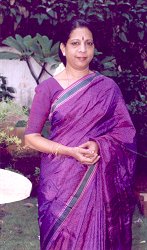 My father was a strict disciplinarian. My training under him has instilled values within me. I am proud of the fact that I am his daughter. The knowledge I have received from him has helped me to contribute to the art world. My father was a genius and to emulate a genius is a hard task, though I try to tread his path. Also, those who couldn't raise their voice against him during his days, now show their contempt in some way or other. But I am happy that his ideals have guided me in my life for a healthy outlook in life and make me work to achieve my goal with immense self-confidence. 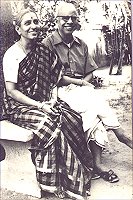 Can you tell us some brief anecdotes about your father's pioneering work? In the field of Sanskrit study, his main area of research was aesthetics. He had a passion for Sanskrit drama. He specialised in every field of art, archaeology, culture, religion, indology and even films. In fact, he wrote the script for the Tamil film "Seethakalyanam" which was a well-known talkie at that time. He wrote the script for "Chapala" and he had tried to find possibility for this at Bombay. His major career as professor of Sanskrit, made him an illustrious scholar of international repute and an authority in the varied spheres of Indian culture and thought. Apart from Sanskrit literature, he was an authority in the fields of drama, music and dance. In his younger days, he wrote under the pen name "Bhavuka". I remember reading a critique he wrote about Balasaraswathi in Sound and Shadow in the thirties. There he mentioned that her abhinaya had to improve a lot. It amused me, because she was known for her abhinaya. His contribution to Sanskrit research is monumental. Scholars and students constantly refer to his works, not only in India but also in countries outside where there is study of Sanskrit and allied fields . His criticisms were eye openers for the art and literary world. His authentic research materials are valuable treasures. 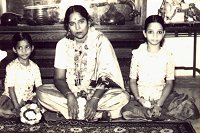 What made you decide to learn under Balasaraswathi? Balasaraswathi belonged to the Kandappa tradition of dance. The school is known for its strict adherence to tradition. Subtle abhinaya and expressions form the core of the school for which my father had a high regard. Being deeply interested in Bharatanatyam, he wanted my sister and myself to learn this art and perform. My father was an admirer of Bala's art; she and my father had known each other through this field for a long period; for my father, Bala's art was the final word. Hence he put us under her guidance. In fact, my sister Priyamvatha was the first student in Balasaraswathi's school at the Music Academy since the time it was started in 1953. I started learning under Balasaraswathi when I was six. The system was almost like a gurukulam. We had our technical dance lessons from Ganesan nattuvanar and had lessons on abhinaya from Bala herself. My arangetram was in 1970. The long period of training prior to my arangetram gave me an in-depth understanding of Bala and Ganesan's techniques thoroughly. 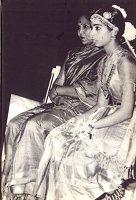 What kind of a teacher was she? What kind of a human being? She was a gentle person with two sides to her nature. As an artiste she was excellent. She was a great teacher, a generous teacher, but there were times when she would shrink within herself for reasons unknown. Sometimes she would share her views and would be warm hearted and the very next day her mood would change. Sometimes I felt that she became influenced by surroundings. A guru teaches about life as well as about dance. What are the valuable lessons about life that you have learned from her? Art should mend a person for a better life. I am fortunate to have been Bala's disciple. My training under her has given me an insight into human emotions and interactions. I have cultivated a traditional frame of mind within which I seek innovations. Balasaraswathi always trained me to see the good, take it and leave the rest. By observing her I have learned to face situations with boldness and approach issues in a confident manner.  Can you tell us about Ganesan nattuvanar? He was a great teacher, guru and an exemplary human being. He was outwardly stiff looking, but inwardly a gentle person. Majority of my opinions on Bharatanatyam have been derived from him. He was the last of the traditional nattuvanars. It is a misfortune that he did not get his due recognition during his time. I am happy that I could take care of him in his last days in addition to the close association and utmost regard that myself and my sister could offer to him. He was a great innovator. His choreographs were distinct, crisp, sharp, minute and intricate. I am greatly indebted to him. Why is that there are so few students of the Balasaraswathi school around the world who are actively performing? The art of Bala has its own uniqueness and greatness. My sister Priyamavatha, as I mentioned earlier was her first student and had her arangetram within three years of her learning . In fact, after Bala, Kamala and Vyjayanthimala there was a void. Priyamvatha was one of the first among the next generation of artists to create a memorable impact in the cultural scene. Bala did not know and believe in the tactics of public relations. Asking for opportunity was against her nature and she neither asked for performance opportunities nor encouraged them to do so. She did not want to compromise on her values for this art for the sake of public image. In the meantime, dancers hitherto unknown started to perform and they knew how to project themselves. In our school of dance, one can feel the emotions but cannot see explicit expositions in the name of abhinaya. Since explicit abhinaya became the trend of the day, Balasaraswathi's students faced hardships in the race. Still, our school of dance is regarded as technically superior, but there is no great demand for our performances. I feel the lack of a proper support system was one of the main factors behind this. When did you start writing? Actually vocalist Vedavalli brought me to senior journalist SVK, who already knew my father and introduced me to the authorities of "The Hindu" in 1994. I had inhibitions earlier, but I realised soon that, I could contribute to the art world through writing. Do you feel a conflict of interest in your career as writer / dancer? Would you rather perform than write? I take both performing and writing equally seriously. During the 80's, I performed for Sri Krishna Gana Sabha quite a few times, apart from some others. There was a void after my guru's death. I was involved with Doordarshan for sometime. Later, I started writing. I take things as they come. In 1993 Narada Gana Sabha gave me a chance to perform with my daughter. At the Music Academy, where I had performed major solos and presented lec-dems with my father until the end of 70's, I had the opportunity to perform again in 1996 during the centenary of E.Krishna Iyer in the veteran series. For Brhaddvani, I gave a lec-dem presentation of Padams in 1997. I love to dance as well as write. Can you tell us something about your association with Doordarshan? I was associated with Doordarshan from 1975-93. It gave me an impetus, when I wanted to do some creative work. I was their first auditioned compere. As an auditioned compere-presenter I did a variety of programmes. I learnt a lot from Mr.B.R.Kumar who is now the present station Director, All India Radio and from Mr. Selvam, the then DTC and Programme Executive. Does your daughter continue to dance after marriage? Yes. She performs and continues to learn and teach. You are an important member of the dance media in India. What are the advantages of your position? I am happy that I am a part of the dance media. Writing has given me a chance to express my views and serve the art community, for a constructive outlook with a positive approach.  You are one of the few people who are genuinely interested in the old traditions of Thanjavur style of Bharatanatyam. Do you plan to write a book so that the younger generation can benefit? I collaborated with the doyen Nattuvanar Thanjavur K.P. Kittappa Pillai and obtained fifteen unpublished compositions of the Tanjore quartette. These scripts were taken from manuscripts and hand written notations of the family of the illustrious Tanjore Quartette to whom belongs K.P. Kittappa Pillai. Last year, Music Academy released this material as a book. This book is a valuable addition to the dance repertoire. I am currently translating Dr. Raghavan's book on Bharatanatyam into English. This contains the views on the basics of the art and the do's and don'ts in it. I also plan to compile all my father's dance related writings. Sometime I may write my own book for the use of the future generation. What do you think of the term choreography and what do you feel about current choreographies? Choreography is a total concept as far as traditional Bharatanatyam is concerned as per the old practice. It combined composing, singing and directing the dance compositions. Today Nattuvanar's hardly compose, and all sections of a dance recital are segregated. So where is the idea of choreography? But within the present day context for choreography, I see tremendous changes both positive and negative. I am not averse to innovation, but it should be within prescribed limits. Some choreographies or dance composing are dangerously innovative. Speed is the order of the day. But I feel momentum should be gained slowly in the course of a performance. If a piece that needs a leisurely pace is choreographed in a fast tempo, it cannot be accepted in the name of innovation. People are tired of old Bharatanatyam format. What do you see for the future of solo Bharatanatyam? This art has transcended the ages. It is divine in nature. A solo Bharatanatyam performance needs concentration and focus. The dancer performs it as yoga. Tanjore quartette composed two hundred and fifty years ago and still the compositions look astoundingly fresh. I am sure that solo dance is here to stay. I do not see any danger to solo recitals of Bharatanatyam. Tastes may differ among the public from time to time; but good things will always sustain and survive. That is my feeling. Are you sometimes pressured by families and relatives of dancers to give good reviews? I do not bow down to pressure. Can your review make or break a young dancer? If a dancer takes reviews seriously and can make productive use of criticism, it helps the dancer and the art. But there is only a minuscule percentage of dancers who take reviews seriously. Most of them want to see their names in the paper and do not even care to read what is written. I remember an incident, when a friend of mine mentioned that my review had so broken a dancer that she had almost decided to quit. But this should not be the spirit. You must have self-confidence and self-introspection. You must be your own critic first. Once I was invited by the Sangeet Natak Academy to perform at the Sapru house in New Delhi. I performed before an elite audience. At a point there was a minor slip in Nattuvangam, but we managed and performed without error. But the critic Subbudu wrote, "Theermanam misfired. After all these years of training, is that what Bala taught you?" I was not shattered by this. I mentioned it to my guru, she asked me to march ahead with hard work and not worry so much about the review. If you do not have the attitude and guts to face things, you are not fit to perform. I feel a review can make a dancer if he / she acts on the pros and cons mentioned in it in a positive way. But, a review cannot break a dancer. Many people feel that objective criticism is absent because of too many vested interests. What is your opinion? There should not be any vested interests whatsoever in criticism. This will hamper the art and the artiste. A critic must be focussed and unbiased and should be true to his / her conscience. I am always true to my conscience and concentrate on the performance rather than the performer's clout and influence. Do you find foreign students more sincere than local students? A foreign student, who is not at all exposed to our culture, can come with a dedication and with an urge to learn the art. Each person takes the art from different angles. Some come to learn for the sake of learning, some come to learn the art to become performers. There are dedicated students in India as well. I am not for this kind of attitude; I feel any student, Indian or foreigner has to be genuine in their efforts. What is your favourite colour? You could have asked my favourite raga. I like Begada. I feel it has all shades of emotions. My favourite color .... All nice colours! Anything that is striking, unique and that suits the occasion is my choice. Your favourite food? Good food. Nothing in particular. Your favourite city in the world? Paris. I have visited it thrice. It is beautiful. The classical style of architecture and the warm and cultural look have mesmerised me. What is your star sign and birth date. I am a Scorpio, born on November 18,1950. Your Idol? No one in particular. I take the best and leave the rest in a person. I want to be individualistic. My ultimate Idol is Anjaneya, because I feel, that he possesses all high qualities. Nandini Ramani "Dr. V Raghavan Institute of Performing Arts" 1, 3rd Street Bhakthavatsalam Nagar Adyar, Chennai 600020 Ph: (044) - 4430344 / 4413927 e-mail: rvr@vsnl.com (as told to TNC) |
