
|
    |
|
|
|


Thirukkural reflects our values in life: V P Dhananjayan e-mail: lalvenkat@yahoo.com June 10, 2005 Bhaaskara & Bharatakalanjali jointly present the world premier of THIRUKKURAL BHAARATAM, choreographed by the Dhananjayans and performed by Kavita-Meera-Anjana (Pathmaraja Trio Sisters from LA, USA), on June 11, 2005 at Bharatiya Vidya Bhavan, Chennai. Bhaaskara Art & Education Trust founded by The Dhananjayans, will award SANGEETA BHAASKARA to Prof. D Pasupathy (Former Principal, Sri Venkateswara College of Music, Tirupati and former Vice Principal, Kalakshetra), and ILAKIYA BHAASKARA to Prof. (Dr) S Raghuraman (Tamizh Professor, Jain College). The former recipients of Bhaaskara Puraskaar are Prof. A. Janardanan (Former Principal, Kalakshetra, Chennai), Kathakali Asaan Sadanam Balakrishnan (Principal International Kathakali Center, New Delhi) and Kaithapuram Damodaran Nambuthiri, the celebrated lyricist and film music composer. Guru Dhananjayan talks to Lalitha Venkat about how the Thirukkural project evolved over the years. 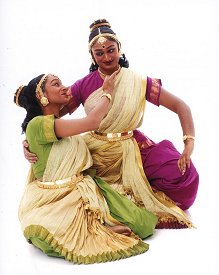 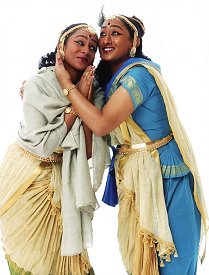
Why did you choose Thirukkural as the theme for the production? Thirukkural project was actually the brainchild of Dr. Pathamarajah - father of the three dancers. He gave me the idea two years ago with some of the earlier music cassettes sung by well-known musicians. Well, the music did not impress me, because it was quite in a light or cinematic rendering, which do not match the classical language of the Kural. Generally the music should inspire me to undertake any compositions. Dr. Pathmarajah was persistent in us teaching Thirukkural to his daughters in Bharatanaatyam. I thought over it for some time, started reading Kural translations and commentaries...totally confused - so much good material for human life. I did not know what to take and what to eliminate. Every couplet seems to be important. So I approached Prof. Raghuraman (an expert in Kural) to choose only a few couplets from various chapters. He read out a few and explained to me the physical meaning, in depth symbolism, word to word meaning, philosophy content for day to day human life etc. We had a lot of arguments between us for several sessions and then finally arrived at a few couplets. I left it to his scholarship to choose the lines and connect one line from one Adikaaram to another in another Adikaaram (chapter). He did it very convincingly with examples of stories and anecdotes, to exemplify the Kural. It took almost six months to arrive at this stage. Then the music...I could envisage only totally heavy classical tunes for this heavy Tamizh literature, and a music composer without any sort of contemporary compromising attitude, and who is not touched by modern approach to Carnatic music. The best person Prof. D Pasupathy, a senior, very unassuming and dynamic musician with long experience in Kalakshetra and on his own, was my choice and I am right, he delivered the spirit of Kural through his divine music. It took 6 months for him to assimilate the essence of Kural into his musical genius. While composing the songs, our musicians Sasidharan and Preethi Mahesh, sat along with Pasupathy sir and learnt the compositions as he composed each couplet. I also sat with DP and made a few suggestions here and there to suite the Naatya idiom. 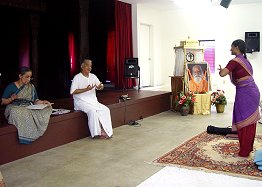
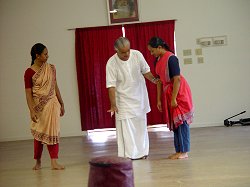
How difficult or easy was it for you to interpret it into dance? It took one year for me to convince myself to undertake the project. It was very difficult, especially to choreograph a major production with young inexperienced dancers born and brought up in an alien culture. But this notion dispelled when I started working with these girls, who have been already groomed into the Thirukkural culture by their parents. Initially it was difficult to transpire my ideas of movements and moods, so I had to resort to rather simplistic patterns of choreography, both physically and emotionally. Probably with some of my best disciples in Chennai, this production might be of a different calibre altogether. In this production Shanta's input remains in making the girls practice to perfection what I choreographed, that is why I use the big 'I' for choreographic credit. She insists I should not give her credit for choreography, though she is always my inspiration, as you all know. What special choreographic input can we expect in this production? Dr. Raghuraman's input helped me a lot in interpreting the idea into Naatya. The total discipline, devotion and dedication of these girls (Kavita, Meera & Anjana) really inspired me to convincingly delineate the theme. To the question of what special choreographic feature I have employed: I have deliberately confined to classical Bharatanaatyam technique. Music is totally chaste classical melodies. Yet you will find some touches of freshness in the approach to each episode. Movements swing with the swaras, some suggestive shadow play, and I adopted a simplistic method of communication, direct approach. To exemplify the Kural, I have taken stories of different religions to emphasize that Kural is truly secular in spirit and content. For your information, I asked a six-year girl from Dubai (my neighbour's grand daughter on holiday) to watch and express her reactions on what the girls are practicing. I was amazed at her frank and free innocent statements, she was able to tell me the mood and simple enactment of mother Teresa helping lepers, old age home, cradle to deserted children etc. If a child of 6 could understand the message, I am sure our initiated audience will certainly enjoy the show. Another special feature is the costume- totally different from usual Bharatanaatyam costumes. Everything including ornaments are newly designed taking inspiration from ancient literature and available sculptures of the Valluvar period. The CD recording is very well done with clarity of words and coordinated instruments. With the dancers based in US and you based in Chennai, how did the production fall into place and for how long did you work on it? These girls have been attending our Gurukulam in Yogaville Virgina, year after year, for almost 12 to 15 years. Then Meera the middle one, used to come to Bharatakalanjali periodically, whenever she had vacations or social projects in India & Srilanka connected with her University study. She had even attended two of our Bhaaskara camps in Payyanur. So, they are familiar with our working patterns. The choreography took place in Yogaville, last year after our annual gurukualm camp. These children attended the camp and stayed back for fifteen days only to do this project. So we worked night and day for 15 days and initial choreography was done. A video camera recorded all our actions and reactions, which helped the girls to remember and practice it later. They did keep on practicing whenever they found time off from their studies. Meera and Kavitha came to Chennai last December to spend one month with us, when I did some little changes in choreography with our senior dancers like Divya and Sandhya helping the girls to practice. Anjana could not attend this session, because she suddenly fell sick. So her 2 sisters went back after a month's gruelling session in Bharatakalanjali. Now, again the three sisters are here from 20th of May practicing and rehearsing for the final presentation on 11th &12th June. They are spending almost the whole day with us - we have both morning and evening practice sessions. The light & audio technicians are also attending the rehearsal from this week. With the SNA controversy still hot news, what is your stand on the whole issue? From the inception of Sonal, I have been telling both in press and personally that she is not a fit person to Chair a prestigious organization, representing the culture of Bhaarata. No doubt she is a fine Odissi dancer. Other than that, she has no qualification to adorn a Chair, sanctified by personalities like Kamaladevi Chattopadhya, Girish Karnad, V K Narayana Menon, Dr. Premalatha Sharma, (Moulana Azad, TL Venkatrama Iyyar, Justice Rajamannar etc, if I am right). Now that a new chairperson has been appointed for SNA, do you think it's a wise decision? What do you look for now? I am glad the Government has removed Sonal, obliging the request of all artistes who have risen against her. This decision proves that artistes' voices are also heard in the melee of politicians, politics and bureaucracy. Democracy is still alive in India. As far as I have heard from different sources, Shri. Mirdha is supposed to be a good person with no axe to grind. We hope everything will fall in place with his experience as a good Parliamentarian. Contact e-mail: bkalanjali@gmail.com |
