
|
    |
|
|
|


A storm in a teacup Exclusive interview with Ramli Ibrahim Photos: courtesy Sutra September 29, 2005 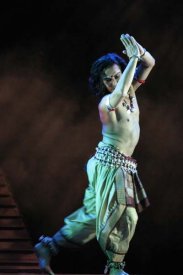 It is said of Ramli Ibrahim that, "Such a dancer comes but once in a generation and in some cultures, once in a lifetime." But even such a great dancer has become the subject of a debate after his recent India tour of 'Spellbound' with his group of young dancers from Sutra Dance Theatre. While Pondicherry, Delhi and Chennai went into raptures over 'Spellbound,' Bhubaneswar stirred up what we now call the controversy over costume. Should "To wear or not wear the 'odhni' (a sash over the blouse)" be the major issue plaguing the Odissi dance circles of Bhubaneswar? Ramli gives an exclusive interview to narthaki.com on the issue. What exactly was the scenario which caused this 'storm' in Bhubaneswar, the heartland of Odissi? Recently Sutra Dance Theatre presented two different programs at the Rabindra Mandap, (Bhubaneswar) on the 10th and 11th September 2005. The programs, entitled 'Spellbound' and under my artistic direction, consisted of Program 1 (traditional Odissi) and Program 2 (contemporary modern works with emphasis and thrust on the use of various Asian images, idioms and points of embarkations). These performances at Rabindra Mandap were organized by Dr. Dinanath Pathy (president of Orissa Lalit Kala Akademi) who secured the three Orissan Arts Institutions (Lalit Kala, Sahitya and Sangeet Natak Akademis) to lend their support and names to the production which, however, was totally financed by Sutra. Sutra through Dr. Dinanath Pathy also organized a two-day seminar of "Dialogues with disciples of the late Guru Debaprasad Das" prior to these performances. I approached Dr. Dinanath Pathy to organize these 'happenings' in Bhunaneswar prior to our performance at the Kamani Auditorium, New Delhi. This choice is natural as Dr. Pathy has been Sutra's major collaborator in exhibitions of Orissan contemporary paintings in Malaysia. I found Dr. Pathy a highly cultured and visionary man who sees all the aspects of the performing and visual arts in its totality. On top of that, he had personally known the late Debaprasad. Where else did you perform and how was the response? Spellbound was also performed in Pondicherry, Auroville and Chennai. The programs and the dancers were well received in all the venues (inclusive of Bhubaneswar), with hardly any protest with regards to the costumes that Sutra dancers wore in the traditional Odissi program. (In fact, I was more nervous of the contemporary work, rather than the traditional Odissi program). After Bhubaneswar, Sutra performed 'Spellbound' at the Kamani Auditorium, New Delhi, presented by the Natya Ballet Centre. This program was also well received without any fuss over the Odissi costumes that Sutra dancers wore. In fact, Sutra have always promoted Odissi costume in this manner, in the twenty plus years we have performed Odissi. It has been our Odissi trade-mark. So what happened? Unfortunately, in Bhubaneswar, the issue of Sutra girls not wearing the 'odhni' over their blouses was sensationalized by certain quarters after the first program. This issue was seized by certain so-called critics in media and then blown out of proportion. As the storm in the teacup brewed, a number of comments were made, even by those who did not attend the performance. What exactly were the girls wearing or 'not wearing'? Basically, if you look at those delightful pictures of Indrani Rehman in the Odissi poses which she made famous, you would see the exact picture of what Sutra dancers were wearing. That is, what we were not wearing, is the 'odhni', a flimsy see-through piece of material worn over the blouses (kanchela) of most Odissi dancers nowadays. It is really a transparent sash. 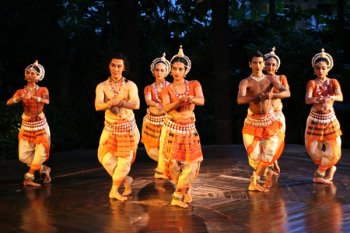 Why don't your female dancers wear 'odhni'? The reason why female Sutra dancers don't wear this sash is mainly aesthetic. However, I am also aware that the 'odhni' was a contemporary and not a traditional embellishment of the Odissi costume created during the 'Jayantika' (crusaders of contemporary Odissi) times, a group of which the late Debaprasad eventually opted out. Where the 'odhni' is concerned, I can only speak for my own Sutra dancers. Most of my dancers are young and on the thin side. Due to their simultaneous training in modern dance, ballet and yoga, Sutra dancers are also well 'pulled up' out of their waist. They tend to look sloppy with these extraneous pieces of material which drop to the sides when they bend, subsequently obscuring their delicate bhangis. This fact was pointed out to me several times by the visual artists and photographers who draw or photograph them, whenever they wear the 'odhni'. It was also obvious in our photographs that these materials can be a hindrance if they are not 'securely' pinned and stitched to the blouses! They are a hindrance because when they are stitched too tightly, they hinder the full movement of the arms! Apart from this, we do not wear stitched costume; we wear full length saris, which are tied during our quick changes between dances even by the youngest member of the troupe, without any assistance. We normally do at least two quick costume changes in a full length program. Securing the 'odhni' has always been an unnecessary hassle apart from its 'unaesthetic' aspect. Where does this stand in terms of the aesthetics recommended by the late Debaprasad? It is important to note that the use of the full sari and not a stitched costume in a performance is a definite stamp and characteristic legacy of the Debaprasad parampara. This particular legacy has been consciously kept alive by Sutra and has set us apart in costuming from the rest of the other Odissi dancers in India and abroad. In a recent book by the late Debaprasad Das, nowhere in his drawings of the Odissi costume which he illustrated was there an 'odhni'! I believe that Sutra Odissi dancers retain this major recommended aesthetics of Debaprasad. We also keep the distinctive facial decorations which Debuji made his dancers do when performing, apart from wearing saris and not stitched costumes. Therefore, to quote Sanskruti O Sanskruti (Orissa premier keeper of traditional values) that we are "distorting the Orissan tradition," is a gross exaggeration and blatant misinterpretation of the first order of a more authentic and less puritanical cultural statement of this often misunderstood Guru! In fact, the late Debaprasad opted out of the Jayantika and caused a furore in the then Odissi 'crusaders' mainly because he was not into a "uniform" Odissi and 'homogenizing' its methodology and presentation. So do you think that all Odissi dancers should dispense with the 'odhni'? Of course not! We are not against the 'odhni.' Many distinguished dancers have come and gone wearing or not wearing the 'odhni.' Many have worn it and looked ravishing as also Indrani Rehman did, without it. Basically, what makes a costume vulgar or otherwise is not just the design but more importantly the context of how a dancer 'costumes' the Dance. Just as the scantily clad sculptures of celestial maidens and goddesses became potent symbols of religion and art but their human counterparts wearing the same in the present crass films can only attract lasciviousness from the public. Thus, Sutra dancers sans 'odhni' did not cause a stir in Pondicherry, Auroville, Chennai, New Delhi, Malaysia and Singapore because their performances were conducted with utmost dignity and professionalism. Contrary to what is hastily surmised by Sanskruti O Sanskruti, instead of 'distorting' the Odissi tradition, Sutra has always ensured that the tradition of Odissi is given the utmost respect. 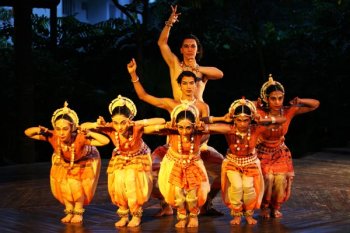 So why is this issue suddenly causing a stir in Bhubaneswar? Who has really stirred the partisan spirits of the so-called Orissan keepers of 'tradition'? I am at a loss myself as to why suddenly this particular issue is played negatively to the maximum. I think it is refreshing to have diversity in how Odissi is interpreted as long as the real values are not transgressed. And we have certainly not done that at all! In fact, Sutra has done much to promote Odissi at its highest level. After all, according to January Low, Sutra's star Odissi dancer who had performed in Bhubaneswar many times… "I had always performed without the 'odhni' in Bhubaneswar. There had been no major outcry. Why the fuss now?" This fact was even pointed out, mentioned and discussed in dance articles of Dr Dinanath Pathy years ago, before Sutra even made contact with him! Do you think there may be an 'agenda' by threatened parties behind all this brou-hoo-ha? I don't really know and life is too short to waste time to find out who is, or the real reason, behind the conspiracy to discredit Sutra. For example, it is interesting that the 'bad' reviews came from only one particular writer who had peddled his/her reviews to as many media as possible, quoting disparaging remarks ("I dislike such patchwork. Ramli should not have tampered with the original pieces…" said Ileana Citaristi) the very dancer who had come backstage to congratulate us! I am sure Ileana did not say this or has any business to say this 'untruth' because all the works, except Astha Sambhu, were created together with Guru Durga Charan Ranbir. So, I am not at all tampering with it and on the contrary Spellbound has the blessing of Ranbirji who conducted its world premiere in Kuala Lumpur. Aditya Acharna, for instance, was created new for Sutra and is different from the way his dancers in Bhubaneswar were taught. So, definitely, there is jealousy. As you know, Bhubaneswar is not exactly an easy place to deal with. Nevertheless, there are many enlightened citizens in Bhubaneswar. Besides Dr. Dinanath Pathy and his colleagues (who worked hard to organize these activities), there were such distinguished luminaries as Dr. Sitakant Mahapatra who said after the performance that, "Traditional Odissi has been given another dimension by Sutra. In Spellbound, tradition also becomes 'modernity' but does not stay out of tradition. Tradition is not a cage but provides a backdrop…" We have got real proof of this on film unlike the reviewer whose quotations may be hearsay. Orissan international painter Jatin Das was also excited by Spellbound when he saw it in New Delhi. But in another layering, there are so-called traditionalists who have their own views often coloured by their insecurities and possessiveness of the art form, which they feel is about to be hijacked from them. In their views, Odissi is theirs and theirs alone. Foreigners like me can't hope to understand or feel a fraction of what they can of Odissi or its music. However, it is quite likely that Sutra's brand of Odissi is getting to be just a little too threatening to some of the above-mentioned people. Billboards of Sutra stood side by side with that of the Guru Kelucharan Mahapatra Award performance, which took place just three days later in the same venue. In the two-day Seminar "Dialogue with disciples of the late Debaprasad Das," organized by Sutra and convened by Dr. Dinanath Pathy in Bhubaneswar, just prior to Sutra performances, (with the objective of gathering precious information of the late Guru) there were unscheduled black-outs. Rumours of jealousy and conspiratorial gossips were rampant and there was even anticipation of interruption to the performance. The organizers had received threats of sabotage. These included using the fact that I was a Muslim and should not be doing Indian classical dance! To avoid untowardly circumstances, security guards/police were employed in and around the theatre as a safety measure. A generator was hired and used as we could not afford any un-scheduled electricity cuts… What about the rasikas of Bhubaneswar? What do they feel about this issue? On the eve of our performance in Bhubaneswar, we were invited to JDCA (Jatin Das Centre of Arts) to talk with some of the more enlightened citizens of Orissa. The question of the 'odhni' was actually discussed and we presented our 'dilemma' in an open and liberated discussion. Most of the people present at the JDCA (comprising honoured citizens of all professions) meeting, attended and were spellbound by our performance. I am sure that the question of 'distortion' of the Odissi tradition did not even cross their minds. I think most of them think that this issue is rather ridiculous, almost not worth discussing about! Someone has 'stirred' the mob and a chain reaction of accusations and counter accusations have been started. People are divided in their opinions and the media is having a field time. However, as far as the dance fraternity is concerned, it is important that the tea-cup storm is quelled lest it becomes a Katrina or Rita and causes further damage… Orissan poet Dr. Sitakant Mahapatra said that the decision of wearing the 'odhni' was a contemporary one and that the original Odissi dancers never wore them. This fact can be verified by palm leaf manuscripts and other medieval literary sources. To tell the truth, and rightly so, Dr. Mahapatra and I were more interested in the content and innovative development in Sutra's presentation of Spellbound rather than discussing the inconsequential authenticity of the token transparent 'odhni' covering, which in my opinion, ironically, accentuates the 'sensuality' of the dancer rather than covering it! What is your own conclusion about the whole issue? It is sad that the media has sensationalized the 'odhni' issue, thereby hijacking the more noble cause-célebre that is really taking place between Malaysia and Orissa - that is, the exciting and vibrant cultural exchange in dance and the visual arts spearheaded by Sutra in Malaysia, together with one of the few 'renaissance' men of Orissa, Dr. Dinanath Pathy. Instead of dampening the efforts of these individuals who have gotten together for the sheer love of Orissan arts, there should be a celebration that such a flame of cross-fertilization of cultures should still flourish between the two shores as in olden times of the Bali Jatra Ramli Ibrahim can be contacted on ramlii@hotmail.com Putting the record straight - Bibhuti Mishra's response to Ramli Ibrahim's interview |
