|
    |
|
|
|


C P Satyajit - Photographer Nov 2000 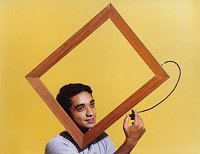 How did you take to photography? My interest in photography started during my school days. My brother helped me load a camera and this initiated my interest in photography. I started taking photos. At school, my teachers wanted me to do a project based on photography. I liked it and gradually my interest in photography grew profound. At the same time, I was also learning dance and performing. At a point I had to decide between dance and photography. This point came only when I was working in Bombay. I decided in favor of photography.  A meeting with Mr.Iqbal from Bombay prompted me to take up photography as a profession. I trained under him for a couple of years, from the beginning of '97. I used to accompany him during photo shoots. By observing him and assisting him, I learnt the techniques. Even now, I am in touch with him and seek his guidance. Mr. Karthik based in Chennai has also helped me in my career. When did you start your individual career? Just a year ago. My first major assignment was to shoot for Natalia's western wear for women. It was a big break. I cannot forget those three days, June 30, July 1 and 2 of 1999. This assignment made my presence felt in the professional field. Interestingly, the ad agency for Natalia was Mudra. Mudra is associated with dance and I was happy to grab that opportunity.  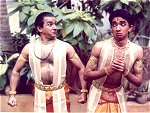 Your parents are well known dancers. How did they react to your choice of photography as a profession? They were upset initially. I tried to convince them that I wanted to carve a niche for myself in the field of photography. I also told them that dance was a part of my life but in the initial stages I wanted to concentrate on my career. I convinced them that I would start dancing again after sometime. Now they have accepted my decision. How interesting is life for a photographer? Each day is a different day. It is a very unpredictable life. Sometimes you slog for three days continuously and then you have nothing to do for a long time. You travel a lot and get to know many people and places. The best part of this profession is that you don't get into a routine and don't get bored. I like the challenges in it. You can make life interesting through photography. You can publish your photos, hold a photo exhibition, you can do a variety of things. What is your idea of photography? For me photography means self-expression. A photograph should evoke a response. Like any art, photography helps me express myself very well. I try to show beautiful things through photography. I like nature photography very much. If I take a nature photograph and show it, thousands of people can enjoy what I have enjoyed. Photography is not merely taking pictures, they communicate a variety of ideas. If my photography can inspire people, I will be happy. How do you define a photogenic face? Do looks decide the beauty of a photograph? You cannot judge by looking at a person. Of course an experienced photographer can do that. But this is an ambiguous area. A person who looks ordinary may look stunning in a photograph. In advertisements, there are set standards for the looks of a model. Looks do matter in an advertisement. Otherwise beauty is beyond that. There is a general feeling that a fair skin is beautiful. I feel this is not a fair statement always. Even black is beautiful. So, basically there are no set standards for a photogenic face. In countries abroad, we find the concept of specialised professionals like dance photographers, fashion photographers and so on. Does that concept hold good in India? In India the market is not broad enough to generate specialisation. In foreign countries, you find the need for specialised professionals like product photographers, fashion photographers, industrial photographers, car photographers and so on. So people concentrate on their chosen area. But in India you need to be competent enough to grab any assignment that comes to you. One day you could do a dance photo and the very next day you will have to cover a fashion show. One area that has come under specialisation in India is fashion photography.  Can you tell us the trick behind capturing the best moments of a performance? Pre-visualising the shot is very necessary. You visualise the event to be covered and plan the shots to be taken. You plan the angles, distance and choose an area and place yourself. If you prepare yourself before the performance, you are safe. Even after such careful planning, something unexpected could happen and also new ideas may occur on the spot. So you must be able to predict things and react quickly. I have an advantage as far as dance photography is concerned, as I know dance. Predicting things and reacting quickly is the main challenge in stage photography. How does stage lighting affect photography? Stage lighting aids in bringing out better quality in photographs. I do not use flash. So my only source of lighting is stage lighting. If the lights are bright, the quality of the picture will be good. But at times the lighting may be deliberately made dim for the asthetic value on stage and we will have to adjust to it. We can combat the problem by using high-speed films. Technically which is the best possible distance, angle to cover a performance? Ideally you cover the performance from different angles and distances. If the performance is for two or three days, then you can cover from different positions each day. You can sit in the centre, cover close one day, then you can change distance and angles the next day. Even if the performance is for a day only, you will have to experiment with different positions. Last year, I had an opportunity to cover Leela Samson's performance at Kalakshetra. The lighting was so dramatic in different angles. I got various angles. I could move around during breaks and got different views. I covered a shot from the top angle. There was a nice streak of light coming in the same line of the dancer. I could not have had this view had I stuck on to one place. So it is better to cover a performance from different angles and distances. Some feel that black and white photographs have better clarity than colour photographs. What is your opinion? Technically both are the same. We are used to seeing things in colour and so when we see something in black and white we are attracted to it. Also when we see colour photographs there is the distraction of colour. In black and white photographs this distraction is not there. The challenge in colour photographs lies in bringing out the best in colour combination. In my view both black and white and colour photographs are equally good and attractive. Which is your favourite auditorium? I like the Museum theatre and The Music Academy in Chennai. I like the atmosphere in these places. Change is synonymous with technology. How do you equip yourself with changing trends in photography? I update myself through books and the Internet. Digital photos are the latest trends. There are changes happening every day. But you cannot keep changing your equipment every day. If you feel that there is a major advancement of technology and it is here to stay for four or five years, there is some point in changing your equipment. Till date which has been your challenging task? I try to make all my assignments different and challenging. You learn through every experiment and it is an experience. Last year, I shot for a brochure for a design studio called Mitrra Media. I had to shoot eight different shots and each shot had to be aesthetically different and creative. That was a wonderful experience. Basically I do not limit myself to a particular task to define it challenging. Every moment in photography is beautiful. Are you satisfied with what you have done at this stage of your career? I am happy with what I have done so far, but I know that I have to keep improving my work everyday because there is no such thing as the perfect photograph. One must never rest on the things one has done in the past, the present is more important, and at every moment you must try to better what you did yesterday. What are your future plans and ambitions? My ambition is to do pictures that touch people. My photos must cater to anybody and must not be confined to particular section of society alone. I want my photographs to be emotional in content. My long-term plan is to concentrate on landscape and nature. I admire phtographers like Ansel Adams and Eric Meola. I wish to emulate then. Any major influences in your life? My guru Mr.Iqbal is my first idol. What are your hobbies? I like to watch movies. I am a great flight enthusiast. I like to watch planes, identify their models. I have a flight stimulator in my computer. I like to travel. I like pets. What about dance? I like dance. But now I concentrate on photography. After some years, I will start to dance again. The spark has to come to make me dance again. Do you still practice dance? No, I do not. But I practice yoga and kalari to keep myself fit. What is your date of birth and star sign? I am a Cancerian, born on 28th of June 1974. List the thing you love Food: I love good food. I like chappatis, dhal and ghee. I am diet conscious. I give my diet an occasional break and taste pizzas and chips. I am totally into Ayurveda. Colour: I need all colours. I do not have colour bias. City: I like Bombay, Ooty, Mudumalai, Switzerland and I wish to go to the Rocky mountains. View more photographs 22, Jeevaratnam Nagar Adyar, Chennai 600020 Ph: (044) - 4911125 e-mail: cp_satyajit@hotmail.com (as told to TNC) |
