
|
    |
|
|
|


Dance - the essence of my life: Ananda Shankar Jayant - Lalitha Venkat, Chennai e-mail: lalvenkat@yahoo.com November 23, 2006 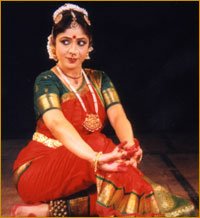 She spent six years at Kalakshetra, learning Bharatanatyam, Carnatic music, veena, dance theory, philosophy etc., and acquired a Diploma and a Post-graduate Diploma in Bharatanatyam. On her return to Hyderabad, she learnt Kuchipudi from Pasumarthy Ramalinga Shastry. Interested in sharing her art as well as thanks to interested parents wanting her to teach their children, Ananda became a dance teacher when she was 17. Her early choreographic attempts were in directing short dance pieces of 10 to 20 minutes for young children. These were staged at school functions and local competitions. 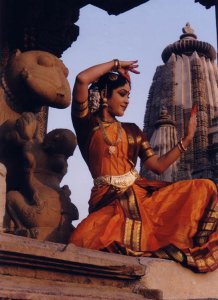 In spite of full time training sessions at Kalakshetra, she did not lag behind in academics. She went on to get an MA (Ancient Indian History, Culture and Archaeology) from Osmania University and M.Phil as a UGC Research Fellow on the topic 'Development of Bharatanatyam - Role of Kalakshetra.' She did her UPSC Civil Services Exam and was selected in the Indian Railway Traffic Service. She got her Ph.D degree for her thesis "Promotion of Tourism in India - Role of Railways." Her dance school Shankarananda Kalakshetra in Hyderabad, now has about 80 students Ananda continues to stretch the outer realms of artistic endeavor, using the grammar, idiom and space-time construct of Bharatanatyam and Kuchipudi making it at once contemporary and communicative. Richly honored and widely traveled, Ananda's critically acclaimed productions include 'Sri Krishnam Vande Jagadgurum,' 'Buddham Saranam Gachchami,' 'Jonathan Livingston Seagull,' 'What About Me?' 'Expressions of Truth' on the ideals of the Mahatma, a mixed media work 'An Easel Called Life' with paintings, 'Navarasa-Expressions of Life,' 'Darshanam - An Ode to the Eye' and 'Dancing Tales... Panchatantra.' Ananda will be awarded the prestigious NRITYA CHOODAMANI by Sri Krishna Gana Sabha, Chennai, on December 7, 2006. She shares her delight with narthaki. 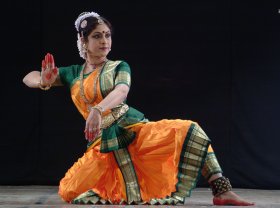 You are trained in Bharatanatyam and Kuchipudi. From when did you start experimenting with contemporary productions? One doesn't impact the other because of the tremendous early training at Kalakshetra. My foray into 'contemporary' productions began with 'Jonathan Livingston Seagull'. In 1992, many years after I read the book Jonathan Livingston Seagull by Richard Bach, I staged the same as a dance production. Initially I had approached this work with Carnatic music but found that it did not jell with the theme of a seagull's search for excellence. During this time I was also actively involved with English theatre. During rehearsals for the play, casual talk with other actors resulted in a jazz enthusiast becoming a friend. On hearing of my idea he compiled jazz music for staging Jonathan Livingston Seagull. I loved the idea and the music. My next problem was the dance style. My traditional Bharatanatyam, with its feet-stamping routine, I found, did not blend with the theme or the jazz music. Jonathan could fly and that was his life breath, and here I was trying to portray the expansiveness of the story in a dance form essentially time-based. So I abstracted from the Bharatanatyam format, eschewed the embellishments and choreographed this work. The dance style used the essential stances of Bharatanatyam, but I don't ever stamp my feet at all. Movements were invested with a contemporary feel, along with an overall feeling of lightness and flight. My next problem was costumes. The Bharatanatyam costume I felt could not be used. I experimented with six types of costumes before we finalised our design. Leotards with skirts, along with a kind of netting cape for the torso were chosen. The colours were white, blue and grey. The costume along with the movements simulated flying birds. I chose to have a plain dark backdrop and used lights to convey mood changes. The premiere received a standing ovation and was followed by many performances. I have also often presented this 60-minute work as part of a lecture series and book reviews for Jawaharlal Nehru Institute for Industrial Banking. This is one of my most favourite works. 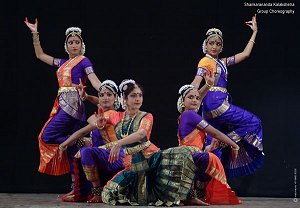 How did you go about ideating for subsequent productions? After that I have been exploring and experimenting both with form and content. Sometimes, I have abstracted from the classical form and sometimes, with the content - like in 'What About Me?' In 1999, we premiered What About Me? A dance theatre work on gender issues and triggered by many causes. In today's global world I am a composite of many cultural influences. My memories and life's experiences need to be reflected in my language - which is dance. My personal, political and social concerns need to find voice in my dance - for that's the way I speak, the only language I know. I as an artiste cannot live on the external fringes of society, irrelevant except as mundane entertainment. Sometimes I feel we artistes live on another orbit. My dance cannot just be pretty, beautiful and artistic. I need to voice my concerns. I need to integrate my artistic voice into the fabric of society. Thus I questioned myself: Can I divest myself from the problems that surround me? Can I live in an ivory tower and be just a pretty dancer? Can I relate to traditional poetry with contemporary sensibility? What About Me? Was my reaction to the scarring gender issues, that surround us. Can I be inured and unaware of happenings around me? Can I eschew and ignore gender issues, racial and religious violence, and caste polemics? Is dance a mere bread winner, a performing profession? Or is it my life breath? If it is my life breath, then I told myself, I cannot divide myself into neat compartments - espouse and speak up for causes dear to me but not relate them to my dance. Sure, to me dance exists on multiple levels, the physical, the esoteric and the spiritual. Sure, I relate indelibly to the jeevatma - paramatma theory and the bhakti bhava (devotion) in dance, training as I did from Kalakshetra. But, this search, this quest is a personal one. Yes, my art will lead me to spiritual upliftment, but my dance has also to touch base with the issues that surround me. I cannot look at the burnt face of a dowry victim and not allow it to find a voice in my dance. All these questions, particularly related to gender, translated themselves into a dance theatre production, 'What About Me?' This presentation of dance and theatre spans both legend and the present. By juxtaposing contemporary happenings with world-renowned stories in myth and legend it seeks, with today's perception, to raise questions. Using contemporary English Poetry written by a Tejdeep Kaur Menon, IG, Police, I raised questions on issues that bothered me. What I have done in this work is to raise questions, seek to trigger consciousness about inequalities. While I had earlier created works away from the usual dance repertoire, they were mostly esoteric and philosophical. This was the first time I was addressing social concerns. Besides showing contemporary social problems aesthetically in dance - problems such as female infanticide, dowry and rape - I had also to depict them through searing English poetry which I spoke on stage. We therefore built up the story gradually: a contemporary average everyday marriage; the obsession to have a son; the ill treatment of women, then and now; the stereotypes and the icons; questioning their position and treatment. I put the ideas together in a linear pattern, and went back and forth between the ancient epics and the present, comparing and contrasting, raising questions every time. I do not give answers to any of the questions asked, as I believe that these are issues for which every individual need to find their own answers. There are no tailor-made solutions. I concluded with the protagonist woman snapping out of asking the question 'What About Me?' Instead she decides on a different path when she says "Never will I ask 'What About Me?'" By this I conveyed her inner resilience, her inner strengths, and her capacity to break free of shackles and stereotypes. I showed her as a free soul, capable of standing on her own feet, crutch less. In this work I tread social issues - gender politics, and women studies. Here the style is Bharatanatyam, essentially, but content is not. What are the movement styles that you incorporate in your productions? You also use a lot of spoken words... Yes, in this work What About Me? I also use the spoken word - Tejdeep Kaur Menon's searing English Poetry - to which I emote or act with little of dance and more of elements from theatre. With this work, I also explored the inanimate and its capacity to portray a visual abstraction. The scene where Sita burns on a pyre depicted by Red Veils and the widow being wrapped in white by six women, I conveyed a powerful image, both visual and social. I use spoken word where necessary. In 'Dancing Tales...Panchatantra,' 'Darshanam - An Ode to the Eye' - the spoken word is only a link, a powerful one through - between episodes / scenes. What kind of theme inspires you when you start a new production? Through all my works, what I have been seeking is to find a visual vocabulary, which integrates the grammar and teaching of Bharatanatyam, with the metre and nuances of poetry, lyric, simultaneously with the expanse of the performing space. The visual vocabulary has been different every time. If it was kaleidoscopic movements in the early days, it has moved to abstraction and minimalistic movements now. Before I start a new work I have to be thoroughly inspired by an idea. This can come from any source - A book, a movie, a thought, a tear and a joke - anything. An issue must touch me, inspire me, bother me or tickle me! How do you balance your pure classical presentations and contemporary forays? Dance to me is my language, my philosophy, a process of life, a path to growth - intellectually, emotionally and spiritually. Having said that - I do exist in different compartments! I wear different hats. I am the same person who will do a Thyagaraja Ramayanam with utmost devotion to Sri Rama and I will also question Rama as the erring husband by Sita - 'Is Ramanjaneya not for Sita' in What About Me? So balance I do, because that's what we all do, regularly in life - Balance our training, upbringing and learning with today's world. As a classical dancer, while I preserve and add to a grand dance style, as a contemporary dancer - I am today's woman - living life in today's world - hence the engagement with contemporary issues - both serious and fun. You work as an officer in the railways. How are you able to balance home, career and dance? Is it easy to take days off when you perform outside Hyderabad or have to tour? Two worlds: My office was and is a very different world from my art world; however I find the differences healthy. My treading two such different tracks, me in both work spaces...I bring the organization and systems of bureaucracy to my dance and carry my sense of harmony, aesthetics and egalitarianism of the art world into my office space. But nothing, nothing whatsoever comes in the way of my dance. I continue to perform, teach and choreograph. Yes, I do a trapeze act and walk a very tight rope - balancing office leaves! Were you pleasantly surprised to be chosen for the Nritya Choodamani? How do you feel about the recognition? When I received the phone call from Mr. Yagnaraman, saying that Sri Krishna Gana Sabha had chosen to confer on me, the title of 'Nritya Choodamani' this year, I was spellbound and thrilled. The Nritya Choodamani title, to a dancer, is like manna from heaven. It is an award presented by connoisseurs of dance, who have been seeing your work and growth as a dancer, and choose to confer on you a prestigious title in recognition of that. It feels great to join the ranks of Dr Padma Subramanyam, Chitra Visweswaran, Anita Ratnam, Dhananjayans, Alarmel Valli and other luminaries in the field of dance. It is a validation of one's art and the direction that I have chosen to follow. What do you think in general about the awards and the Dec season in Chennai? Your comments also about how Chennai sabhas also honor artistes from outside Chennai. The December season is a fantastic festival - so unique and beautiful. The beauty of this festival is that it is majorly a private affair - hardly any Government support! That is something unique to Chennai. I love to come to Chennai to perform. I find here, a true recognition of talent. There is very little parochialism, or feelings of region or language that you often encounter elsewhere. The Chennai December season, is truly national and should be branded so! The sabhas do not look at an artiste as from outside Chennai - the bottom line is good work! I love the atmosphere here! You have quite a few performances lined up this season. As an artiste based in Hyderabad, how important is it for you to perform in Chennai during the season? Chennai is a wonderful place to perform. It is a validation of one's art and work. Do you think the proliferation of sabhas and too many performances presented across the city, is affecting the quality of performances? May be the festivals could be staggered, rather than telescoping into each other. This way crowds will not get spread thinly. I notice that new sabhas are holding festivals in different areas / colonies. This may be a good idea - keeping in mind the distances and the traffic! This way may be more youngsters will watch classical performances?? My worry: Why are dance audiences mostly bald or old?!! Where are the youngsters - the 20 something Generation Next? If this continues, what will happen 20 years hence? What is your advice to upcoming artistes? Stick with it: you are the recipient of a great blessing Wait a while: before you add 'choreographer' to your resume! Understand, learn and then explore new worlds. Do not clone: Find your own métier. Perform: Yes as much as you can - free lance with the right groups Band together as a new youth force - instead of backbiting behind each other. You guys will have to carry the baton forward. Contact: Dr. Ananda Shankar Jayant Shankarananda Kalakshetra C-52, Road No.10 Film Nagar, Jubilee Hills Hyderabad 500 033, India Ph: (91 - 40) - 2354 8384 / 23542378 e-mail: anandasj@rediffmail.com Website: anandashankarjayant.com |
