
|
    |
|
|
|


Praveen Kumar: Art runs in his veins - Lalitha Venkat, Chennai e-mail: lalvenkat@yahoo.com August 26, 2007 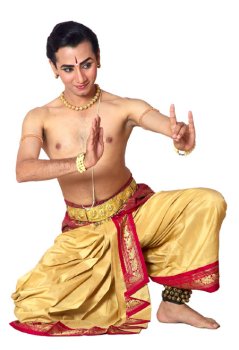 Natyarangam, the dance wing of Narada Gana Sabha presented its 11th annual Bharatanatyam festival from Aug 6 - 12, 2007 at Chennai. This year's theme was Kshetra Bharatham, on 11 places of pilgrimage in India involving 11 resource persons and 11 dancers. Bangalore based dancer Praveen Kumar took us on a pilgrimage of Pandharpur, known for its bhakthi movement and bhajans, as well as mythically and historically great traditions. The main lord of this city is Vittala (Lord Vishnu). Many saints like Namdev, Thukaram, Gyneshwar, Janoben and others have written 'abhangs' in praise of the lord and popularized them. R Krishnaswami, Secretary of Narada Gana Sabha, gave a brief outline of the fame and legends associated with Pandharpur. Praveen's recital included the invocation, a description of the lord, the pilgrimage to the banks of Chandrabhaga, the finding of baby Namadev, and concluded with Siva devotee Narahari's discovery that Siva and Panduranga Vithala are both manifestations of one truth. In a one man show, Praveen donned several roles effected by quick changes of headgear or tunic and this was greatly appreciated by the audience that filled the hall to near full capacity. Music was interspersed with easily understandable Marathi dialogues. Both the dance and music was of high quality and the story of Pandharpur presented in a neat, seamless fashion. A disciple of gurus Narmada and CV Chandrashekar, Praveen Kumar hails from a family of artists and thus art runs in his veins. Recognizing his potentialities, the Indian Council for Cultural Relations (ICCR) confirmed Praveen's selection on the panel of classical performing artists for the Indian cultural missions and festivals abroad. Praveen has won the first place at the national-level Seventh Yuva Sangeetha Nrithya Mahotsava organized by the South Central Zone Cultural Centre, Nagpur. He is an 'A' grade artist on television too. For more than a decade, Praveen has performed as a solo dancer as well as lent his choreographic skills to dance dramas received with much critical acclaim. Praveen runs a dance school called Chithkala School of Dance in Bangalore. He talks to narthaki.com about his participation in Kshetra Bharatham. 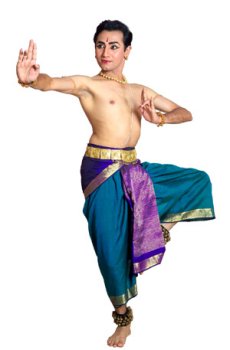 It was nice to see that 3 male dancers were given slots at the Kshetra Bharatham festival. Being from Bangalore, how did you manage to break the local lineup? Well, I was very happy and thrilled to have got a program in Natyarangam's annual dance festival. For me, it gave a great kick to see my name along with some very big and popular dancers. Me being a non-localite, I still don't know! Regarding Natyarangam's festival, I have always seen male dancers given slots in their dance festivals. Between you and your research person, how did you work out about how to go about the presentation? My resource person was Swami Namanandagiri, but I met him and discussed with him just two weeks before the program. The reason, he was busy travelling and our dates to meet didn't work. My work for Pandharpur started crazily. The moment I came to know it was Pandharpur, I knew it had to be abhangs. (Abhang is a form of devotional poetry sung in praise of lord Krishna, also known as Vithala). I had always heard this word, but never had any chance to listen to abhangs. So I went to a music shop and got all the available cassettes and CDs sung by many artists - in fact now I have so many that I have a mini store of abhang collection. Then came the story part. Initially I didn't know how to go about it so I just started collecting books on Pandharpur and went to websites regarding the place. I found so much information. Later, I started to note down those important points which could highlight the place and its characters. Mr. Krishnaswami and Charukesi helped me a lot. After I got my final script ready, I met my resource person. He was happy with it and blessed me to go ahead. Did you get any suggestions about the choreography / costume / music? Choreography is entirely my own. I also decided on what songs to use and what not to. Mr. Krishnaswami gave me the song for the third episode and suggested that it would help me for the story, so we used that. We used the original music for some of the songs by Pt. Bhimsen Joshi and Shyamlalji Bhave. For two other songs, vocalist Ganesh set the tune. I saw a lot of pics of Namdev, Thukaram and so on while doing my research. To lend authenticity to the characters, I used the Marathi type of turban. I also used the kartal (a pair of wooden clappers with small metal jingles) and the ektar, that one generally sees singers of abhangs use. A whole story being condensed into an 80 minute program must have been very challenging. What were the particular challenges you faced in your presentation? Like I said earlier, I had so many materials about the place it was very confusing as to where to start from (I always have a starting problem!). The only thing I was pretty sure was not to just do the abhang songs in a regular format. Then I decided to work on three aspects - geography, mythology and philosophy. That clicked in a way, and slowly things started to fall into place. I narrated the story like a guide taking a group of people through Pandharpur. This takes care of the geographical aspect. The people ask who is Namdev and the story of Namdev is told like a flashback. Every place has its mythology, so that aspect was narrated through the birth of Namdev and so on. The last story where the realization is made that Panduranga is a combination of both Vishnu and Shiva is the philosophical aspect of the story. Then came the choice of musicians. Generally we always have a Carnatic singer for our regular Bharatanatyam performances, but somewhere I felt that a Hindustani singer would be more apt for this subject and that's when I chose Ganesh Desai. He is an accomplished Hindustani singer, but he had never sung for any dance recital, so for me and him, it was a new experience because they are not used to our 'jathis' and sometimes you need to take the song immediately after the jathi, which he was not familiar with, so it was quite interesting and fun to work together. He cooperated and did wonders with his vocals. With male dancers having dwindling opportunities to perform solo, how did you feel dancing to a near full house in Chennai? Getting a full house in Chennai was a blessing in disguise. Actually I never expected that much crowd, because I know only few people in Chennai, so it was a big surprise to see a full hall and that too in Narada Gana Sabha. Actually, the day I landed in Chennai along with my musicians from Bangalore, I got the first dose at the railway station when they said there was an auto strike. I just looked up and said "PANDURANGA HELP!!!" Probably my request reached him and I had a full house. Initially when I started my performance, I didn't know there were so many people. Only later when it was curtain call, I realized that the hall was full. I was also happy because all the big gurus, dancers and art lovers were there and I believe they all enjoyed my performance; that mattered to me a great deal. Since most male dancers are seen only in group work, do you see the solo male dancer slowly disappearing from the dance scene? If you see right from the past, the male dancer ratio has always been less compared to female counterparts. Regarding disappearing, I don't think so, because nowadays you can see lot of male dancers in every city. Well, they being slotted to groups / solos is left to them to choose. When initially you keep waiting and look forward for performances to happen, it is very tough. That's when the decision has to be made whether you want to be a part of group performances or stick to your focus of being a soloist (I am sure it applies to female dancers also). I do agree, if you are concentrating on being a solo performer, your performances are restricted to few in a year, but in groups it is not so. So it all depends on what you want to choose! Also nowadays, there is a demand for male dancers abroad, so if things don't work out here, it works elsewhere! Why do you think talented male dancers are being generally overlooked by presenters, so they are being relegated to teacher roles even when they are still young? I still can't understand this logic. As to why many male dancers are overlooked... probably the organizer / presenters feel that they can draw a good crowd only with female dancers! Well, again it all depends on the organizers as to whom they are giving opportunity. Naturally when a male dancer gets overlooked for performances, the person who has taken dance as his profession needs to support himself / his family, so he relegates himself to be a teacher, which is lucrative. I believe in Chennai there are many male dancers giving classes for female dancers. On a lighter note, in a way it is good that many female dancers' success ratio can also be attributed to male teachers. All these factors apart, what do you think are the other challenges facing male dancers today? Whether male or female, every dancer is always facing some challenge in some way or the other. It all depends on how you deal or cope with it. You being an only child, how did your family react to your taking up dance as a profession? Many of my friends have faced opposition from their families for taking up dance as a profession but for me, I never went through that process since my whole family is into art. When I first announced that I wanted to take up dance professionally, my parents just gave me the green signal to go ahead. So did my cousins, aunts and uncles! They are all into art, so it was never an issue for me. It is believed generally that Bangalore has a better dance scenario / atmosphere than Chennai. Do you think that Bangalore is a better place for a male dancer to be in than Chennai? Every city has its plus and minus, so whether it is Bangalore, Chennai or Delhi, every city has its own share of limelight / disappointments. It's all an experience with different people / different city, so on and so forth... Contact: praveendance@hotmail.com |
