 |
    |
|
|


 Form in flow: Curvilinear Aesthetics and Ontological Logics in Odissi- Dr. Rohini Dandavatee-mail: dandavate2@gmail.com August 20, 2025 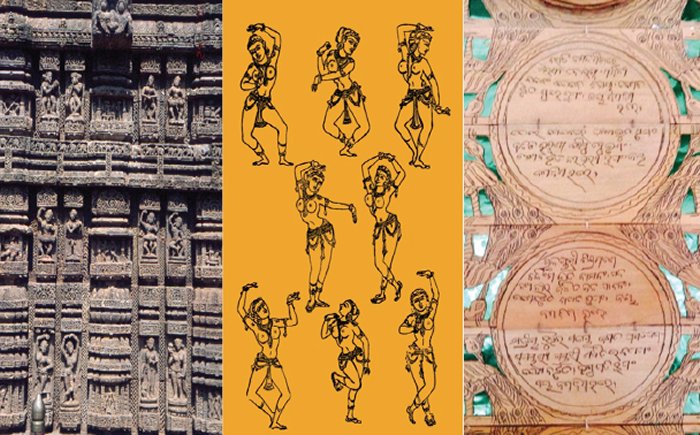 Curvilinearity in Odishan architecture & palm leaf manuscripts Introduction Growing up in Odisha and witnessing firsthand the legendary Gurus reconstruct the present-day form of Odissi, I carry vivid memories of their deep engagement with the region's temple traditions - particularly the intricate stone reliefs of the Konark Sun Temple and other sacred sites. As the accompanying visual references suggest, curvilinearity not only defined the region's built environment, but also shaped its artistic and performative traditions. Curvilinearity in Odisha isn't just about style - it is a cultural sensibility, deeply embedded in the aesthetic, spiritual, and material consciousness of the Odia people. When traced through temple architecture, Patachitra painting, filigree ornamentation, and even the Odia script, what emerges is a profound visual and conceptual coherence, grounded in an ethos of flow, fluidity, and sensuous form. This paper explores how curvilinear expression manifests across these domains and how it has profoundly influenced the signature grace and lyrical quality of the Odissi dance style. This curvilinear aesthetic finds one of its most enduring and foundational expressions in the sacred architecture of Odisha, where temples themselves become monumental embodiments of this visual philosophy. Curvilinearity in Odia Temple Architecture Odisha's temples are marked by a distinctive curvilinear verticality and rich ornamental detail. For example, in the Jagannath Temple in Puri, the Rekha Deula - the towering spire above the sanctum (garbhagriha) - is not a straight shikhara as seen in the Nagara style, but a gently curving vertical form, rising in arcs reminiscent of a flame or a mountain, symbolizing spiritual ascent. The Jagamohana and the Natamandira, the adjoining halls employ sloping pyramidal roofs, which soften the architectural transitions and enhance the sense of flow. The temple surfaces are adorned with intricately carved apsaras, deities, and dancers, depicted in sensuous, dynamic poses full of implied motion and emotional nuance, echoing the gestural language of Odissi dance. The entire temple layout possesses an organic, womb-like spatiality, more intuitive than geometrically rigid. Overall, in the temple architecture in Odisha, curvilinear lines are not simply ornamental. They constitute the very foundation of the sacred architecture's structural and symbolic logic. This curvilinear aesthetic, so central to the structure and symbolism of temple architecture finds a parallel in Odisha's visual traditions as well, most notably in Patachitra painting, where flowing lines and sinuous forms animate mythological narratives with the same rhythmic vitality found in stone and dance. Curvilinearity in Patachitra painting 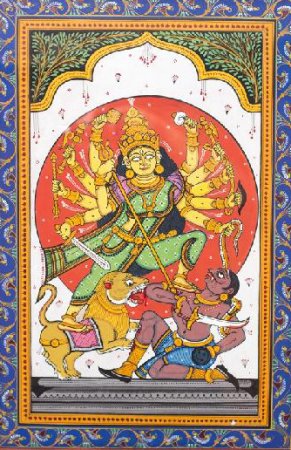 Patachitra painting Similar to the temple aesthetics, Patachitra, the traditional cloth-based scroll painting from Odisha, mirrors the same design philosophy. The outlines in Patachitra are often drawn with a single brush stroke, displaying confidence and fluidity. Figures are enclosed in rounded contours, never angular. In the composition of the painting, whether illustrating the Jagannath triad, mythological narrative, or folklore, the configuration is circular or concentric, with movement spiraling inward or outward - suggesting cyclical time and divine harmony. The elaborate borders flow like garlands around the central theme, reinforce an enveloping rhythm in the artwork. 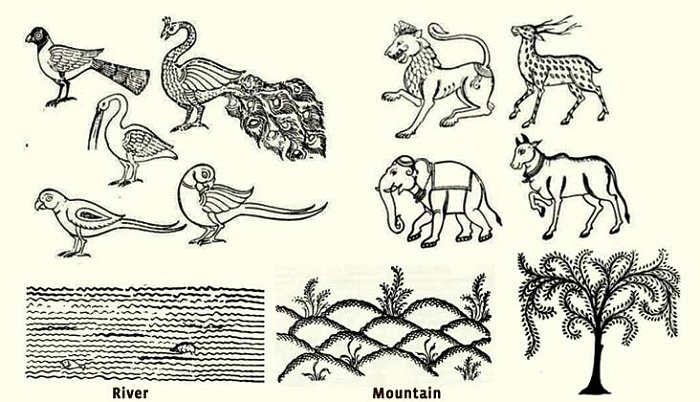 Motifs from Patachitra paintings This shared curvilinear aesthetic extends seamlessly from the grand scale of temple architecture and the intricate rhythms of Patachitra painting to the very script of the Odia language, where rounded, looping characters echo the same sensibility of flow, softness, and organic form. Curvilinearity in the Odia script and Filigree ornaments 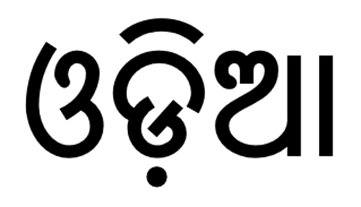 Odia script The Odia script is one of the most recognizably curvilinear among the Indic scripts - a quality that is both historically and culturally determined. Traditionally, Odia was written on palm leaves (talapatra), a fragile surface where straight lines could easily tear the material. As a result, rounded letter forms were developed to ensure durability and legibility, giving rise to a script composed of circular, looping characters that feel more drawn than constructed. Visually, the script echoes the arcs of temple architecture and the gestural fluidity of Odissi dance and Patachitra painting. Designs in Filigree work 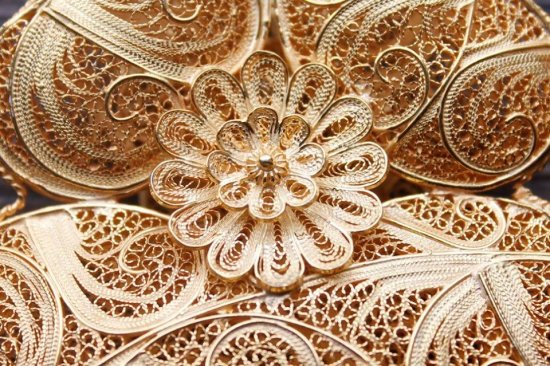 A similar curvilinear sensibility is reflected in the silver filigree tradition of Odisha, known as Tarakasi. This exquisite craft translates the aesthetic of the curve into intimate, wearable forms of art. Filigree ornament designs are composed of delicate scrolls, spirals, and looping lines, enveloping the body with the same graceful fluidity, rhythmic detail, and sensuous intricacy found in larger artistic traditions. Across all these creative expressions - script, ornament, architecture, painting, and dance - emerges a consistent cultural tendency toward the integration of movement and stillness. Whether in stone (temples), paint (Patachitra), or dance (Odissi), the dynamic is rendered still, and the static is imbued with movement. There is also a deep sensory richness to curvilinearity: it invites the eye to travel, encouraging us to experience form as a journey rather than a fixed point of focus. Finally, the curve carries a potent spiritual metaphor, symbolizing continuity, cyclical time, and the divine embrace, in contrast to the linear, segmented, and rational forms often associated with other design logics. 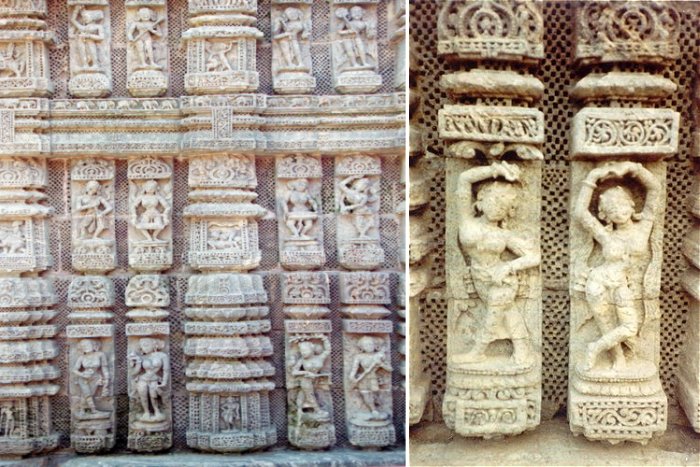 Panel from Konark Temple. Photo Credit: Shailan Parker Considering that curvilinearity lies at the heart of Odishan artistic and architectural traditions, it is only natural that this sensibility deeply influenced the choreographic imagination of the Gurus who reconstructed Odissi dance. Through meticulous study of sculptural forms and a deep engagement with regional creative expressions, Gurus uncovered and employed a codified system of postures and gestures in their revival of the Odissi dance style. Two primary positions emerged as foundational: the Chowk, a square, grounded stance symbolizing strength and stability; and the Tribhaṅga, a three-bend pose that creates the iconic S-curve - both of which became central to Odissi's visual and kinesthetic identity. This revival was not a return to tradition but a reconstruction process which involved the careful synthesis of multiple knowledge systems which included ritual practices, detailed visual analysis of temple sculptures (especially at Konark), and engagement with classical textual sources such as the Natya Shastra, Abhinaya Darpana, and other regional treatises. Rather than treating these sources as static repositories of tradition, the Gurus approached them as living materials - to be interpreted, embodied, and transformed. Through this interdisciplinary engagement, they reconstructed a dance form that was ritualistic in origin, yet reimagined for the proscenium stage and relevant to the modern cultural landscape.The outcome was a dance vocabulary that preserved the spiritual and aesthetic ethos of Odisha, while also emphasizing sculptural lines, curvilinear movement, and expressive storytelling. 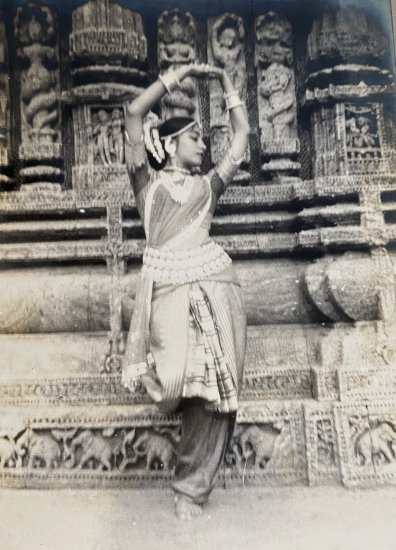 Dance posture (bhangi) emulated from the stone carvings of Konark. Photo: Dr.Rohini Dandavate Drawing from my lifelong practice and embodied engagement with this tradition of dance, I observed and therefore propose that Odissi's movement language exemplifies what architectural theorists describe as the anexact: a form that resists rigid geometry without collapsing into formlessness - responsive, emergent, and irreducible to static representation. In architecture, anexact geometries or forms are used to describe the "amorphousness and undecidability" of real-world matter, especially where architecture must grapple with organic, complex, or indeterminate shapes that resist simple geometric reduction. Odissi also unfolds within what Deleuze and Guattari term smooth space - a dynamic, non-striated spatiality aligned with Indian aesthetic frameworks rooted in rasa (aesthetic flavor) and bhava (emotional tone). Through this lens, Odissi becomes not just a dance form, but a type of kinetic architecture - an embodied spatial practice modeling complexity, fluidity, and contextual sensitivity. Contemporary architectural theorists like Greg Lynn offer valuable insight into the aesthetic logic that resonates with the curvilinear grammar of Odissi. In his theorization of anexact architecture, Lynn defines a mode of form-making that resists rigid geometry without descending into chaos - favoring fluid, responsive, and emergent forms shaped by context and material logic. Odissi's movement vocabulary, particularly its use of spirals, S-curves, and non-linear transitions between postures, exemplifies this "anexact" quality: the body moves not through rigid codification but through kinesthetic intelligence, where gesture unfolds as form and form as feeling. This kinesthetic and visual logic aligns as well with the work of Elizabeth J. Petcu, whose study of amorphous ornament challenges the traditional boundary between structure and decoration in architecture. She highlights how ornamentation in certain architectural traditions - especially those rich in sculptural detail - functions not merely as surface embellishment but as a generative, formal language in itself. Odissi, similarly, blurs the distinction between ornament and structure. The dancer's body is at once the medium of spiritual expression and the sculptural form animated by rhythm and emotion. Like the filigreed temple surface or the fluid stone relief, Odissi renders ornament mobile, embodied, and experiential. Chowka and Tribhanga: The geometrically rigid and the Anexact In Odissi dance, Chowka and Tribhanga the two main postures are not merely contrasting but they represent two fundamentally different geometric and philosophical logics of embodiment. Chowka: The geometrically rigid Sequence from a choreographic work on a song of Meera Bai.  Dancer, Dr. Kaustavi Sarkar in this movement sequence describes the engulfing dark clouds, using the position of 'Chowk' using Anga (body) bhramari (circular movement of the body). Chowka is rooted in symmetry, with right angles, and structural clarity. It approximates a square in both stance and energy. The alignment of limbs, the bent knees, the squared hips and shoulders - all articulate a body that is anchored, stable, and governed by precision. This posture resonates with the idea of geometric rigidity, where:
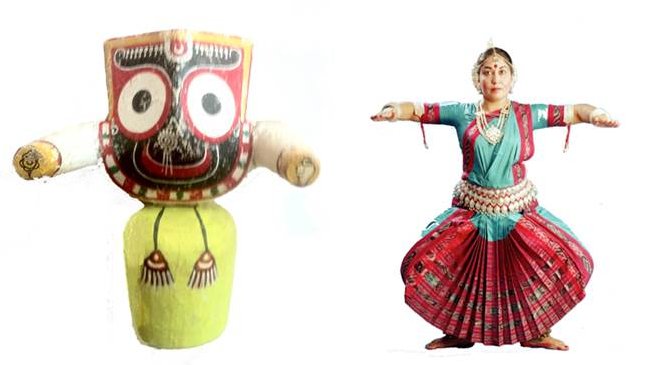 Chowka In this sense, Chowka aligns with the architectural idea of the exact - a form that can be drawn, measured, replicated. It is a rigid grid, a container of power and discipline, embodying the masculine and the formal. Tribhanga: The Anexact in motion By contrast, Tribhanga - with its iconic bends at the neck, torso, and knee - disrupts linearity and symmetry. It introduces torsion, curve, and asymmetry without forgoing coherence. This form operates within a logic of structured asymmetry. Sequence from a choreographic work on a song of Meera Bai.  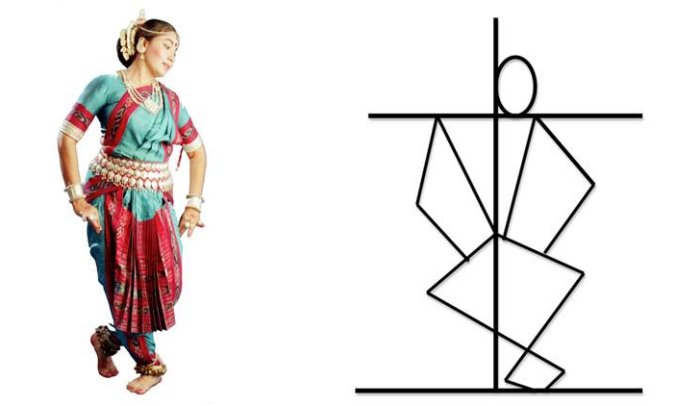 Tribhangi Here, the Deleuzian concept of the anexact becomes a fitting philosophical lens. As Gilles Deleuze and Félix Guattari describe in A Thousand Plateaus, the anexact is: "neither exact like a metric form nor inexact like a vague sketch, but a precise vagueness guided by affect, force, and rhythm." Tribhanga belongs to this realm of fluid precision. It cannot be reduced to static lines or perfect measurements. Its geometry is embodied, improvisational, and affective. Rather than following a rigid blueprint, its shape unfolds through motion, emotion, and presence. Embodied Geometry: Between structure and flow Chowka might be likened to the temple mandala or Vastu grid - a form grounded in cosmic order and ritual clarity. Tribhanga, by contrast, echoes the erotic sculpture adorning the temple's exterior - fluid, emotive, and evocative of life in motion. Both are essential:
Together, they create a dynamic dialectic between form and movement, rigidity and flow, precision and improvisation. The reconstructed movement patterns of Odissi can be understood through the lens of Greg Lynn's concept of the anexact and Elizabeth J. Petcu's exploration of ornament as generative form. The signature S-curve of the tribhaṅga, drawn from stone yet animated through breath and rhythm, exemplifies how Odissi resists rigid codification while remaining structurally coherent - fluid, yet not formless. In this sense, Odissi enacts what Deleuze and Guattari term "smooth space": a spatial field not determined by rigid coordinates but by emotive flow, narrative logic, and bodily memory. The dancer, as a spatial practitioner, generates space through gesture, creating meaning through subtle shifts and curves. This movement language, shaped by cultural and architectural lineage, cannot be detached from its context without losing its ontological grounding. The reconstruction of Odissi in the mid-20th century was deeply informed by the stone sculptures of Odisha's temple architecture, particularly at Konark. These reliefs depict dancing figures in dynamic poses that emphasize curves, twists, and organic continuity - forms that the revived Odissi consciously emulates. The reconstruction process involved translating these static, smooth sculptural forms into living motion, ensuring that the qualities of flow, rhythm, and asymmetry were preserved. Odissi offers a compelling model of how form, space, and emotion can be integrated into a non-reductive aesthetic system. Through the lens of the anexact and smooth space, Odissi reveals itself not merely as a historical performance tradition, but as a dynamic spatial practice - deeply contextual, fluid, and philosophically resonant. As Odissi evolves in contemporary practice - often hybridized with classical ballet, yoga, or modern dance - there is a growing risk that its curvilinear grammar may be flattened or aestheticized, detaching form from its deeper architectural and spiritual roots. Yet, the anexact offers a framework for innovation without erasure: a way of evolving the form while honoring its sculptural origins and cultural resonance. In Odissi, curvilinearity is not ornamental - it is ontological, expressing a worldview where space is lived, relational, and charged with meaning. Citations
 Dr. Rohini Dandavate is an Odissi dancer, choreographer, and educator with over four decades of experience across India, Europe, and the U.S. Trained at Kala Vikash Kendra under Gurus Kelucharan Mohapatra, Raghunath Dutta, and Ramani Ranjan Jena, she brings a strong classical foundation to her work in performance, pedagogy, and intercultural dialogue. She holds a Ph.D. in Cultural Policy and Arts Administration from The Ohio State University. In the U.S., she has taught at Denison University, served as an Artist-in-Education with the Ohio Arts Council, and developed multimedia learning tools for Odissi training. A recipient of fellowships from the Ohio Arts Council, Asian Cultural Council, and India's Department of Culture, Dr. Dandavate continues to perform, publish, and collaborate - exploring new possibilities in Odissi through both creative and academic practice. Post your comments Pl provide your name and email id along with your comment. All appropriate comments posted with name and email id in the blog will be featured in the site. |
