 |
    |
|
|


 Art as labor: Toward sustainable models for independent artists- Adhirai Karthike-mail: adhiraikarthik08@gmail.com September 14, 2025 Stepping into the vibrant and colorful atmosphere of Room 213, I heard the voices and laughter of my classmates as they playfully played on the pianos and instruments scattered across the room and gleefully harmonized with their classmates on a new song they were composing. For myself, the world of choir had always been a constant in my life and the investment in the arts had, in my mind, been always present. As we slowly quieted down and quickly rushed to our risers, whispering excitedly as we prepared to begin our warm-ups, I began to notice a difference: something wasn't right. Today, amidst all the laughter, there was tension. Subtle but unmistakable. I watched as our teacher emerged from the classroom and time slowed a little, all the murmurs slowly dissipated and dissolved until I could only hear the shallow breath of my own voice, anxiously leaning in to unravel the millions of little intricacies hidden behind her saddened smile. Her eyes dampened and her hands clasped as she took a quick breath before beginning to speak. "I need to share something with you all," she said gently. What followed was more than just an announcement - it was a glimpse into the quiet erosion of an arts program I had always taken for granted. She began to explain the changes implemented in our choir system for the next year. Due to statewide arts funding cuts, many of our choir events that had continuously filled our choir department with creativity and exploration had been cut and our teacher had to take on a second job teaching the middle school choir, cutting down on the effectiveness and vibrancy of her choirs. These changes didn't just affect the teachers, they impacted the students as well. According to a study published in the Journal of Educational Psychology, high school students who continued their involvement in music ended up academically performing very well and scoring significantly high in their academics. In many school subjects including math, science, and English, the musically oriented ended up performing academically ahead of their non-musically oriented peers, regardless of their socioeconomic background or prior achievement. Their ability to fine tune their listening skills, music notation, and teamwork efforts for playing in an ensemble enables them to strengthen their cognitive and motivational skills, thus increasing their academic intelligence. However, with these cuts that opportunity was slipping away. The losses of these programs weren't just about missing concerts, they were about reducing the ability for children to find an environment they can grow in, academically and personally. Our choir teacher's words hung in the air with a sense of urgency and disappointment, letting us see a side of her that was frustrated by these budget cuts. It slowly dawned on me that the quiet struggles witnessed in Room 213 echoed beyond its borders, across the country, the reflection of a much larger issue: the systemic underfunding and undervaluing of the arts. I revisited these ideas again as I attended and participated in Matrusena's Interbeing - a 3-part performance with the beginning starting as a vibrant panel discussion featuring six interdisciplinary panelists where these artists discussed their disciplines and their shared struggles and strategies for survival in the art industry. However, they weren't just talking about ideas in theory - they were living the very realities my teacher had voiced: how artists must constantly fight to fund their work, sustain their practice, and support themselves simultaneously. As Deepa Mahadevan framed it, the true challenge is not just making the art, but maintaining "the project, the art form, and the artist." 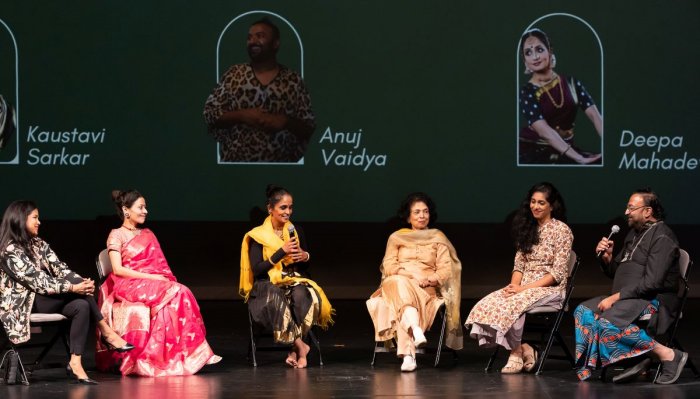 L to R: Usha Srinivasan, Kaustavi Sarkar, Deepa Mahadevan, Maya Kulkarni, Nadhi Thekkek, Anuj Vaidya Taking lessons from the six panelists in Matrusena's Interbeing dialogue, the paper is divided into two halves: the first half engages with Nadhi Thekkek, Maya Kulkarni and Kaustavi Sarkar who adopt a product-based approach through their art and share funding strategies that have worked for them. The second half explores the work of Anuj Vaidya and Usha Srinivasan who create work with the audience / community and carry their art using a more process driven approach. Here, unlike the product driven approach, the focus travels from the product to the community, its value generated by community engagement and cultivated togetherness. Through the examination of both product and process-based art practices and hybrid models that echo collaboration, we will explore alternative economic models for independent artists, considering national arts initiatives are threatened. The panelists on this particular day include:
Nadhi Thekkek opened the discussion as she explained product-based work where the onus for generating funds is vested in the creator of the artistic work. Especially in the Indian dance field where art is conflated as a cultural heritage and tradition, people end up undermining the importance of the actual artistic labor. For instance, for an art project to come alive, the resources needed would include renting a theater, having music, having a script writer, doing the marketing, finding the props and costumes, and selling tickets to name a few. Thus, you are paying the professionals involved in all of these different fields of work. But the one person who is most involved in this creative endeavor - from beginning to end - is the choreographer who - in most Indian productions - doubles up to be the lead performer and dancer. However, you don't need just one lead performer; you need to recruit several quality dancers to the ensemble to create a rigorous artistic product. When you add all of these elements together, the true cost of the product emerges. For a community that has always looked at art as cultural capital and treasured as tradition, the labor of dancers is taken for granted, meaning it is not monetized. One of the main aims of Nava Dance Company, Nadhi says, is to pay the dancers the market rate. Normally, a typical project takes at least 2 years to develop with a minimum of 10 hours of dance labor each week. As Nadhi adds, "The ticket sales are just not going to cut it anymore." To combat this issue, for certain specific projects, she uses crowdfunding through Kickstart and Indiegogo. But, on an ongoing basis, Nava Dance Company asks donations from the public every year to build a seed capital for their future projects in addition to looking for local grants. For instance, Thakkek with her co-collaborator, Shruti Abhishekk, presented "This is Work Too" for Matrusena's Interbeing through funding from the Rainen Foundation and Zellerbach. Using the work samples created for them, they applied for larger grants like New Music USA, East Bay Community Fund, MAP Fund, and NFIA. However, Nadhi Thekkek wasn't the only artist in the discussion who believed in this product-based approach for their work. In fact, Kaustavi Sarkar, a known Odissi dancer and researcher explained during the panel discussion that she also used this approach and discussed how her creative impetus is firmly grounded in deep, rigorous academic research. During the panel, Sarkar expressed her particular enjoyment for exploring Indian classical dance practices through a contemporary lens, seeing how these traditions begin to shift once orthodoxies are questioned. It is precisely this merging between traditional artistic practices and more modern concepts like social justice that Sarkar can exercise her thirst for scholarly inquiry. For example, in her first NEA grant in collaboration with Dr. Ananya Chatterjea, a professor of dance at the University of Minnesota, Sarkar explores how movement research can expand and redefine the meaning of social justice. Similarly, her love for both dance practice and academic research has led her to pursue additional regional grants such as the Ohio Arts Council, the North Carolina Arts, and even the NEA. Maya Kulkarni, another product-based artist, draws much of her inspiration from literature and poetry which most times, doesn't align nor have an angle concerning social justice and equity that are largely favored by fund-making organizations. However, she is largely removed from the actual sourcing of funds as she works with advanced dance practitioners who look up to her for choreographing their arts projects. Many of these artists run their own dance institutions and rely on incumbent funds that the dance schools accumulate to fund their projects. For instance, Kulkarni has partnered with choreographers like Bharathi Penneswaran of the Aalokam School of Dance, Sonali Skandan of Jiva Performing Arts, and Deepa Mahadevan from Tiruchitrambalam School of Dance, to name a few. Many of these seasoned practitioners also double up as teachers and bring the money earned through their teaching to fund their own projects with choreographers like Kulkarni. Unlike the previous artists we discussed before, Usha Srinivasan speaks of another type of approach: process-based artistic practices. Just to review, in this case, the goal is to create connection between the performers and the community, achieving a collaboration between everyone involved in the artistic work, from the set designers to the little children watching from the audience. During the panel, Usha discussed many different ways she used the process-based approach in order to prioritize community impact instead of just creating a final product. For example, using a $100,000 grant funded by the San Francisco Foundation's Creative Corps with $75,000 directly paying artists, Usha engaged east-Asian elderly, language-isolationed residents in supportive housings. Usha recruited Tai Chi instructors, calligraphy artists, and Mandarin and Vietnamese story-tellers to conduct workshops, bridging the gap between communities and health providers, improving access to services like Medi-Cal. Through this community bonding, she was able to not only attract funding to arts organizations, but also to public health, aging and social impact sectors. Similarly, in Saratoga, Usha led a commission called "Strings and Bow" performed by a sitar player, a Chinese pipa player and a cello player. Usha was able to use the local library multipurpose room for this performance, reducing the need for buying a costly venue. In addition, because of the use of the library, no additional fundraising was needed because libraries naturally bring in guests 24/7. In this performance, multiple traditions and cultures were combined, offering many different ethnicities the ability to appreciate different cultural musical practices that they might not have been previously exposed to. This approach qualified for local cultural engagement funding as the venue choice, context and performance was extremely fundable and didn't require any costly elements. Additionally, Usha also touched on many other concrete funding strategies that could be adopted by dancers who would like to fund their artistic visions:
Similar to Usha Srinivasan, Anuj Vaidya explores funding using this process–based approach to apply to a range of venues and budget levels for designing performances that are interdisciplinary and adaptable. For example, his work Ganga Satellite was constantly adapted to fit the many different venues and time limits required: a 90-minute stage production, a 15-minute solo for living rooms, as well as public-infused showcases shown at sidewalks, porches and libraries. Thus, he is able to reach many different spaces and many different audiences without having very high costs. However, Anuj also finds that he can apply and receive many grants when working on more interdisciplinary collaborations with environmental scientists, somatic practitioners as well as public health researchers. He also looks to seek funding outside of the arts including from university research centers, departments of health and climate-focused nonprofits. By reforming his performances as pedagogy, he makes his audience his participants which can be very appealing for funders who would like to see community impact and engagement. As an artist myself, just embarking into the world of independent art making, this panel discussion, envisioned and conducted by the founder/director of Matrusena, Dr. Deepa Mahadevan, opens up multiple pathways of looking at sustaining art. Especially at times like this, funding options are withdrawn. These product and process based methods shared by seasoned art practitioners, researchers, curators and promoters gives artists like me, and my choir teacher, concrete foundational steps to come up with our funding strategies. This paper will be a valuable resource to artists and for someone who is approaching business as my field of study, grant finding and other sources of funding retrieval could be a foundational idea for my business venture. Is anyone up to fund my business idea?  Adhirai Karthik is a senior at Ridge High School in Basking Ridge, NJ. She has been learning Bharatanatyam for 13 years under the guidance of her mother, Dr. Deepa Mahadevan. She is the founder of Natya Mayuri, a student-led dance organization and also serves as an artist liaison and student researcher at the nonprofit Matrusena. Post your comments Pl provide your name and email id along with your comment. All appropriate comments posted with name and email id in the blog will be featured in the site. |
