 |
    |
|
|


THE DHANANJAYANS compiled by Lalitha Venkat Mar 2002 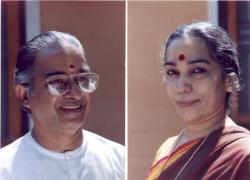 Vannadil Pudiyaveettil Dhananjayan and wife Shanta Dhananjayan, popularly known as the Dhananjayans have become one of the legendary dancing couples of India. Dhananjayan was born on 30th April 1939 in Payyannur Kerala. An Economics graduate, he joined the Kalakshetra on 5th October 1953. He has a Post Graduate Diploma in Dance (Bharatanatyam & Kathakali) with distinction from Kalakshetra, Madras and was a leading male dancer under Rukmini Devi (Founder, Kalakshetra) from 1955 to 1967. 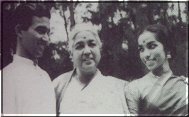 Dhananjayans with Rukmini
Devi
Dhananjayan was born into a poor family, but he had a flair for Sanskrit dramas. As a youngster he had seen the occasional Kathakali performance in his village. His father happened to meet Chandu Panicker, who was teaching then at Kalakshetra, in a train compartment, when the latter was looking for a boy to be trained as per Rukmini Devi's wishes. Even though Chandu Panicker had already selected Balagopal from the same village, Dhananjayan's father requested that his son be taken along too and if he did not meet with Rukmini Devi's qualifications, to send him back. Fortunately, not only was he accepted, but he was also given a scholarship to study at Kalakshetra where the rigors of his education and way of life prepared him to meet the challenges of life as a dancer later on. Shanta Dhananjayan born on 12th August 1943, joined Kalakshetra after finishing her schooling in June 1952. She has a Post Graduate Diploma with distinction in Bharathanatyam and Kathakali from Kalakshetra and was a leading female dancer from 1955 till 1968. 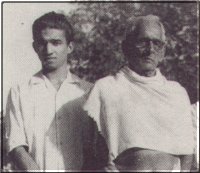 Dhananjayan with Chandu
panicker
Chandu Panicker taught Kathakali and Sarada Hoffman taught Bharatanatyam. The training imparted at Kalakshetra was painstakingly precise and the dance dramas produced there taught the students set designing, discipline and administrative acumen. The Dhananjayans have served as performing artistes and teachers in the Dance and Academic Faculty in Kalakshetra. DANCING DUO - THE AWESOME TWOSOME 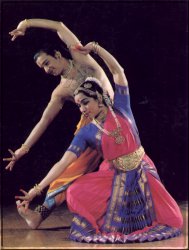 When Guru Chandu Panicker was taking the 2 boys Balagopal and Dhananjayan to meet Rukmini Devi, Dhananjayan saw the 10-year-old Shanta for the first time at the Theosophical Society gardens. Shanta was a serious girl totally devoted to her dance and she made up her mind even at the age of 12 to marry Dhananjayan though she did not reveal her feelings to him. They were later paired as Rama and Sita in 'Sita Swayamvaram'. Dhananjayan has played the role of Arjuna when 93-year-old Chandu Panickar played the role of Santhanagopalan in the premises of the Subramanya Temple in Payyanur. Dhananjayan on his part made his feelings clear to her when he was 18, but Shanta kept him in suspense and he thought maybe she did not wish to marry someone lower in economic status. Shanta left Kalakshetra after her post graduation and took up a job in Malaysia. When her parents started to look for an alliance for her, she revealed her interest in Dhananjayan and returned to India to marry him. They do not experience any conflicts in dance because of the mutual understanding, which has grown over the years. So, they complement each other beautifully in their personal life as well as in their dance career. Dhananjayan is 62 now, but he and Shanta still continue to enthrall audiences all over the world. Despite dancing together for 50 years, they manage to keep routine and boredom at bay by working on varied themes, involving themselves in different projects, collaborations and workshops apart from being totally involved in guiding their students' recitals. Dividing their time between Bharata Kalanjali in Chennai and Bhaaskara in Kerala, keeps them busy year round. The varied activities, which take up so much time and energy, keep their spirits vitalized and their outlook fresh. The Dhananjayans have 2 sons. The elder lives in the USA while the younger son Satyajit who's a good dancer is carving out a niche for himself as a photographer. BHARATA KALANJALI "Teaching is a great education. Shanta and I are learning all the time while teaching" - Dhananjayan 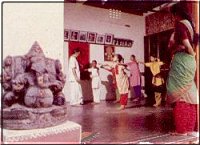 While in Kalakshetra, Dhananjayan proved to be a hard-working and creative dancer and a shrewd administrator. But his outspoken nature made things difficult and he quit Kalakshetra after marrying Shantha. As a dancing couple, they faced enormous opposition in the following years. They had a lot of ideas and wanted to propagate them. It was an uphill task for them when they started their own academy Bharata Kalanjali in Madras in 1968, in a small thatched cottage with just one student who was Chittilakshmi, a cousin of Yamini Krishnamurthy. But through it all, they worked hard to fulfill their aspirations to make their school internationally recognized as one of the premier institutions for dance training. When they presented their international collaboration Jungle Book based on Rudyard Kipling's work, westerners started to recognize the magnetism of Bharatanatyam as an art. In their choreography, they try new things but not at the cost of giving up tradition. The mode of interpretation may differ, but the undercurrent of tradition is retained. Dhananjayan feels performing Kalari or yoga on stage is not Bharatanatyam and the deliberate attempts at assassinating Bharatanatyam should be countered. The foundations of their teaching are the 3-D's which are discipline, devotion and dedication. Deeply involved in their students' recitals, they try and plan out different combinations and methods of presentation for their students. They change an old repertoire by accommodating new challenges and situations. They encourage senior students to attempt their own choreography. Some attempts have been so good that the gurus themselves have been credited with the choreography, which proves the high level of training imparted at Bharata Kalanjali. Bharata Kalanjali has also trained many members of dance orchestra, who are professionally engaged by other dance fraternity. In Bharata Kalanjali research scholars are enrolled through International educational foundations such as Fulbright Scholarship holders and other University students. Government of India Merit Scholarship holders are sent here for higher studies and Bharata Kalanjali receives regular ICCR (Indian Council for Cultural Relations) scholarship holders from abroad. Bharata Kalanjali has many teachers on their faculty and enrolls the largest number of male students. The dancers are hired by other Institutions to participate in their productions as well as for teaching. Bharata Kalanjali has students from different parts of the world and training is given not only in dance, but also in culture-oriented lessons. It has branches in different parts of the city and country, classes operated individually by senior faculty members, who are otherwise attached to the Institution. Bharata Kalanjali alumni have well established dance schools in different parts of USA, Japan, UK, Germany, Spain, Sri Lanka, Malaysia, Singapore and Australia. These teachers visit Bharata Kalanjali regularly for reorientation courses. The Dhananjayans and some of the teaching staff are invited to conduct short and long term intensive courses in these countries. So periodically there is exchange and inter-action between the main institution and its branches. A good example is the Natya-Adyayana-Gurukula (summer dance camp) conducted by the Dhananjayans since 1988 at Satchidananda Ashram organised by the Fine Arts Society of Yogaville, Virginia. THEIR DREAM PROJECT - BHAASKARA (The Sun) 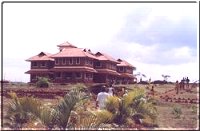 When Dhananjayan turned 60, he wanted to open a school in his hometown Payyanur to give the rural children art integrated quality education into which he put all his life's savings. He chanced upon the spot when his taxi broke down near a hillock. BHAARATEEYA SAAMSKAARIKA KALAA RANGAM (BHAASKARA) center for art, culture & education is a monumental project similar to Kalakshetra (Chennai) and Viswabharati (Shanti Niketan) Bengal. It came up after a divination ceremony at a nearby temple, which owned the land and indicated that the barren area would thrive with the coming up of a school. The temple trustees readily sold it to Dhananjayan. The Dhananjayans during their lifetime assimilated artistic style, tradition and values from various masters and gurus, and have created a niche for themselves in their chosen field. Today with Bhaaskara, they hope to share with the world at large, the rich heritage they have accumulated over the years. Already working in a small way, the Dhananjayans have worked hard to elicit support from various artists. The institution is spread over 40 odd acres in the sylvan surroundings of Kerala and has an ambience of greenery, clean air and water. When first bought, the place was barren and they have planted nearly 7500 trees all around the hillock, which looks out on valleys on all 4 sides, witness to glorious sunrises and sunsets. There are 36 varieties of medicinal herbs also growing here. The surroundings and environment is all aimed at giving the future generation a wholesome appreciation of art along with understanding of traditional values and appreciating the beauty of nature. The centre envisages a true value oriented, non-formal education integrated with fine arts, combined with academic course from standard one to twelve, leading to University education. Every form of art is to be taught to the students, but apart from the academic curriculum. 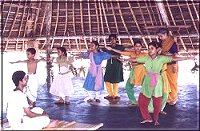 The residential gurukulam will impart training in Kathakali, Bharatanatyam, Carnatic music, painting, sculpture and folk art. Sanskrit is a compulsory subject and caring for the plants on the campus forms an integral part of their education. Students also recite Hindu, Muslim and Christian prayers everyday. Bhaaskara and Bharata Kalanjali have jointly conducted the Gurukulam camps at the Bhaaskara campus in 2000 & 2001. Dhananjayan hopes to convert the hill slope into an open-air auditorium, and host international festivals. He also wants to build a well-appointed performing hall in the kootambalam (temple stage) tradition, a fully equipped theatre of international standard with Indian architecture and aesthetics. Audio and video recording studios, library of books, audio and video cassettes, photographs of great artistes of India, exhibition hall are some of the features of the proposed centre. BHAASKARA will also be a place for reviving the dying crafts of Kerala. There is a plan to build a craft village in the premises. Crafts like the making of Kathakali crowns and other Kerala handicrafts like bronze statues, wood carvings and temple jewellery, musical instruments for dance and music will be promoted in due course with other collaborators interested in the field. DANCE PRODUCTIONS Bharatakalanjali has produced more than thirty dance productions, winning high praise and acclaim in the International art scene. They work on different themes, some of which culminate into dance dramas. The Dhananjayans have collaborated with National and International choreographers and Institutes to produce monumental theatrical ventures, which have won them many prestigious National and International Awards. They have collaborated with world-renowned sitarist Pandit Ravi Shankar, and New York dancer Jacques D'Amboise, among others. They have been invited to perform at the India Festival in the Soviet Union and at the Birmingham Touring Opera House of England. The Dhananjayans have been sent abroad by the Government of India on several occasions to represent Indian dance on prestigious occasions like the Festival of Indian Arts in USSR. Major International Dance Collaborations / Productions * Pt. Ravishankar's Magnum Opus "GHANASHYAM" (1989/90) was choreographed by Dhananjayan. This is a fusion of music, dance, mime and opera. A unique production commissioned by Birmingham Touring opera house U K. * National Dance Institute, New York "CHAKRA", with a cast of 1,000 multinational children * A joint venture of Ohio Ballet Co., Cuyahoga Community College and Cleveland Cultural Alliance - JUNGLE BOOK Ballet * Choreographer for International Art Festival of Government of Singapore, "SITA RAMA KATHA" 1986 * In the same Festival, choreographed dance drama "SANGHAMITRA" with Singapore Artistes 1994 *"MAHAABHAARATHAM" dance drama jointly produced by French Theatre Fluerry & Association Vaani in Reunion French Island 1998 *ADVENTURES OF MOWGLY (Jungle Book): Rudyard Kipling's Indian Jungle story retold in dance and mime, choreographed by Dhananjayan for Academy of Indian Dance in London. It is a contemporary presentation with innovative and creative movements deployed to bring in the beauty of Nature. Music: Pt. Vijayaraghava Rao. Group Productions: Sri Valli A mythological story in Tamil written by Periyaswami Thooran and music set by Turaiyur Raja Gopalasarma, a well known music composer in films during the forties, who also composed many dance dramas is Kalakshetra. This production involves both classical and folk style in both music and dance. Radha Madhavam The twelfth century love lyrics by Jayadeva in Sanskrit have ideal songs for interpretations in dance. Some of the musical score in this production is by Dhananjayan. Sanghamitra A Sanskrit dance drama written by Prof. V Subramaniam of Carlton Univ., Ottawa, depicts the tranformation of King Ashoka from a war monger to a peace loving king. This is a Buddhist theme. The costumes and choreography are different in their originality, reflecting the historical period. Music: Turaiyur Raja Gopalasarma. Aikya Bharatam The popular production crossed more than 1000 presentations. A programme designed to integrate India through folk and classical dances from different regions, with authentic costumes, music and dance. Navarasa Episodes predominant with the nine emotions are presented using both Kathakali and Bharatanatyam styles. This is both educative and entertaining. Music: Turaiyur Raja Gopalasarma. Ramanatakam The epic story is presented without characterized costume, but with emphasis on just body and facial expression. Music: Turaiyur Raja Gopalasarma. Lyrics: Arunachala Kavirayar. Stree (The Woman) A biblical theme in Tamil, written by Justice Nainar Sundaram with music by Dhananjayan is a very innovative stage presentation with suggestive costumes. This goes with the contemporary theatre movements and is very effective as a social theme. Karuna (Compassion) A beautiful piece of Malayalam poetry by the poet laureate Kumaranasan is a Buddhist theme promulgating the idea of love and compassion to the needy. Cultural Panorama of Tamilnadu It is a mammoth production involving 100 artistes. It uses modern technology of slide projection and audio visual technique incorporated with live dancing and music (both folk and classical) Shiva Sakthi Vel Poet Shemmanar Koil Shanmugam's Tamil poems on the birth of Muruga is a gripping dance drama with just three characters Shiva, Parvathi and Kartikeya. Music is by Reji George and T K Padmanabhan under the guidance and direction of Dhananjayan. Kaliya Mardanam The story of Sri Krishna's dancing on the hood of a serpent to lyrics taken from Bhattatiri's Narayaneeyam. Music by Reji George. Return of Spring A production by the Academy of Indian dance in London was choreographed by Dhananjayan which saw classical theme in a contemporary vein of presentation. Music by Vidwan T V Gopalakrishnan. Madhavageetam Tamil transalation of Gitagovindam of Jayadeva by Smt D Pattammal conforms to traditional dance drama presentation, yet very simple and elegant with many dancers participating. Nritya Tarangini Nritya Tarangini (Ripple of dance) is a unique presentation of group choreography in Bharatanatyam with subjects relating to nature and human body. Dr. Balamuralikrishna's Kadanakutuhala Tillana is the piece de resistance in this dance presentation. Sita Swayamvaram (Tulasidas Ramayana in Hindi) The epic story of Rama's wedding with Sita is completely tuned into Hindustani music by Pt Rama Rao and is a beautiful fusion of north-south dance & music. Dasavataram Description of the ten incarnations of Lord Vishnu as narrated by Jayadeva. There are two kinds of interpretations, one in Kathakali and the other in Bharatanatyam. Chandalika The famous story by Rabindranath Tagore against casteism - a dance drama with original music and lyrics. Important solo presentations Nandanar Charitam The popular Tamil legend immortalized by the great poet Gopalakrishna Bharati. Story of a down trodden who attains Godhood. The story is against casteism. A solo dance presentation. Vyasolpathi Birth of sage Veda-Vyasa who wrote Mahabharatam and Bhagavat Gita. In this solo dance narration (lyrics in Malayalam by Tunjat Ezhuthachan) the birth of VedaVyasa is explicitly portrayed. Music by Reji George. AWARDS AND DISTINCTIONS They have received innumerable National and International awards and recognition. Major Awards At Home * Sangeet Natak Akademi (Presidential Award) 1994 * Kerala Sangeeta Nataka Academy Fellowship 1993 * Kalaimamani Award from Eyal Isai Nataka Mandram, TN Govt. 1990 * Nritya Choodamani Award from Sri Krishna Gana Sabha 1983 * Haridas Sammelan Sursingar Sansad Mumbai "Nrityavillas" Award 1989 * Scroll of Honour Arts and Crafts Magazine, New Delhi awarded by then Vice President Hon.Sri.K.R.Narayanan. * Kaladarpana, a prestigious and popular Kerala Art magazine (Malayalam) has conferred on V.P.Dhananjayan the coveted award "Kala-Sreshta" after an opinion poll taken among many artists, connoisseurs and readers of the magazine. This title and citation were conferred on him on 2nd October 2001 in Eranakulam Important Overseas Awards * Life Magazine Achievement Award (Ohio State Academy Award) 1997 (for the best Theatrical Production of the year '96-97 for jungle book dance choreography for Ohio Ballet Company) * Plaque of Honour awarded by the Governor of Ohio State for excellent Community Service and * International Understanding through Art 1996 * Munshi Centenary Commemorative Award, Bharatiya Vidya Bhavan, London UK 1988 * UNESCO Paris, Medallion De Merit 1984 V.P.Dhananjayan, Shanta Dhananjayan Bharata Kalanjali New # 6, Old # 22, Jeevaratnam Nagar Adyar, Chennai - 600020 Ph: 91 - 44 - 4911125 e-mail: bkalanjali@gmail.com |
