 |
    |
|
|


Chitrasena by Upeka, Colombo e-mail: cvdance@gmail.com April 2003 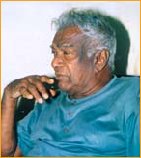 What Wickramasinghe was to literature, Ediriweera Sarathchandra to drama, George Key to painting, Lester James Peiris to film, Amaradeva to music, Chitrasena is to dance. Amaratunga Arachige Maurice Dias alias Chitrasena was born on January 26,1921 at Waragoda, Kelaniya in Sri Lanka. His father was late Seebert Dias, well known actor/producer of the 20s and 30s, founder and instructor for the Colombo Dramatic Club, producer of John de Silva plays and a luminary in the theatrical circles of the day. He was a pioneer actor/director of Shakespearean dramas in Sinhala and English. Chitrasena was encouraged by his father from a young age to learn dance and theatre. In India, Tagore had established his Santiniketan. His lectures on his visit to Sri Lanka, in 1934 had inspired a revolutionary change in the outlook of many educated men and women. Tagore had stressed the need for a people to discover its own culture to be able to assimilate fruitfully the best of other cultures. Chitrasena was a schoolboy then. His father Seebert Dias' house had become a veritable cultural centre, frequented by the literary and artistic intelligentsia of the time. In 1936, Chitrasena made his debut at the Regal Theatre at the age of 15 in the role of Siri Sangabo, the first Sinhala ballet produced and directed by his father. Presented in Kandyan technique, Chitrasena played the lead role, and this made people take notice of the boy's talents. D.B. Jayalilake, who was Vice Chairman of the Board of Ministers under British council administration, Buddhist scholar, founder and first President of the Colombo Y.M.B.A, freedom fighter, Leader of the State Council and Minister of Home Affairs, was a great source of encouragement to the young dancer.  Chitrasena learnt Kandyan dance from Algama Kiriganithaya Gurunnanse, Muddanawe Appuwa Gurunnanse, Bevilgamuwe Lnpaya Gurunnanse. Having mastered the traditional Kandyan dance, his 'Ves Bandeema' ceremony of graduation by placing the 'Ves Thattuwa' on the initiate's head followed by the 'Kala-eliya' mangallaya, took place in 1940. In the same year, he proceeded to Travancore to study Kathakali dance at Sri Chitrodaya Natyakalalayam under Sri Gopinath, Court dancer in Travancore. He gave a command performance with Chandralekha (wife of portrait painter J.D.A. Perera) before the Maharaja and Maharani of Travancore at the Kowdiar Palace. He later studied Kathakali at the Kerala Kalamandalam. In 1941, Chitrasena performed at the Regal Theatre - one of the first dance recitals of its kind - before the Governor Sir Andrew Caldecott and Lady Caldecott with Chandralekha and her troupe. Chandralekha was one of the first women to break into the field of the Kandyan dance. Chitrasena founded the Chitrasena Dance Company in 1943. He toured extensively in the provinces. Chitrasena's brother Sarathsena, a versatile drummer, and sister Munirani were associated in the early dance period. Munirani was a soloist in 'Vidura' ballet. Chitrasena established the first school of National dance, the Chitrasena Kalayathanaya, in Colombo at Kollupitiya in 1944. The sprawling building was handed to him by Sir E.P.A. Fernando, a great patron of the arts - to pursue and further his artistic work. Starting as a small nucleus, the dance centre where Chitrasena lived and worked for 40 years was to become a landmark and a renowned cultural centre for dance enthusiasts and connoisseurs of the arts. In 1945, Chitrasena studied at Gurudev Rabindranath Tagore's Shantiniketan in Bengal and had the distinction of dancing the lead role as Ananda in Tagore's dance drama 'Chandalika' opposite Nandita Kriplani, Tagore's granddaughter. Chitrasena is a contemporary of Uday Shankar. He represented Shantiniketan at the All India Dance Festival in Delhi. He visited numerous dance centres in Lucknow, Lahore, and Uday Shankar's dance centre in Almora, Assam. He performed in a Shantiniketan show in aid of Tagore's Memorial fund at the New Empire theatre in Calcutta. Rabindranath Tagore and the indigenous revival among India's Bengali elite inspired several Sri Lankan artistes to drop their Portuguese influenced names and adopt oriental names. Amaradeva, Sarachandra and Chitrasena are some of those who did. Early Period - Obstacles The early period was fraught with severe hardship, insecurity and frustration. The urban intelligentsia, nurtured as they were on pseudo- colonial values, frowned on things indigenous, or at best with native curiosity. They were unprepared to accept the idea of the traditional dance in relationship to the theatre. There were indignities and insults. No patronage, a reluctant and disoriented public, little if any media coverage- Leaflets were distributed that the traditional dance was being destroyed, anonymous postcards. Chitrasena was breaking new ground and there were instances of him being actually hooted off the stage. Not belonging to the traditional dancing 'parampara' it took him years of hard work to be recognized as an artiste in his own right. Even the traditional dancers who were the proud custodians of an ancient heritage going back over 3,000 years, looked on Chitrasena with derision. There were no proper theatre facilities. In the outstations, stages were poorly constructed, the local town hall or central school hall serving as theatre. Primitive lighting fixtures, often having to improvise a switch board and make do with cardboard and coloured cellophane, dimmers operated with fan switches, improvised bamboo frames to hang curtains and no green rooms were some of the drawbacks one had to contend with. Pioneering Years Started in 1944 in Colombo, The Chitrasena Kalayathanaya was the centre of new forms of arts and culture from the 1940s to the 70s. Begun in a rented house gifted by philanthropist Sir E. P. A. Fernando, The Kalayatanaya building situated a few yards away from Kollupitiya junction, was the oasis of contemporary innovators who searched for new vistas in the aesthetic field. Chitrasena and Vajira introduced a new creative dance form based on indigenous dance to these young artistes. The school started with only a handful of students who lived and worked in the Studio. The school became a cultural haven to the leading artistes of that period whose talents and contributions were to become highly recognised. There has hardly been a name in the world of arts and letters, which has not at one time or another been associated with the Chitrasena Dance School. Some artistes were launched in their respective careers. Ananda Samarakoon lived and worked with Chitrasena and created the National Anthem whilst living in the School. He composed the music for some of the early ballets - with J. Sadiris Silva for 'Vidura' and with Amaradeva for 'Chandali'. Sunil Shantha after his return from Lucknow, Bathkande College of music, held his music classes at the Studio. One of the country's leading authorities on music, Amaradeva's early days are closely linked with the Chitrasena School. Other artistes of the pioneering years included Somabandu, Edwin Samaradivakara, W B Makuloluwa, Lionel Algaina and Somadasa ElvitigaIa. Ganganalh, Prema Kumar, Sesha Palihakkara were some of the earliest pupils. The dawn of a new era brought with it the challenges of the unknown. In spite of the frustrations, due to lack of patronage, they were years of fruitful exchange of ideas, and experimentation activity. 'Ravana', 'Vidura', 'Chandali', 'Nala Damayanthi' were creative outpourings of that time and there was a tremendous Indian influence on the local art scene. In 1951, Chitrasena married his star pupil Vajira. He saw in her the makings of an outstanding dancer. She made her debut as soloist in the role of Prakriti in the ballet 'Chandali' in 1952. Her rise to stardom was coupled with unswerving discipline and dedication both as teacher, performer and choreographer, even as she illumined her husband's career. In 1951, an open-air theatre was inaugurated at the Chitrasena Kalayathanaya under the patronage of Sir E P A Fernando. Sir A E de Silva was the Chief Guest. Contributions After 50 decades of colonial rule, the traditional dance was left impoverished and it was left to Chitrasena to infuse it with a new dynamism. He is associated with the revival of the traditional dance. He was the first professional artiste in Sri Lanka. He challenged the mood of the 30s and 40s and influenced the mind of a generation, establishing himself as an artiste unparalleled in the dance annals of this country. He was the pioneer of the modern dance theatre, which proved a viable alternative to the changing social milieu that sustained the traditional dance rituals. Chitrasena steered the course of dance along unchartered paths infusing it with a dynamism that flowed from his visionary seal and dedication, creating a distinct yet meaningful medium of expression. He revolutionized and extended the scope of dance, forging a link between the traditional and contemporary with the vision of one who seeks to preserve whilst yet extending the horizons of his medium, always going back for inspiration to the roots of our rich heritage. He was the pioneer of the national ballet. Chitrasena established the first school of dance in 1944. The Chitrasena Dance Company has won repute and fame that is international and received rave reviews for their productions both here and abroad. In the realm of creative work, the Dance Company has played a vital role in the evolution of contemporary dance theatre of Sri Lanka. Dramas Rakthakshi in 'Siri Sangabo' directed by Henry Jayasena on the occasion of the revival of the Tower Hall Theatre. Besides spearheading the revival of indigenous dance forms, Chitrasena also made his stage debut as Othello in the Ernest MacIntyre production of Shakespeare's '0thello' and Emperor Jones in the late Karan Breckenridge's production of Eugene O'Neill's 'Emperor Jones'. Cultural Awards received by Chitrasena Yuganthaya - 31st December 1999, awarded for his outstanding contribution to the dance of Sri Lanka. Desamanya - 6th April 1998, the highest award given to a citizen of Sri Lanka. Presented by H E President Chandrika Bandaranaike Kumaratunge. Vishva Prasadinee - 20th April 1996, in honour of the national pride and international prestige brought to Sri Lanka by Chitrasena. Presented by Hon. Prime Minster Sirimavo Bandaranaike. Kala Bhushana - 22nd May 1994, honouring the extraordinary contribution made by Chitrasena to posterity and to the development of the arts and culture of Sri Lanka by Hon. Prime Minister Ranil Wickremasinghe. Kala Keerthi - Presidential award presented by H E President Dingiri Banda Wijetunga. Honorary degree of Doctor of Philosophy (Fine Arts) - 21st March 1991, Institute of Aesthetic Studies, University of Kelaniya, Sri Lanka. Presented by H. E. President Junius Richard Jayewardene. Kala Suri First Class - 22nd May 1986, Presidential award presented H. E. President Junius Richard Jayewardene. Productions Chitrasena insists on the importance of expression in the arts and the artist's right to freedom from technique. The limitations of pure dance, was apparently the reason for Chitrasena's attempt to create a genuine Sinhala ballet. According to Chitrasena, tradition was a kaleidoscope within which a vast variety of forms could be created. But the possible forms were not endless. Throughout the journey from Vidura and Ravana dance - dramas to the ballets Nala Damayanti and Karadiya, his singleness of aim was to develop and extend Sinhala dance forms, and to look for possibilities of emotional expression within the existent idioms. And when they failed, to expand the national vocabulary through nature's instinctive gestures and movements. The absence of conventional mudras, Chitrasena once said, is not essentially a weakness in our traditional forms, inhibiting their use in ballet. It is often their strength, allowing flexibility and the use of natural gesture, which is the language of instinctive understanding. Some of his famous dance productions are: Rama & Seeta -1943, Vidura - 1944, Pageant of Lanka (Ramayana & Landing of Vijaya) - 1948, Ravana - 1949, Nala Damayanthi - 1950, Chandali - 1952, Kumudini - 1952, Himakumariya - 1953, Sepalika - 1955, Kindurangana - 1956, Sama Vijaya - 1957, Vanaja -1958, Karadiya - 1961, Nala Damayanthi (2nd production) -1963, Rankikili - 1965, Nirthanjali -1965, Gini Hora -1968, Nirasha -1972, Shadi -1972, Navanjali -1972, Anaberaya -1976, Kinkini Kolama -1978, Hapana -1979, Bera Pooja - 1980, Navoda Ranga - 1981, Shishya Pooja -1982, Dance of Shiva -1985, Nritha Pooja -1986, Chandalika (2nd production) Temple of Dance to rise again To the dancer in Sri Lanka, a trial of unrelenting perseverance in the face of poverty and social scorn, a great triumph over the severest odds, is a test of exceptional loyalty and dedication to his art. For Chitrasena, the course of his long, illustrious career has been one of personal achievement through struggle and triumph, of quest and conquest, of bitter and happy days, of lean and prosperous years. In the mid 1980s, like a bolt from the blues, the Chitrasena family and the country at large were deprived of Kalayatanaya in a cruel and inhuman manner. The Chitrasena Kalayathanaya, which has earned national and international recognition, an institution incorporating the finest traditions of the country, that nourished cultural activity for 40 years and was aptly described as 'Temple of the Dance,' was acquired by the Urban Development Authority in 1984. The school was razed to the ground and the prime land in Kollupitiya still lies idle. Nearly 20 years have lapsed since this cruel experience, indeed a sad apology for the artistes Chitrasena and Vajira, who have dedicated their lives to dance. The loss of the Chitrasena Kalayatanaya is a national tragedy. Fortunately, five years ago President Chandrika Bandaranaike Kumaratunga who had learnt ballet dancing at the Chitrasena Kalayatanaya during her youth, donated a plot of land situated at Park Road, Colombo, to them. Now an effort is being made to build a new Kalayatanaya on this plot of land. Yakdessa Budduwatte Punchi Gura, the revered doyen of Kandyan dancers, participated in the ritual Khomba Kamkariya performed at the Chitrasena Dance Academy on Galle Road to celebrate his birthday in 1973. Guru Chitrasena, turned 81 on January 26, 2003 and a felicitation ceremony was held at Colombo. It was celebrated with great fanfare, a photo exhibition, dance performances and felicitations by speakers who paid handsome tributes to him for placing Sri Lankan dances on the world map. Distinguished audiences Maharajah of Travancore Palace - 1940 H. E. Governor Andrew Caldecott - Regal Theatre (with Chandralekha) - 1941 In aid of Tagore Memorial Fund - (with Tagore's grand-daughter Nanditha.Kriplani) -1945 Claudio Arrau - Chitrasena Dance Studio - 1946 H.R.H Duke and Duchess of Gloucester - Pageant of Lanka - Colombo - 1948 H.E. Governor General Lord Soulbury (Premier of Ballet Nala Damayanlhi - 1949 Sir Ernest de Silva and Sir E.P.A.Fernando (Patron) - Opening of the first Open Air Theatre in Sri Lanka at the Chitrasena School - 1952 H.R.H. Queen Elizabeth II at Regal Theatre - 1954 Martha Graham - Colombo - 1956 Hon. Prime Minister S.W-R.D. Bandaranaiake - Colombo (Ballet Chandali) - 1956 Moscow Youth Festival - 1957 Hon. Prime Minister Chou En Lai of China - Temple Trees, Colombo - 1957 Hon J.R.Jayawardene, N.M.Perera, William Gopallawa (Governor -General) Colombo - 1962 Hon. Prime Minister Nikita Krushev of USSR and Hon. Sirimavo Bandaranayake, Prime Minister of Sri Lanka - Old Kremlin Theatre Moscow - 1963 Hon Prime Minister Dudley Senanayake and Mayor of Montreal - Expo '67 - Montreal - 1967 H.E. President V.V.Giri of India Temple Trees - Colombo - 1967 H.E.The President William Gopallawa - Chitrasena's 50th Birthday celebration - Colombo - 1971 Leaders of the Non-Aligned Nations - Colombo - 1976 H.R.H Crown Prince Akihitho of Japan - President's House Colombo - 1979 H.R.H. King Birendra of Nepal - President's House, Colombo - 1980 H.R.H.Queen Elizabeth II and H R H .Prince Philip Duke of Edinbourgh, President's House Colombo - 1981 Tours 1957: USSR.- Russian Youth Festival Sponsored by World Peace Council. 1959: India - First Cultural Group sent by Government of Sri Lanka. 1963: Australia - Perth, Sydney, Melbourne-Sponsored by Elizabethan Theatre Trust, Tasmania - Hobart, Launcheston, USSR-Tashkent, Leningrad, Al-mata, Moscow, Kalinin, Poland-Warsaw, East Germany-East Berlin, Eisenhotenstat, Czechoslovakia-Prague, India - Bombay, Delhi, Lucknow, Madras. 1967: Canada - Montreal 1970: West Germany - Hamburg, Heidelberg, Frankfurt, Freiburg, Baden, Hannover, Dusseldorf, Munich, Stuttgart, Essen, Wuppertal, Switzerland - St.Morritz, St.Gallen, Holland - Amsterdam, Arnhem, Tilberg, Heerlen. France - Colmar. 1971: England - London, Sadlers Wells Theatre, Malaysia - Kuala Lumpur, Singapore, Brunei. 1972:Australia - Perth, Adelaide, Melbourne, Sydney, Canberra, New Zealand - Auckland, Wellington, West Germany - Frankfurt, Denmark - Copenhagen. 1974: Denmark - Copenhagen. 1991: India 1993: Bangladesh - Dhaka 1995: London - Sadlers Wells, Birmingham 1997: Singapore - Asian performing Arts Festival. Japan - Tokyo, Takasaki, Gifu, Tokushima 1998: India - Chennai, Calcutta, Shanthiniketan, Delhi, Mumbai |
