 |
    |
|
|


National treasure and beloved mentor: Tribute to Guru Kelucharan Mohapatra by Rajika Puri, NYC e-mail: rajikapuri@yahoo.com April 12, 2004 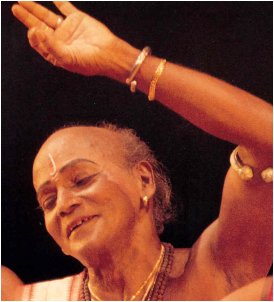 Photo: Avinash Pasricha At the close of the Odissi Festival held in Washington D C last summer, as Guru Kelucharan Mohapatra reached the end of his performance of Jayadev's ashtapadi "Naatha hare", he went up to the flower pots surrounding the image of Lord Jagannath on stage. Breaking off two handfuls of marigolds, he slowly backed away strewing bright yellow petals in front of him. As he disappeared into the wings, we could have sworn that we saw Krishna walk along that enticing path in response to the impassioned plea of his devotee. Padma Vibhushan Guru Shri Kelucharan Mohapatra, who died in Bhubaneshwar on the 7th of April, was a body language genius - and a national treasure. A major architect of Odissi as we know it today, he created an enormous repertoire of dances, and was teacher to some of the greatest dancers of India. A mesmerizing performer, he not only danced but played pakhawaj as well - captivating audiences in India, in Europe, the United States and Japan. He also painted and sculpted. First and foremost, however, he was a bhakt. Guruji's bhakti was simple. It was just a part of him, and flowed out of his eyes whenever, as Radha, he looked at Krishna - or, as Kewat, he gazed at Rama. He may have been a consummate showman, and possessed of an imagination that could create wondrous images in movement, but more important than anything else was the fact that he could move us because of his faith. We saw Krishna because he clearly saw Krishna when he 'talked' to him in dance. We grew closer to the divine because he brought him on stage for us to get to know. Kelubabu, as he was affectionately called, was born on January 8, 1926 in Raghurajpur, a village of pattachitra painters and gotipua dancers, situated near the temple town of Puri in Orissa. His father, a khol player introduced him as a child to percussion instruments, which he later followed up by studying mridang with Agadhu Moharana. He even learnt how to play tabla. Introduced to the many skills of Oriya theatre as a teenager in Mohan Sunder Dev Goswami's Ras Lila group, he later joined Kali Charan Patnaik's theatre company and then, in Cuttack, the Annapurna Theatre where he studied with Guru Pankhaj Charan Das - and fell in love with his female lead, Laxmi Priya, known to us as 'Guru-ma'. Once the Odissi revival was in full swing, Kelucharan Mohapatra quickly found himself at the forefront. He had researched extant Odissi traditions with the few remaining maharis and gotipuas, and began to teach in Cuttack by the mid 'fifties. By 1966, when he received the Sangeet Natak Akademi Award, and 1972 when he was awarded his first central governmental honour, the Padma Shree, he had already started attracting dancers like Sanjukta Panigrahi, Madhavi Mudgal, and Sonal Mansingh. Soon even renowned Bharatanatyam dancers like Yamini Krishnamurthy, Malavika Sarukkai and Alarmel Valli studied with him and performed this alluring 'new' form of classical dance. 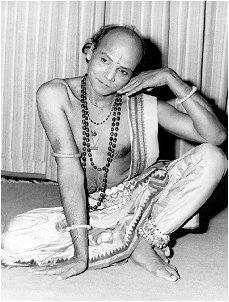 Photo credit: Sangeet Natak Akademi 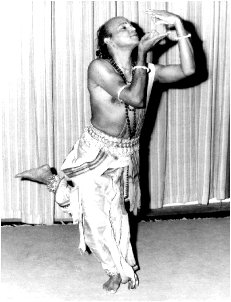 The "kiss" (Photo credit: Sangeet Natak Akademi) Accompanying his senior dancers he traveled all over the world and gave lecture demonstrations and workshops until he became a sort of 'jet-set- guru', flying from Bombay to Washington, Delhi to London, Bhubaneshwar to New York, responding to an enormous demand. At the same time, his own house was open to dancers willing to come and study with him in Orissa, where they became part of his 'working household'. Protima Bedi told me that during her very first days with him he asked her to participate in a workshop he was holding for Oriya dance teachers in his home. Another dancer remembers being nursed through a miscarriage as if she were a daughter of the house. All this activity, however, took a toll on guru-ji. He developed a heart condition and had to have surgery, after which he was advised by his doctors not to perform any more. He also developed asthma. Still, he never stopped teaching - or performing. And whenever he performed, he did not hold back. With his lithe body, which could fold itself into such pliant shapes, he would sink into the floor or spring up without a thought. His tribhanga was always perfect, his torso ever sinuous, his footwork swift and sure. His last performance, his son Ratikant tells me, was as late as the first of April. He was supposed to have performed in Benaras a few days later. Sujata, his daughter-in-law and a beautiful dancer herself, adds, "He was so active, so lively - teaching, performing, and everything - when suddenly, so suddenly . . ." At 78, we all thought he would be around for a while yet. Beyond all the achievements of this legendary guru and beyond all those epiphanies we experienced when he crossed over the modern proscenium stage and included us in his conversations with his god, lie Guru Kelucharan Mohapatra's humanity and his capacity to love. Favoured students or recalcitrant truants, his arms were always ready to embrace us, his hands to bless us. He had a twinkle in his eyes, which set our hearts to laughter, and a generosity of soul, which led him not only to teach and perform full out, but also to care, to nurture, to feed. Yes, he was an extraordinary talent, the like of which we will likely never see again. More than that, however, he was a wonderful human being. We are bereft. Rajika Puri, dancer, actor, and writer, is a senior member of the Guru Deba Prasad Das shaili of Odissi dance. |
