 |
    |
|
|


Pandit Chitresh Das: Master artiste, guru and humanitarian - Charlotte Moraga, California e-mail: ckathak@yahoo.com January 5, 2009 "This is a good time as any to step back a little and pay tribute to one of the most committed ambassadors of Indian culture in the West. While political analysts and theorists like to talk about the profound "soft influence" of culture, Das has shown its enormous power by example." Why does India West journalist, Mr. Ashfaque Swapan, say this of Pandit Das in a recent review of Das' critically acclaimed full length Kathak solo, Master of Tradition, a performance that is named among the top 10 dance events of 2008 to see along with such mainstream greats as the Kirov Ballet, San Francisco Ballet, Mark Morris Dance Group, Merce Cunningham Dance Company and the San Francisco Hip Hop Festival? 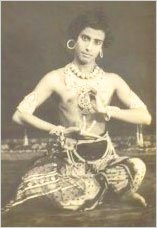 Pt Das' father, Prahlad Das, performing contemporary dance 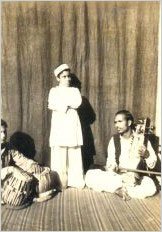 Pt Das at age 9 with Pt Ramnath Misra (sarangi) and Ram Shankar Sahai (tabla) From an early age, Pt Chitresh Das, was set to be the ambassador of Kathak, but not just for Americans. His contributions to Kathak have universal reach. Das may be viewed as the Johnny Appleseed of Kathak dance, spreading the seeds of Kathak from the east coast of the United States of America beginning in 1970 to the west, but the journey actually began in 1954 in Calcutta, the city that gave birth to other missionaries of culture and art like Swami Vivekananda and Uday Shankar. 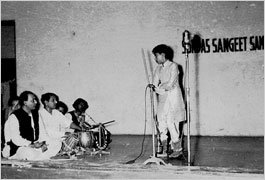 Pt Das at age 9 performing with the great tabla master Pt Samta Prasad. Seated in front is his guru Pt Ram Narayan Misra 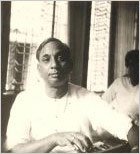 The great Shambhu Maharaj at the Das' home (c 1958) Growing up in his parents' dance school in Calcutta, Nritya Bharati, Pt Das was surrounded by great literary artists, poets, dancers, and gurus of the times. He has fond memories of iconic dancers such as Rukmini Devi, Uday Shankar, Balasaraswati and the legendary Shambu Maharaj coming to visit his home. There were also famed musicians such as Gulam Ali Khan and Amad Jan Thirakwa and many more. 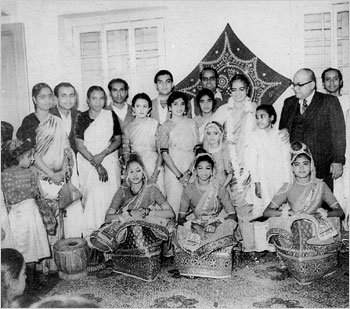
Nritya Bharati dance room: third from left is Chitresh's mother Nilima Das, Pt Das (age 9), to his right is the great Rukmini Devi Arundale After such a childhood, coming to America with eight dollars in his pocket was an adventure rife with new experiences. In 1970, Pt Das came to America on a Whitney Fellowship to study modern dance and teach Kathak at the University of Maryland. While teaching in Washington DC, he remembers his roommate who had an alligator in his basement giving him a ride to the university on the back of a chopper. In his first years in America, Das was exposed to the vibrant dance scene in NYC. On weekends he used to go to NYC to stay with supporters, Alwin Nikolai and Murray Louis. There he met many American dance luminaries. But Das, then as now, never felt the urge to fuse western dance with Kathak. He was to experiment within tradition in the coming years, but always sticking to his motto, "Freedom comes from refined discipline with responsibility." Being exposed to the greatest ballet dancers, tap dancers, modern dancers, athletes and artists only inspired him to go deeper into his own tradition where he continued to find depth and relevance in Kathak. 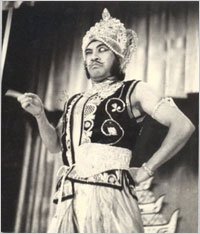 Pt Das as Ravana in the first dance drama he created in America. (Herbst Theater, c. 1975) One year later, in 1971, Ustad Ali Akbar Khan invited him to establish a dance program at the Ali Akbar College of Music in San Rafael, California. While at the AACM he was again steeped in a rich artistic environment... "I was in the right place at the right time. Everyone used to come, Ravi Shankar, Lakshmi Shankar, Nikhil Banerjee, Ustad Alla Rakha Khansabh, and Shankar Ghosh was the music director. What an exciting time. But it wasn't easy. Zakir, Aashishda and I were just starting out. The hippie culture was in direct clash with my upbringing." 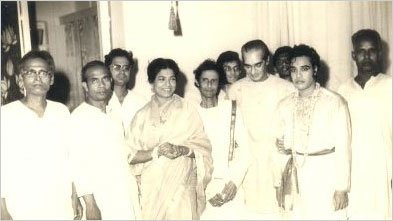 Following Pt Das' historic performance before Uday Shankar Front from left: Nanku Maharaj (Benares Gharana tabla master), Ramnath Misra (sarangi - Pt Ramesh Misra's father), Amala Shankar (wife of Uday Shankar), Prahlad Das (Pt Das' father), Uday Shankar, Pt Das, Nazim Ali Khan (1970) Das continued to go back to India for winter performances and in 1976 he took his American students on a tour to India where they performed on Indian national television. Shortly after his return to America, he founded his own dance company in 1979, the Chhandam Chitresh Das Dance Company (CCDDC), incorporated as a non-profit organization in 1980. Twenty-four years later, CCDDC boasts of being one of the world's foremost Indian classical dance companies and the largest Indian classical dance school in North America. He has also expanded to have one of the world's only pre-professional youth Kathak company, the Chhandam Youth Dance Company, outside of India. But, he is quick to remind that it took almost 40 years of hard work. 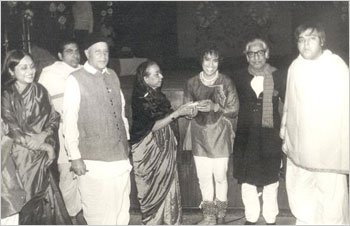 Pt Chitresh Das being presented with an award by the mother of Ustad Vilayat Khan. To her right is the great harmonium player Mantu Banerjee, to Chitresh's left are Daggarsahib and Sabir Khan (1982) In the 1980's Das created many innovative choreographic programs. One of his ground breaking features was Gold Rush. Das collaborated with composer George Ruckert, currently professor at MIT, incorporating western violin, banjo and synthesizers. He even incorporated the high kicks of the French Can-Can dance and a Mexican Mariachi waltz. Das saw the Gold Rush as a metaphor for the joys and pitfalls of following a dream. He created other innovative choreographies ahead of his time such as Energy, Class Tech, and Rhythmics. Dancers wore black body suits, short silver kurtas, and he even wore a tank top in on of his choreographies. Some of the music he composed used synthesizers and an electric flute. 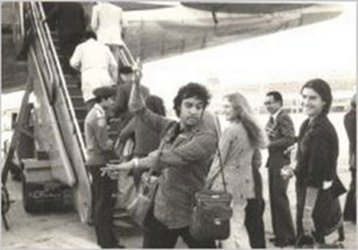 First tour of India by Pt Chitresh Das' American Company The 1980's were a time of experimentation and lots of touring the globe, performing at the Lincoln Center, the Olympic Arts Festival, Los Angeles Summer Olympic Games in 1980 and opening Pt Ravi Shankar's Rimpa Festival in Benares, India with Zakir Hussain in 1983. 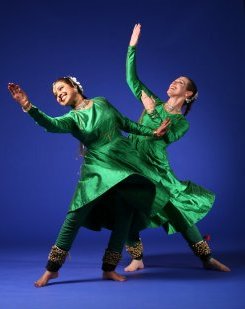 Chitresh Das Dance Company members Jaiwanti Pamnani and Charlotte Moraga In 1987, Das was invited to establish the first accredited Kathak course in the US at San Francisco State University (SFSU) and began teaching and touring annually in Germany, Poland, Hungary with Tanzprojekt as well as expanding his school in the US. For the first time, his students, no longer the blondes and brunettes of the hippie era, were predominantly of the Indian diaspora, though his company, many of whom began studying with him at SFSU, were ethnically diverse with different backgrounds in dance. The 1990's brought a new era of introspection and going still deeper into the roots of classical Indian art, teaching at SFSU, spending time in nature surrounded by the giant redwoods, and running in the hills of San Rafael, he carved out his own Himalaya. Through intense riyaz he began to develop a new technique called Kathak Yoga. Yoga comes from the Sanskrit work yug, meaning union. Kathak yoga is a meditation in motion, focusing on the union of breath, voice, dance, footwork and subtle expression, and sometimes playing an instrument simultaneously. He trained dancers such as myself and Jaiwanti Pamnani, reinvigorating the guru shishya parampara. We presented our first full length traditional solos in 2001 and 2002 respectively and recently a new generation of company members has taken the stage in their evening length solos. What makes these performances unique is upaj. Upaj, improvisation, is at the heart of these solos, and appears to be getting more rare. Is the reliance on recorded music and slick choreographies impacting this dynamic tradition in Kathak? Das is demanding that serious students preserve the heart of Kathak, improvisation, by developing a serious riyaz with mehenat and performing with live music. In performance, a dancer's individual struggle and joy at overcoming obstacles permeate the atmosphere compelling the audience to intense levels of admiration and joy. I find it most relevant in contemporary times because it's about a unique individual's journey. Every time a soloist mounts the stage, it is a chance to reinvent oneself as the dancer strives for ananda. The Kathak vocabulary provides a limitless source of expression. And Das has inspired a new generation of artists to delve deeper into that vocabulary, many of whom are opening schools around the world. Das spent a lifetime exposing audiences to the universal aspects of Kathak and its cultural relevance and bringing it back to India, from Calcutta to California and back to India again. He can be seen turning on a new generation to the thrills of upaj with his award winning collaboration India Jazz Suites. It's more than just a jugalbandi. It's a real conversation and sharing of unique traditions. One journalist even called it a blueprint for world peace. Pt Das refuses to compromise the depth, complexity and relevance of Kathak, but easily crosses cultures, borders and modes of communication with film makers for Sadhana, Balinese Gamelan for Subali, Sugriwa, and utilizing great masters of Kathakali, Balinese and Kathak in 'East as Center.' Among his collaborations in India has been the celebrated 'Art of Rhythm' with contemporary painter Shahabuddin, where the fastest feet meet the fastest hand in a mélange of movement, color, and interpretation of a relationship. Each collaboration is a model for cultural exchange, understanding and appreciation, rather than fusion of different styles. 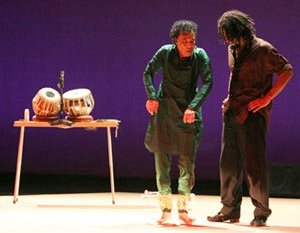 Chitresh Das and Jason Samuels Smith in India Jazz Suites It was the collaboration with young tap star Jason Samuels Smith that sparked a relationship which is taking on new levels of virtuosity and cultural exchange. When Charles Reinhart, director of the famed American Dance Festival called organizers in India searching for the quintessential Kathak dancer for his premiere of Festival of the Feet, they said, the artist you are searching for sits in the US, in California, much of the year. Though not the first time, Kathak, Flamenco and Tap were brought together on the same stage; it was the first meeting of Pandit Das and Jason Samuels Smith. Since they met in 2004, they have been touring the world electrifying audiences everywhere, each concert different in its way because neither artist relies on choreography, but pure unadulterated upaj, and also abhinaya! The rasa of the feet as well as face come to play in these dynamic episodes. Das firmly believes that dance has the power to heal, enlighten, and affirm peace in the world. His work with the blind opera, Newlight organization, and Vatsalya Boys School has had a powerful impact on the lives of children in India, less fortunate than some. Deeply devoted to preservation and promotion of Kathak, the Chitresh Das Dance Company presented the first International Kathak festival and symposium in San Francisco at the Yerba Buena Center for the Arts in 2006. The mayor of San Francisco inaugurated the event, proclaiming September 28, 2006 as Kathak Day. Many dancers, icons of Kathak, critics, scholars, students and lovers of Kathak from around the world came to celebrate and contemplate this diverse, complex and compelling art form. After 40 years propagating Kathak in America, Das continues to think of exciting ways to give back to the field. The Chitresh Das Dance Company is planning on expanding to present the first ever International Classical Indian Dance Festival in San Francisco in 2010, delving deep into the issues of performing, preserving and presenting classical dance in a contemporary context. Coming full circle from Calcutta to California and back again, Das is interested in reaching young people in India, encouraging them to take pride in their unique heritage and the classical arts. "The West does not have all the answers, look deep within yourself and find new inspiration." Currently, Das, the quintessential ambassador to the world of Kathak returns to India yearly to train a new generation and tour. The Hindustan times says, "Das has opened so many avenues to his art, it's no wonder he is called a phenomenon." You can catch him setting stages ablaze with tap virtuoso Jason Samuels Smith and in solo performances throughout India in Jan. 2009. For more details go to www.kathak.org Charlotte Moraga is a Kathak artiste and educator living in San Francisco, California. |
