 |
    |
|
|


UDAY SHANKAR: AN APPRECIATION by Dr. Sunil Kothari (Natya Kala Conference 2000) Photos: The Sunil Kothari Dance Collection May 2001 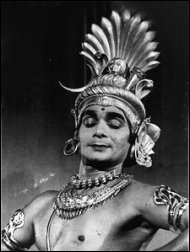 While Uday Shankar was earning for Indian dance a great respect abroad and had succeeded in placing it on the world map in the 1930s, there was, concurrently, a revival of classical dance forms in India. The poet Vallathol in Kerala was inspiring people to re-establish the Kathakali dance-dramas; Rukmini Devi who too, was advised by Anna Pavlova to turn to Indian classical dance, established Kalakshetra in Madras to train young people in Bharata Natyam (and every other girl in society was aspiring to becoming a versatile Bharata Natyam exponent); Madame Menaka was responsible for lending prestige to Kathak which till then was called Nautch (following in the footsteps of Uday Shankar, she established her dance school in Khandala near Bombay). Gurudev Rabindranath Tagore had already introduced Manipuri dance at his famous university Shantiniketan. A unique movement of revival of classical dances had begun and dancers were attempting to discover our classical dance heritage and tradition. This was but natural in a period when the spirit of nationalism was awakening with the freedom movement, and Indians were taking legitimate pride in their indigenous arts in the face of alien rule. Uday Shankar was a genius. He had no formal training in any of the schools of classical dancing. His dances were creative. He had a wonderful gift of taking the essence from various dance traditions and techniques and using them to choreograph his dance - dramas. His contribution lay in his very creative answer to the challenge of finding and identifying a suitable style and form to communicate a particular theme. Despite his acquaintance with traditional dance forms, he cut across all of them so that an integrated composition could be presented. And in that he succeeded marvelously. His multi - faceted talent shone forth in his creative works. The experience he gained from experiments in music composition for his creative dances during the formative years of his European and American tours was fully utilized at the Almora Center. Along with Ustad Allaudin Khan, Vishnudass Shirali (a former student of Pandit Vishnu Digambar), Uday Shankar had, in Paris, experimented with creative music for his solos, duets and ballets. 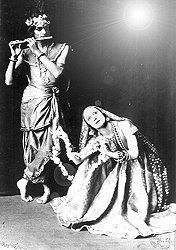 His works had a sound base. And that was evident in his method of training at Almora Center, which prepared the dancers for the ballets he produced. The training was all embracing. It included technique of dance, folk dances, improvisation, stage and costume design, make-up, elementary physical exercises, expressive movements, development of sensitivity of the body, concentration, imagination, group feeling and observation, knowledge of steps, psychology of movements, sense of colour and line, and the relationship of dance to drama. Added to all this was his superb showmanship and emphasis on perfection. He knew how to keep his audiences hungry for more. He had a remarkable gift of presenting dances in a very brief time span. But they left an indelible impression. His own vision of various Indian gods and goddesses was presented before the audience. And those who have seen his solos of Indra, Karthikeya, and Shiva recall with great nostalgia the artistic illusion and haunting images that he created. On stage, his physical beauty was astonishing. It invariably cast a spell on his audience all over the world. It was an individual and rare quality that cannot be duplicated. Only its memory lingers on. His student Shanti Bardhan was another creative dancer and he devised movements which had a distinct identity. Among Uday Shankar's other trainees and followers, Narendra Sharma, Sachin Shankar, Amala Shankar, Uday Shankar's daughter Mamata Shankar and son Ananda Shankar are carrying on his legacy, and the contemporary modern dance scene is enlivened by their works. The creative dance movement in India owes its growth to Uday Shankar. He did not follow tradition blindly. But with his uncanny gifts he transformed traditional forms into the most extraordinarily memorable works. Artistes like Uday Shankar come once in a century. Their greatness cannot be duplicated. They can only serve as an inspiration and guide. Today, when classical dance forms have become well established, to master them one has to undergo a thorough training for several years. Dancers have to face a greater challenge, for they have to recreate an authenticity or break away from these forms. Therefore, it is impossible for a dancer to create any kind of impressionistic style which draws from the resources of classical dance forms like Bharata Natyam, Kathakali, Odissi or Kathak. Those who follow Uday Shankar's footsteps are searching, groping and sometimes they get lost. But dance being a dynamic art takes newer forms and creative artistes all over the world continue to mirror their ecstasies and agonies through movements that astound the audience. No other dancer in India has rendered a greater service than Uday Shankar did at the turn of the century, when the rest of the world had forgotten Indian dance. The world of dance owes him a debt of eternal gratitude for his pioneering work, for giving Indian dance its pride of place. His contribution remains of great significance and importance. 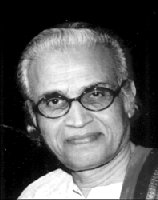 Dr. Sunil Kothari was professor of Dance at the Rabindra Bharati Universty at Calcutta. Rabindra Bharati University was given the status of a full University in 1962 with Uday Shankar in charge of the dance section. After his demise, the Uday Shankar Chair was created and Dr.Sunil Kothari was the first to occupy the chair. A dance writer, roving critic, research scholar, author of many books, he has been the recipient of the Sangeet Natak Akademi Award. |
