|     |
|
| |

 NMACC presented Parampara Pravaha - Janani festival- Chandra Anande-mail: chandra6267@yahoo.co.in Photos courtesy: NMACC June 4, 2026 Nita Mukesh Ambani Cultural Center, Mumbai, held a three-day classical dance festival, 'Janani', to commemorate Mother's Day, from 8th May - 10th May 2026. Curators Kshama Puranik and Anand Satchidanandan declared it was requisite to pay tribute to mothers, "not only as nurturers, but also as torchbearers of culture, tradition, strength, and creativity across generations". Accordingly, "honouring motherhood through movement, music, storytelling, and artistic legacy", the festival opened on 8th May "with captivating performance by Aishwarya Ananth Karthik with R.P. Shravan, bringing together grace, rhythm, and emotional depth in an evocative artistic dialogue". On 9th May, "a unique double bill presentation, one featuring three generations of Bharatanatyam artistes - the legendary Dr. Sucheta Bhide Chapekar, her daughter Natya acharya Arundhati Patwardhan, and her granddaughter Sagarika Patwardhan, celebrating together the continuity of tradition, mentorship, and familial artistic heritage", and second, Guru Marami Medhi and Meghranjani Medhi, presenting "a compelling Kathak duet that reflects the beauty of artistic inheritance and shared expression"- was presented. Both performances were accompanied by a stellar live music ensemble, enriching the experience with vibrant rhythm and melody. On May 10th, the festival concluded with a powerful storytelling and dance theatre performance by Ulka Mayur, "weaving narratives that reflected the many dimensions of womanhood and motherhood through expressive movement and theatricality". Thus "the festival", Kshama and Anand asserted "becomes a heartfelt celebration of mothers by evoking their love, resilience, wisdom, and enduring influence across generations". 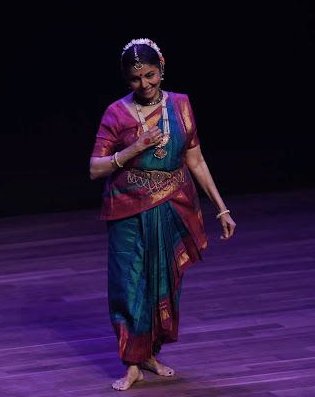 Sucheta Bhide Chapekar The second day's theme, 9th May 2026, was "Parampara pravaha", for which Dr. Sucheta Bhide Chapekar, along with her daughter Arundhati Patwardhan , her granddaughter Sagarika Patwardhan and senior disciples of the Kalavardhini school of dance, Falguni Oza and Sayali Kane, showcased Bharatanatyam that has flowed through their family since three generations. The theme was well formulated to include Krishna, Rama and Shiva to uphold the epical glory and philosophical sensibilities of the Bharatanatyam margam and contemporized it with a new composition on girl child constructively locking in her divinity. Ganesh Vandana, "Tandava nritya kari gajanana" (Mohanam, adi), a composition of Sant Ramdas, was performed by Chapekar family. It had descriptive stories of Lord Ganesha and all three life stages of Ganesha was wonderfully shown. Jathis incorporated were appropriate, the mridangam playing done, looked real. They ended with Ganesha poses, holding different icons of Ganesha, in a manner, endearing Lord Ganesha to one and all. 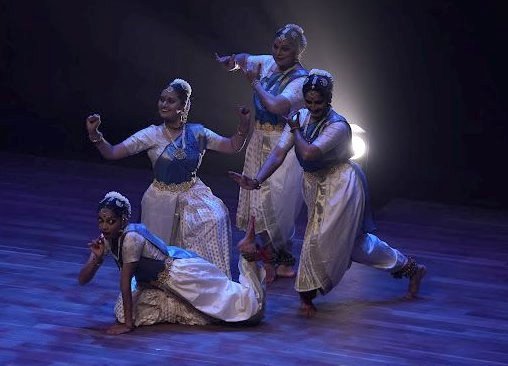 Krishna kavuthvam Krishna kavuthvam (Ragamalika, chatushra ekam) written by Dr. Sucheta Chapekar was performed by Arundhati, Sagarika, Sayali and Falguni. All stories of Krishna were registered in the kavuthvam, and so, many names of Krishna were called out throughout its lyrics enabling kirtanam, shravanam and smaranam of Krishna's life, which uplifted all into bhakti marg. Stories relating to gopis' search for Krishna, 'krishna pahila", description of playing ball, dancing raas, his antics of breaking pots of gopis, the epitome of love through Radhakrishna were done briefly and crisply. Nritta for the rhythmic syllables in kavuthvam lyrics were crisp and elegant. No teermanams were used, giving a soft look to the style. In between verses, poses taken were apt and statuesque. Lovely choreography. Costumes were also beautiful, a favourable modification from the traditional one. "Ragavu kashi tula", in Marathi language, (Hindolam adi), written and composed by Guru Smita Mahajan, senior most disciple of Dr. Sucheta, was about a mother and her little daughter. Sucheta alleged how, in classical dance, all tended to pick mother and son i.e., Rama and Krishna to celebrate vatsalya bhava. But, here, she appreciates Smita to take the stand that one can have lot of fun and affection with daughters too. Smita describes, how 'brahmananda', the feeling of being immersed in God, is available when a mother spends time with her daughter too. Their rapport was shown exploiting a few activities together. The mother is amazed to see her daughter - run like a deer, wanting to dress up like herself, also wanting to make rotis and to enjoy the enchanted look on her daughter's face on watching the rotis bloom. The emotive singing of the melodious voice of Sivaprasad and the playing of the violin by Anantaraman enhancing every movement and emotion of Dr. Sucheta in this item, was commendable. "Kuzhandai Ganapati" (Kalyani, adi) exposes the story of the fight for the mango brought by Narada. The story is further extended, to imbibe values of sacrifice and sharing in children. Thus, the story is given a refreshing treatment. Arundati as Parvati, Falguni as Ganapathy and Sayali as Karthikeya enthralled the audience with antics of the brothers' fights and the mother condoling and consoling her young ones respectively. Ganapathy gives the fruit to Karthikeya and their fight is resolved as Karthikeya too offers it back and they share the fruit. Thus, the mother teaching her children the act of sacrificing and of sharing between siblings is commemorated. Viruttam from Krishna Karnamrutam, "Ramonaam babuva" (Nilambari), took the audience through the epic Ramayana, which was enacted succinctly by Dr. Sucheta Chapekar. Yashoda is trying to put Krishna to sleep, by telling him the story of Lord Rama. The climax of the item is when Krishna is told the part where Ravana abducts Sita. Krishna cries out involuntarily to Lakshmana asking him to give him the bow to fight Ravana. At that time, Yashoda pacifies him by saying, he is her Krishna and to relax, it was only a bedtime story. "Yallinam yallam jay devadi deva yallilam yallam le" a Jakkini Daru (Bilahari, adi), is a 17th century composition composed by King Shahaji II. The sahitya was on Lord Tyagesa of Tiruvarur of whom the Maratha king was a devotee. The swara passages had elegant korvais woven around them which were ended with adept teermanams and signed off with appropriate dance poses. This was performed by Arundhati, Sagarika, Falguni and Sayali. The artistes were accompanied with good musical support with Smita Mahajan on the nattuvangam, Sivaprasad on vocals and B Anantharaman on violin and Yashwant Hampiholi on mridangam. The feather in the cap was the heartfelt compering done by Dr. Sucheta Bhide Chapekar that took all through the universalised presentation as an experience. Guru Marami Medhi and her daughter and disciple Meghranjani Medhi from Assam performed Kathak style together. They exemplified the guru-shishya relationship, as well as the rapport of their mother-daughter relationship. Guru Marami's first guru was Guru Charoo Bordoloi, and she later trained for most of her life under Guru Surendra Saikia of Lucknow. She also received training from Pandit Birju Maharaj when she attended the various workshops he had conducted, across India. She established the dance school of Kathak "Sur Sangam" in 1990 and since 36 years, has been propagating Kathak in Assam. Marami said how happy and lucky she was for having a daughter who had chosen Kathak as her dance form, loved the art form as much as she herself did, and though she has been her daughter's guru, the present times has shown her daughter to be her mentor too. They dressed in similar costumes of maroon and gold and moved in sync when they performed together. The love and respect Meghranjani has for her mother was noticed in her demeanour throughout the performance. In spite of being film stars, they both have managed to hold on to the purity of the classical style of Kathak. Ganesh Vandana (Bhupali, Addha taal), an invocation and salutation to Lord Ganesha was performed on a bhajan composed by Saint Tulsidas with music composition by Joyprakash Medhi. The item choreographed by Guru Marami Medhi was descriptive, well presented with forceful footwork, good tihais and aesthetic movements describing Ganesha the remover of obstacles and the bestower of wisdom and auspicious beginnings. 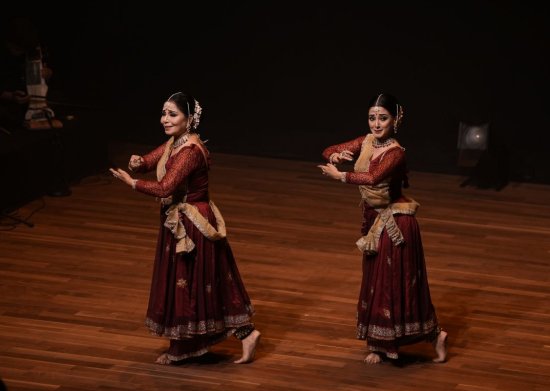 Marami and Meghranjani Medhi Presentation of Shuddha Nritya, was by showcasing a Paramparik Kathak Gatha, rooted in the Lucknow Gharana, in Teentaal, traversing vilambit, madhya and drut layas. It highlighted the refined adaayen and andaazen that defined the elegance of this tradition. The vilambit laya was a little technically heavy for the lay man. In two out of six pieces of nritta done, it was difficult to understand the tihaai pattern. A graceful piece anaghat that portrayed shringaar raas with delicate movements was performed elegantly. The piece that showed rain falling had a perfect combination of nritta and abhinaya. An aamad was performed by Guru Marami displaying the ched chaad of Krishna with Gopis, where antics of Krishna breaking pots, teasing gopis was displayed. The highlight was the gopis' excitement to be with Krishna and also laaj sharam of the gopis were shown aesthetically. Madhya Laya was performed by Marami Medhi highlighting pakhawaj rhythms and bols. Paranjuri aamad introduced the graceful entry, followed by paran done to powerful pakhawaj-based bols that created structured rhythmic patterns. A tukra executed highlighted intricate movement and speed and was completed with a cute tihai. The grandeur and grace of this art form was visually well brought out with clarity. The technical pieces of drut laya were done by Meghranjani while Marami recited the padanth. Meghranjani performed 'Parvati gat', a piece choreographed by Pandit Birju Maharaj and 'mor gat,' a choreography by herself which were accompanied with sarangi music. Parvati gat showed a lady moving with her ghunghat, the usage of which was epitomised and 'Mor' gat a story which began with description of people enjoying the rain, then seeing the beauty of dark clouds and hearing the patter of raindrops, the peacocks danced. The full opening and full closing of the peacock feathers were beautifully showcased. She successfully performed a special bandish called 'bedam' distinguished as a breathless tihai, a chakradar paran, and ghode ki chaal with a story of a king getting ready to greet his subjects, and then finished the section with another bandish of 45 chakkars. 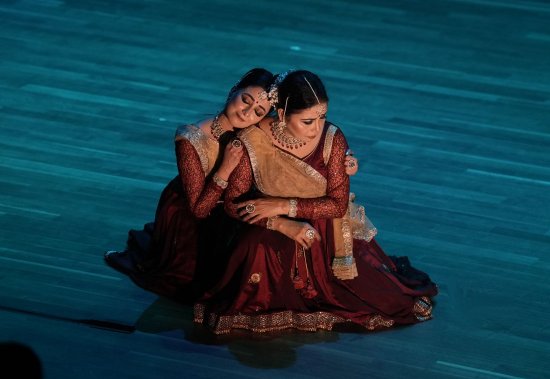 Marami and Meghranjani Medhi An abhinaya piece, completing the theme, was presented with a Borgeet song "Tejore kamala poti", composed by Madhavdeva who is known for his compositions for the classical style of Sattriya nritya, combined with Surdas's immortal bhajan, "Main maiya mori, main nahi makhan khayo". The first song invoked the gentle awakening of Vrindavan, and portrayed Yashoda's vatsalya prem towards Krishna and then the second showed Krishna giving his excuses to Yashoda of why he couldn't have eaten the butter. The parts were played with appropriate actions and histrionics by Marami as Yashoda and Meghranjani as Krishna. The music for this item, where there was a intermingling of two styles of music, from soils of braj and Assam, has been specially composed by Assamese vocalist Joyprakash Medhi. The accompanying artistes were Joyprakash Medhi, husband to Marami Medi, on vocals and harmonium, Amaan Ali Khan from Delhi was on tabla, Ustad Farooq Latif Khan from Mumbai was on sarangi, Parth Bhumkar from Pune was on pakhawaj and Neil Das, husband of Meghranjani Medhi was looking after management. These were very joyous performances that celebrated motherhood showcasing the camaraderie between mothers and daughters, confirming sustenance of the classical arts by passing the arts through to the next generations with voluntary choice, and excellent training signalling the continuation of guru-shishya parampara.  Chandra Anand is a Bharatanatyam artiste and teacher. She has an MA in Bharatanatyam from Tilak Maharashtra Vidyapeeth, and her series on 'Education in spiritual values through Bharatanatyam' is featured in narthaki.com. |
