
|     |
|
| |

 Dvaita Advaita- Sayali Goswami & Pooja Khandelwale-mail: sayaligoswami@gmail.com June 5, 2026 A joint production by Jyotsna Vaidee and Shambhavi Dandekar Presented on April 26 at Cubberley Theatre, Palo Alto, CA Jyotsna Vaidee and Shambhavi Dandekar brought their worlds together in Dvaita Advaita, a production conceptualised and choreographed by both artistes, that wove Bharatanatyam and Kathak into a single philosophical conversation, held together by the music of both the Carnatic and Hindustani traditions. At its heart was a simple but profound idea: that two things can be beautifully, distinctly themselves, and still become one. What gave the evening an added layer of meaning was something that happened the night before. Shambhavi sustained an injury at the final rehearsal and could not perform in full capacity. This was a production she had poured herself into for six months, from concept to choreography, and yet without hesitation she entrusted it entirely to her protégée Surabhi Kulkarni. There is a particular kind of generosity in that, the ability to let go of something so close to your heart and trust another to carry it, because the work itself matters more than who is seen doing it. Shambhavi took her place on padhant, and the team quietly worked through the night so the show could go on. Holding it all together musically was a live orchestra of exceptional depth: Snigdha Venkataramani and Rajat Kulkarni on vocals, Santosh Ravindra Bharathy on mridangam, Tushar Gupte on tabla, Srivathsa Pasumarthi on flute, Souryadeep Bhattacharya on sarod, Rajdeep Singh on harmonium, Aishwarya Raman on nattuvangam, and Guru Shambhavi Dandekar on padhant. 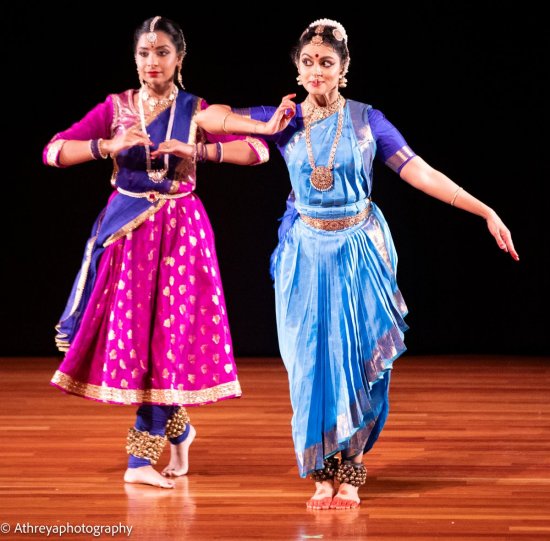 Surabhi Kulkarni & Jyotsna Vaidee The evening opened with the Ardhanarishwar Ashtakam written by Adi Shankaracharya, performed by Jyotsna and Surabhi, and it set the tone beautifully. The piece explored the Dvaita aspect first, the masculine and feminine, Shiva and Parvati, Purusha and Prakriti, with the two dancers embodying these contrasts through their respective forms. Surabhi carried the flowing femininity of Kathak while Jyotsna brought the geometric, grounded strength of Bharatanatyam. The contrast between the two styles was itself a kind of argument for duality; these are not interchangeable forms, and the choreography made no attempt to pretend otherwise. What worked particularly well was how the piece then let those lines blur. As the rhythm built, the separateness began to soften, and the two dancers moved toward something more unified. The shift from Dvaita to Advaita was felt rather than announced, which is exactly as it should be. Jyotsna's expressions while portraying the masculine, Shiva-like energy were especially striking: assured, precise, and fully inhabited. If there was one performance that evening that stopped the room, it was Surabhi's solo. She was not supposed to be performing two weeks ago. She stepped into this role at the last moment, in a major venue, carrying pieces that were not originally hers to carry. None of that was visible on stage. From the moment she walked out, she owned it, every composition, every pause, every padhant phrase. It did not feel like a stand-in performance. It felt like hers. Her Basant Taal, a nine-beat rhythm cycle as an ode to the spring season, was clean, crisp, and joyful. There was a lightness to her movement that felt entirely right for Basant, a playfulness that never tipped into carelessness. The unique Parans from the pakhawaj tradition, passed down through Guru Shambhavi's lineage, were rendered with an ease that only comes from years of deep work. Her padhant drew the audience in naturally, warmly, without effort. What stayed with us, though, was her confidence. Not the performed confidence of someone trying to prove something, but the quiet kind, the kind that comes from knowing exactly where you stand in relation to your art. She did complete justice to her guru's vision, and then some. Jyotsna's Varnam, a tribute to Goddess Chamundeshwari composed by Muthiah Bhagavatar in ragam Vasantha, reminded the audience why the Varnam holds its place as the most demanding piece in the Bharatanatyam repertoire. It asks everything of a dancer: rhythmic precision, emotional range, stamina, and the ability to move between pure nritta and deep abhinaya without losing the thread of either. Jyotsna's abhinaya was the heart of this piece. The Goddess Chamundeshwari carries a duality of her own, the compassionate mother and the fierce, righteous warrior who defeats Mahishasura, and Jyotsna moved between these two aspects with remarkable elegance. Even in the more intense passages depicting the final battle against the demon, there was a refinement to her presentation that never sacrificed grace for power. Her angika was beautiful, her facial expressions completely inhabited. It was a pleasure to watch someone who has clearly lived inside this piece for a long time. When Shambhavi took the stage, the audience already knew the evening she had been through. She performed a Padam by saint-poet Purandaradasa, a piece from the Bharatanatyam tradition presented through Kathak abhinaya, and she did so with limited movement. What she brought instead was pure storytelling. 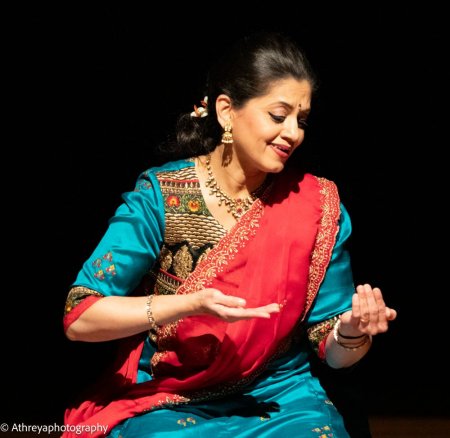 Shambhavi Dandekar The Padam narrates Yashoda's tender, slightly exasperated love for the young Krishna, her gentle threats, her helpless amusement, her final quiet act of ignoring him in prayer until he stops crying. It is a deeply human piece, full of warmth and humor. Watching Shambhavi connect the audience to Yashoda's world that evening, given everything else that was happening offstage, felt like witnessing something quite special. The artistry was fully there, even when the body could only do so much. Some performers take years to understand that abhinaya lives in stillness as much as in movement. It was evident she has always known this. The crossover pieces were conceptually the most interesting part of the production, and Jyotsna's presentation of the Thumri "Jamuna kinare mera gaon" was a highlight. A Thumri, traditionally at home in the Hindustani and Kathak world and saturated with shringar, presented through Bharatanatyam grammar is not something one sees often. Frankly, it is something that could go very wrong in lesser hands. It didn't. Jyotsna brought genuine emotional depth to Radha's invitation to Krishna, and the Bharatanatyam structure held the piece beautifully without flattening its lyrical quality. The incorporation of the Kavit bol "Nachatha Gopala" was a lovely addition. Taken together with Shambhavi's Kathak presentation of a Bharatanatyam Padam, these two crossover pieces made the evening's central argument more convincingly than any spoken words could have: that the soul of expression is not bound by the form that carries it. The finale brought Jyotsna and Surabhi back together for the Thillana - Tarana, the crowning pieces of their respective traditions, set to raga Bhairavi and Sindhu Bhairavi. This is where the Advaita finally arrived in full. Watching the Mei Adavu of Bharatanatyam find its shape in Kathak's verticality, and the Gat Chaal of the North settle into the southern structure, was genuinely exciting. The dancers were not simply alternating between styles; they were threading them together, and the thread held. By the time the piece reached its close, the earlier separateness of the two forms felt like a memory. That is a difficult thing to choreograph, and a more difficult thing to perform. The audience was with the production every step of the way. By the time the finale drew to a close, the response was immediate and unanimous: the audience rose to its feet. Dvaita Advaita was, above all, an evening of resilience. A production that faced a genuine crisis the night before, and chose to go on. That in itself was the truest expression of the production's theme.  Sayali Shetye Goswami is a Gandabandh Shagirdh of Guru Uma Dogra of the Jaipur Gharana, and holds a Master's degree in Kathak from Samved School of Kathak and Society for Performing Arts. A recipient of the 'Singar Mani' title by Sur Singar Sansad in 2006, she is the founder of Kathakaars School of Dance, based in the Bay Area. |
