
|     |
|
| |

 Parampara: From Pune to Paris- Sonya Wynne Singhe-mail: sonya.s.wynne@gmail.com June 6, 2026 On the evening of 30th May, the day Paris St-Germain lifted the UEFA Champions League trophy, another kind of magic was unfolding at the Centre Mandapa in Paris 13. Guru Sucheta Chapekar, a renowned exponent of Bharatanatyam in India and abroad, along with her disciple Jyotika Rao, and in turn her students Anjeli Romero and Mathieu Convert were presenting 'Parampara'. Parampara -- a word that evokes the themes of preservation, perpetuation and progression -- was a fitting concept for an evening dedicated to the living legacy of a classical art form and the guru-shishya tradition. The auditorium was filled beyond capacity. Each one present had braved the 37°C heat outside to see the ever-graceful and immensely talented Sucheta Chapekar perform. 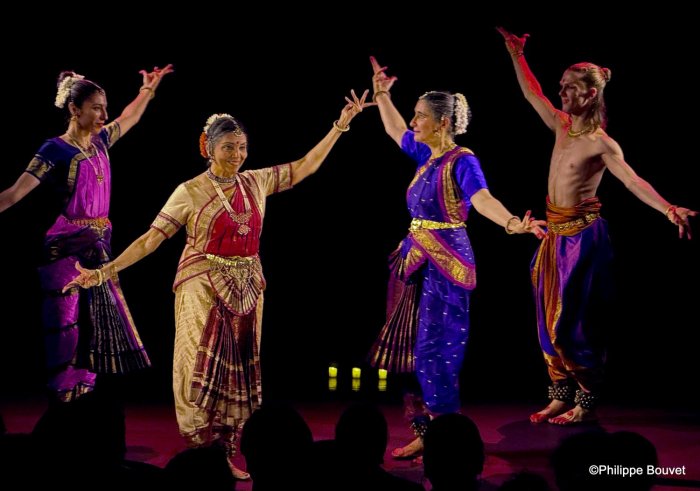 Sucheta Bhide Chapekar performing with Jyotika Rao, Anjeli Romero, Mathieu Convert (Photo: Philippe Bouvet) The program began with a Ganesh Kirtanam by Sucheta tai, as she is affectionately called by not just her disciples but all those who cherish the arts. The enthralled audience journeyed with her through each movement, each mudra as she brought to life the Vighnaharna vividly to life. This was followed by a Saraswati stuti performed by Jyotika Rao and Anjeli Romero, both students of Sucheta Chapekar. Mathieu Convert, a contemporary dancer currently learning Bharatanatyam, then presented an interpretation of Ashtamangal. Next Sucheta Chapekar presented three padams, each portraying a different nayika expressing her anger and jealousy towards an errant lover. While the Radha in Yahi Madhava showed complete rejection, the second khandita nayika revealed the sting of jealousy and the third one welcomed her beloved with maturity, grace and composure. The last is drawn from a Marathi padam Sakhi Yaata. 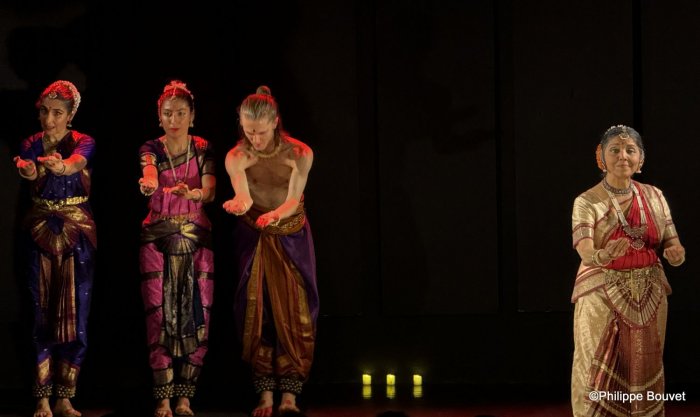 Sucheta Bhide Chapekar performing with Jyotika Rao, Mathieu Convert and Anjeli Romero (Photo: Philippe Bouvet) Through these three portrayals, the audience experienced the remarkably large gamut of expressions in Sucheta Chapekar's abhinaya. Jyotika and Anjeli then returned to the stage to present an ukti prayukti padam, a playful dialogue between Shiva and Parvati where each effort and plea made by Shiva to gain entry into Parvati's chamber was met with a witty retort from his consort, much to the audience's delight. The evening would not have been complete without a Tillana. The guru along with her disciples presented a vibrant Hindolam Tillana set to adi talam and captivated the audience by its rhythm and energy. The evening ended on a serene and auspicious note, with Sucheta tai performing Nithya Mangala, a prayer invoking peace, harmony and well-being for all present. 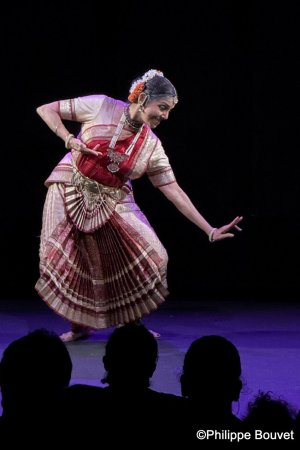
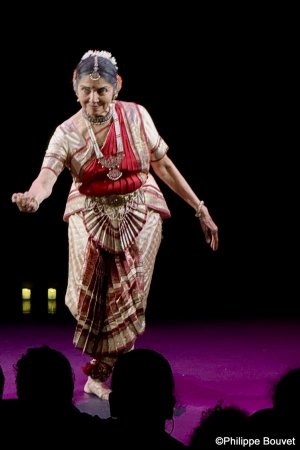
Photos: Philippe Bouvet With over five decades of active involvement in dance, Sucheta Chapekar has left an indelible mark on the world of Bharatanatyam. A disciple of Gurus Parvati Kumar and K.P. Kittappa Pillai, she broke boundaries in 1982 with Nritya Ganga, an innovative experiment that brought together the classicism of Bharatanatyam and Hindustani classical music with the use of the pakhawaj. Beyond being an accomplished performer and teacher, Sucheta Chapekar is a distinguished choreographer and academician. Her book Nrityatmika, which explores various dimensions of Bharatanatyam, was originally written in Marathi and later translated and published in English. Several of her scholarly works have been presented at important conferences as well. Among numerous honours, in 2007 she received the prestigious Sangeet Natak Akademi award. Sucheta Chapekar is the Founder-Director of Kalavardhini Charitable Trust. Along with all this, she is a deeply respected and appreciated guru whose disciples are spread across the globe. Yet, I suspect she has a small penchant for France. When I asked her about her multiple trips to France since 1979 and all the memories of teaching the French students, she replied with characteristic simplicity in a matter of fact way, "Perhaps I was French in a previous life!" Her connection with France has been both enduring and fruitful. Dominique Biard, Pauline Reibell, Jyotika Rao from Paris, Armelle Choquard from Arles, Jyoti from Grenoble, Jessie Veeratherapally from Nice, are continuing the legacy of their guru Sucheta Chapekar with the guru-shishya parampara and have gone on to carve careers in dance. Interestingly, in her article in Ashish Khokar's attenDance 2025, Sucheta Chapekar wrote about a quality she found particularly striking among French students. She observed that they were deeply fascinated by and readily grasped the concept of the saguna and nirguna aspects of the Divine and the perception of Gods as humans. They responded enthusiastically to the music and when the narrative was explained, they appreciated the abhinaya also. Hence, while conducting workshops, she always begins by explaining the philosophical, mythological, practical, and social significance of the composition. This approach, she believes minimizes the language and culture barriers and allows students to engage more meaningfully with the art form. When asked whether the concept of Nritya Ganga could be adopted to combine Bharatanatyam and western classical music, her reply was characteristically direct and memorable: "You can't mix chicken curry and basundi, they both have their own taste." As we were coming towards the end of our interview, I raised the subject that many classical art lovers discuss in hushed tones: Will Bollywood dance eventually overshadow the classical forms? Once again, her answer was thoughtful, measured and direct. She pointed out that just as the Natyashastra recognizes the existence of dasarupakas, different artistic forms have coexisted and will continue to coexist. She went on to add that human beings need variety and diversity but it becomes the responsibilty of the older generation to nuture interest and appreciation among the younger audiences to keep our heritage alive. This she emphasized is why more lecture demonstrations are needed to cultivate an informed, vibrant and engaged audience. The last question I asked her was which dancer filled her with admiration and enchantement. Immediately Sucheta tai's beautiful blue eyes lit up and she said, "Bala. No one is like her." The two hours of the interview passed in what felt like minutes. Sucheta Chapekar was so engaging, insightful and endearing that time seemed to disappear. She spoke with remarkable clarity expressing her ideas with conviction and a refreshing candor and directness. Yet, it's not only what she says that captivates. Her expressive eyes, graceful gestures and a laughter that retains the joy of a sixteen-year-old all bring her thoughts to life. This effortless artistry in the way she speaks is like the elegance and poise she brings to her dance. I came away from our conversation and her performance with a strong feeling of admiration and an even stronger desire to see her perform on stage again. 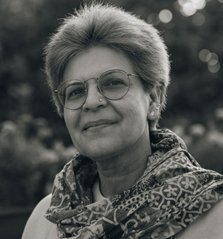 Sonya Wynne Singh is a senior talent in art books publishing from 1980's and recently guest-edited 'Indian Dance in France' for attenDance 2025. She lives and reports for various publications from France. |
