
e-mail: leelakaverivenkat@gmail.com
Music Academy's annual Mid Year Dance Festival
presents variety of competing young talents
July 30, 2025
The Madras Music Academy's annual Mid Year Dance Festival (July 17-19)
at the mini hall, facilitated by the endowment of the family of late
M.N. Subramaniam, projected a select group of young talents - comprising
one Mohiniattam exception, amidst a predominantly Bharatanatyam group -
all meticulously trained with good grasp over dance technique and line.
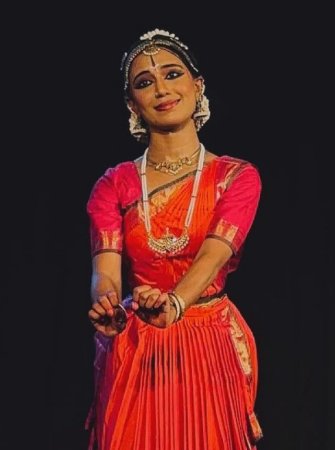
Sai Brinda Ramachandran
Heralding a start, was Sai Brinda Ramachandran, a student of Indira
Kadambi with Jayachamaraja Wodeyar's Keertanam in Malavi ragam "Shankari
Sadananda Lahiri." A brief veena overture, ushered in a poised,
measured dancer, her movement clarity sans any type of fudging, in
keeping with the accompanying team comprising a balanced team of
musicians led by Indira Kadambi's nattuvangam, with mridangam support
provided by G.S. Nagaraj. Vocalist Abhirama G.Bode's rendition,
characterized by clear enunciation of the sahitya in terms like Shankari
Sadanandalahiri, Chintamanigriha, Brihannayaki, Shakambari, qualifying
the Goddess, with Raghu Simha and N. Anantanarayanan providing melodic
embellishment on the flute and veena, were all a well combined effort.
Flawlessly rendered, was the centrepiece, K.N. Dandayudapani Pillai's
varnam in Poorvikalyani, "Saamiyai vara solladi," with the interspersed
teermanam rhythm punctuations. Portraying the lovelorn Nayika
entreating, cajoling and chiding the sakhi, in turns, comprised the
entire varnam effort. The persuasion was to convey the urgency of the
nayika's message of love to the great son of Shivagami, to make haste to
her side. Bemoaning her state wherein time seems to stand still with
each moment stretching endlessly, in the second half interspersed with
solfa passages, in the punch line, the Nayika berating the reluctant
sakhi, asks if her heart is made of stone that she is still tarrying.
Sung in slow paced Punnagavarali, the Kshetrayya padam "Ninnu Joochi" in
the typical style of late Kalanidhi Narayanan, Indira Kadambi's
abhinaya Guru, saw the Nayika's quiet ecstasy on answering the knock on
the door, seeing before her the figure of the long absent beloved. At a
contrasting brisk pace was the finale with Lalgudi Jayaraman's Tillana
composition in Mohanakalyani. The composure and poise of the dancer
impressed.
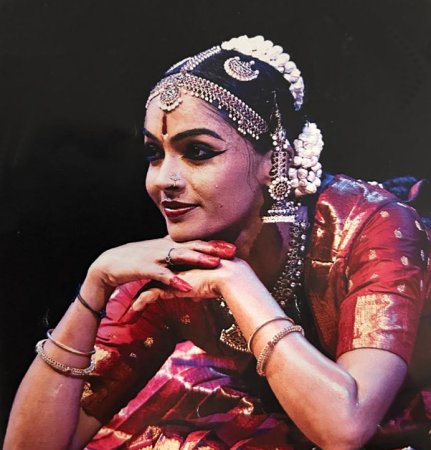
K Aswathi
Commencing with an artfully knitted Jayachamaraja Wodeyar Keertanam "Sri
Jalandhara" and Alarippu in raga Nattai, K.Aswathi groomed under
Shijith Nambiar, revealed, along with her exceptional talent, the
enhanced artistry, contributed by the Guru's presentational aesthetics.
An Alarippu movement for instance, presented in angled profile, away
from the usual frontal treatment, has a different appeal. So too, the
punch and vivacity in the fractional moment of an uninterrupted
continuity, when sahitya laden dance yields place to the Tam dhit tam,
tai tat thai nritta of the Alarippu. Since Aswathi's very involved
rendition of the varnam in Behag, "Vanajaksha ninne nammiti," a
composition of T.R. Subramaniam, has been recently commented upon in
this very column, while generally commending the out-of-the usual
sancharis while visualizing the heroine's adoration of Krishna, one
would like to comment on the emotive strength of the accompaniment she
had. Janani Hamsini Narasimha's bhavam filled singing, supported fully
by K.P. Nandini's interventions on the violin, with sensitive mridangam
support by Charudutt - all led by Shijith Nambiar's spirited
nattuvangam, Aswathi had strong support.
But in a fine performance, the item which set her apart from all the
rest, with the stillness and internalized power of this dancer's
abhinaya, was Arunachala Kavirayar's Padam in Huseni "Eppadi manam
thunindado." Even as the city of Ayodhya is rejoicing over Rama's
awaited coronation as King, Sita joyously welcoming Rama to her boudoir,
learns of his banishment. But what stings her beyond belief, is his
decision to take leave of her before proceeding on exile for fourteen
years. She demands, as to how his mind, after exchange of all the
marriage vows, could stoop to reconciling itself to a fourteen year
separation. "Taking my hand and going round the fire, did you not take
the oath that you and I would never be separated - and that our union
was for all time - including births yet to come!" The silence and
strength of the dancer's interpretation, totally without resorting to
over blown histrionics, succeeded in evoking a feel of withering
condemnation of Rama. The way the item was visualized, with a fleeting
snatch of 'Gowrie Kalyanam' with a happy Sita playing on the veena,
rising joyously to greet Rama on the announcement of his investiture as
King, followed by the contrast in what follows. Aswathi's
rendition in its emotive power, had the audience totally involved - the
aftermath leaving one drained, with a great sense of emptiness.
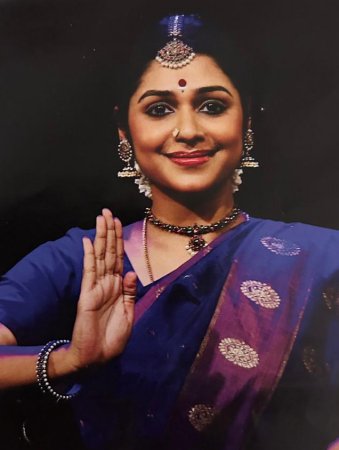
Shruthipriya Vignesh
On day 2, Shruthipriya Vignesh, a student of Nithyakalyani Vaidyanathan,
began with a prayer to the Guru through a rare slokam, offering
salutations to the Guru, who, while without the distinguishing divine
aspects, is equal to Shiva, Vishnu and Brahma. The much-rendered Tanjore
quartet varnam "Sakhiye inda velaiyil" in Anandabhairavi, brought to
the fore, the dancer's mobile facial expressions, reacting to each word
of the sahitya. In the very first line, it was interesting to see the
many variations spun round the word 'Inda velai' (at this moment) while
addressing the sakhi who is being persuaded to play messenger, conveying
to her beloved Ragagopala ensconced in the tirunagar, the urgency of
her love. With her guru providing the nattuvangam, the nritta
interludes of teermanams and arudis were rendered with exactitude, the
dancer's movement agility dealing with mandi adavus with ease.
It was a high profile team providing accompaniment with veteran K.
Hariprasad's vocal, S Govindarajan on mridangam, E Devaraj on flute and
D. Ananthanarayanan on the veena. While admiring the dancer's poise as
the ankle bells on one leg fell off (and by the time of the charanam
praising the pangana Mayile, the other set of ankle bells too had come
off), one feels that dancers need to rely on buckled fasteners instead
of relying on Velcro, which cannot take so much movement. Shedding bits
of accoutrements while performing does detract from performance
artistry. The dancer's presentation of the Ghanam Seenayya's padam
"Shivadeeksha parulalanu raane," which very few dancers present today,
was surprisingly convincing. This very unusual picture of temptation
shows the nayika, brought up in the traditions of Shiva bhakti, having
to keep at bay the temptation from the Vaishnavite knocking at the doors
of the altar. The either/or situation was well caught. In a very
different mood was the Purandharadasa "Adahothale makkalu" showing young
Krishna's confusion and reluctance to join the other youngsters at
play. He is teased and taunted about not being Yashoda's biological son
and having a reputation for stealing butter! "The story is that your bed
is a coiled snake and that you were born in jail, to parents Vasudeva
and Devaki who were prisoners.'' The dancer followed with a convincing
performance.
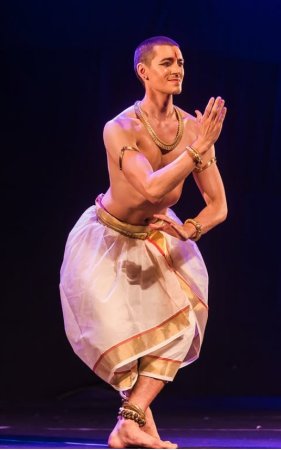
Thomas Vo Van Tao
Thomas Vo Van Tao's devotion to Mohiniattam, which he has been learning
for fourteen years under Dr. Neena Prasad, has to be commended, not only
for its technical exactitude, but also for the steadfast devotion with
which this dancer of mixed French/Asian parentage, has diligently
practiced a dance form predominantly designed for female dancers. The
starting 'Cholkettu composition in Hamsadhwani set to khanda triputa
talam composed by musician Chenganassery Madhavan Namboothiri (who for
years has been the music composer for Neena Prasad), brought out the
dancer's clean technique. Projecting him, both in his growing
ability for choice of composition, coupled with creative enthusiasm to
choreograph (thanks to the freedom to grow given by Neena), was the
Shyama Sastri Swarajati in Todi, "Rave Himagiri Kumari Kanchi
Kamakshi." Wisely selecting a song calling out to the Goddess in
an intense mood of prayer, gave free space for rendition by a male
dancer, instead of a customary sringar centrepiece fashioned round the
Nayika, in a female oriented form. Not only did the dancer address the
Goddess with deep reverence, but he also brought out effectively her
qualities as the Kamalamukhi, Kanchi Kamakshi, Gajagamana (graceful walk
like the elephant), daughter of the Himalayas (Himagiri Kumari).
Calling out to the Goddess to be his saviour, he depicts her as Mahisha
Mardhini or slayer of the evil Mahisha. The dancer's understanding of
the art form was also reflected in the measured, slow rendition of the
swarajati in Todi. Rendered at pace, the mood of the composition
would have been totally lost. And in preserving the vilamba kala
rendition, with most of the singing in the lower octave was not easy and
singer Srividya Ramanath needs to be lauded. With Neena Prasad
conducting, K.P. Nandini was on the violin with Prithvi Krishna on
mridangam. In the typical Mohiniyattam tone were the edakka
interventions by Kalamandalam Arun Das.
Of the pure abhinaya items, Iraiyaman Tampi's padam "Entaho Vallabha"
projected the Nayika asking why, despite her unfailing love, her loved
one is neglecting her. Both bodily attitudes and expansion of the
statements, reflected the Nayika negating the feel of a male body. The
Jayadeva ashtapadi "Mamiyam Chalita" set to ragam Desh portrayed
remorseful Krishna, bemoaning his flirtatious behaviour, which has so
anguished Radha, sending her away from the woods where she came seeking
him. Here it was the male reflected in abhinaya conviction. The dancer
concluded with the Tillana in Madhyamavathi - again Chenganassery
Madhavan Namboothiri's composition.
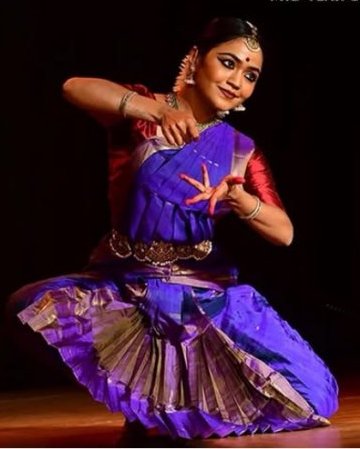
Vaishnavi Dhore
On day 3, Rama Vaidyanathan's student Vaishnavi Vitthal Dhore, performed
with the handicap, of the intended vocalist Janani Hamsini Narasimhan
with whom the performance rehearsals had taken place, opting out for
unavoidable reasons. With sessions with the new singer Vishnupriya
Rangarajan inadequate, compounding the effort was sound balancing which
showed problems - quite unlike Music Academy's generally impeccable
arrangements, with S. Vijay Kumar's nattuvangam and Yeshwant Hampiholi's
mridangam marred by overloud decibels. The vocalist hitting the
odd flat notes later complained about not being able to get the
feedback. Vaishnavi's rendition of the Tanjore Quartet varnam in Khamas,
while technically flawless, for this critic, seemed to project the
Nayika's adoration for Sri Tanjapuri Brihadeeshwara, at an unrelieved
pacey clip from start to finish. The counterfoil of softer touches, even
in the charanam line calling out to the sakhi "Rave na maata..." (Come
listen to my words) were missing.
Sita's plaint "Eppadi manam tunindado" as conceived by Vaishnavi,
projected a more aggressively bold Sita, demanding how Rama could have
so easily forgotten his marriage vows - different from the anguished
query of Aswathi. Hitting a different tone, on a note of protest
against societal discrimination, the Abhang was a fine addition - which
Rama Vaidyanathan has often used for her compositions in Bharatanatyam.
Sant Chokkamela's 'Abhir Gulalit Udhalit Abhang' has the 14th century
Marathi saint from Mahar caste, calling out to lord Vithal's (Vitthoba)
manifestation, prevented from partaking in the gulal throwing inside the
temple because of his low caste. The finale was a Lalgudi Jayaraman
Thillana in Madhuvanti ragam.
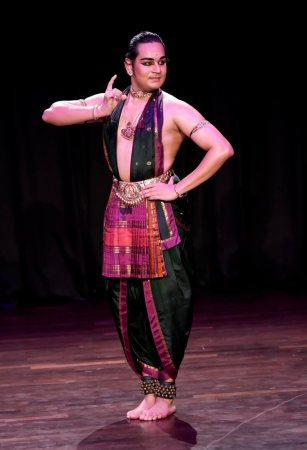
Mohanapriyan Thavarajah
The concluding dancer from Singapore, Mohanapriyan Thavarajah, a student
of Priyadarsini Govind, displayed commendable grasp over technique and
interpretative dance, starting with Sivapuranam in a raga/talamalika
composed by Dr. Rajkumar Bharathi. Considered against the fact that the
chosen Bhairavi varnam "Mohamana en meedu," so completely designed for
and associated with, the pining Nayika, could have proved to be awkward
for a male dancer, Mohanapriyan's presentation and involved rendition
deserve praise. The sancharis woven round lines like "Bhoga Tyagesa
anubhogam seyya vaa," with the nayika inviting her epicurean beloved,
offering herself body and soul to him, were suggestive and rendered with
panache.
The teermanams met with impeccable presentation, with Jayashree
Ramanathan who has often conducted Priyadarsini's programs providing the
nattuvangam lead. With Dr. Sreedev Rajagopalan's vocal support, the
rest of the supporting team comprised names familiar to Chennai
audiences of V. Vedakrishna's mridangam, K.P. Nandini's violin and
Sashidhar on flute. The way the padam in Madhyamawati, a Oothukadu
Venkatasubba Iyer composition "Adathu asangathu va" was treated, was
also very interesting. Here, instead of the sway and lilt of little
Krishna's dance, walking, running or performing on the snake (making
even Shiva seem the lesser dancer), the composition imagines Shiva
snatching the snake and winding it round his own neck, challenging
little Krishna with a snake, that can neither sway nor dance. The dancer
ended with a Tillana in Jonpuri.
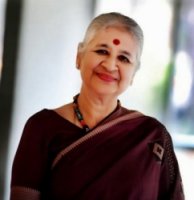
Writing on the dance scene for the last forty years, Leela
Venkataraman's incisive comments on performances of all
dance forms, participation in dance discussions both in
India and abroad, and as a regular contributor to Hindu
Friday Review, journals like Sruti and Nartanam, makes her
voice respected for its balanced critiquing. She is the
author of several books like Indian Classical dance:
Tradition in Transition, Classical Dance in India and Indian Classical dance: The Renaissance and Beyond.
Post your comments
Please provide your name and email id along with your comment. All appropriate comments posted with
name and email id in the blog will also be featured in the
site.
|