
|     |
|
| |

 e-mail: leelakaverivenkat@gmail.com Utsav Educational and Cultural Society's Sare Jahan Se Achha devoted to memory of Guru Mayadhar RautAugust 28, 2025 SARE JAHAN SE ACHHA Photos: Krishna Chakraborty Dedicated to the memory of late Guru Mayadhar Raut, was the two-day festival Sare Jahan Se Achha (Aug 12 & 13) at the Habitat Auditorium, Delhi. This annual flagship event, curated by senior dancer Ranjana Gauhar and held under the auspices of her organization Utsav Educational and Cultural Society, was marking its twentieth consecutive year of celebration, with the Utsav Samman awardees for this year being Bharatanatyam exponent Geeta Chandran, Odissi dancer Geeta Mahalik and dance historian, author and critic Ashish Khokar. During the formal inauguration followed by pithy awardee statements of thanksgiving, Geeta Chandran pinpointing the significance of the event and Samman, mentioned the special merit of an award coming from a fellow artiste, competing in the same space for recognitions. She complimented Ranjana on successfully heralding twenty consecutive years of celebrating Sare Jahan Se Achha as no mean achievement and more creditable was managing to attract a decent audience. 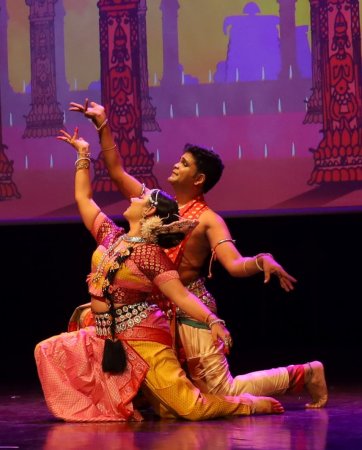 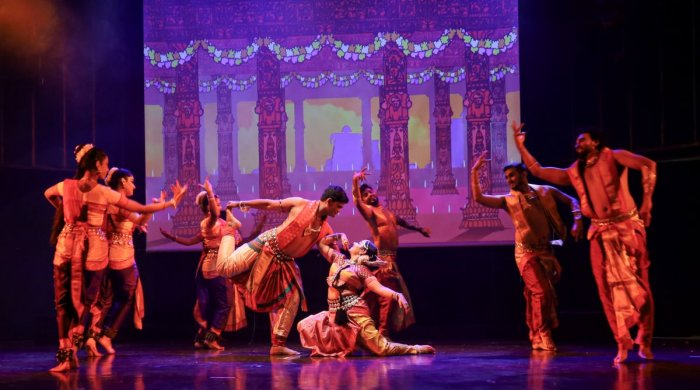 Nal Damayanti Combining Ranjana's experience in theatre, dance, film, it was a novel start to the festival with a collaborative effort comprising Siddharta Daniel's animation work, with dance in Odissi and Chhau genres- sharing the stage in a simultaneity of narration - the choreographic effort by Ranjana, built round the tale of Nal Damayanti. While the Odissi was by students of Ranjana, the excellent Chhau performers were students of Santosh Nair. Who does not know the story of Nal Damayanti, and how King Nala was enticed into a dice game by evil spirits, which cost him his kingdom and everything he held dear - to be exiled to the forest, and to the land of the serpents. Stung by a reptile, with his changed appearance, donning a new identity as Bahuka, he found a place as charioteer for King Rituparna of Ayodhya - till finally redeemed as King Nala joining wife Damayanti. The beautiful swan flying in all its grace, has a special place in the story, being the messenger bringing together King Nala who has not found the ideal mate to wed, and princess Damayanti who turns away all suitors who only seem to eye her with lust in mind. Against a backdrop of the swan flapping wings and flying gracefully across the citadels, the dancer swans with the male Chhau dancers, were a delight. Since it was a story telling with animation (like the Amar Chitra Katha, to quote one dancer), the straight forward narration carried no elaborative details. Vrinda Chadha made a convincing Damayanti with her sakhis, and Nala inevitably was Vinod Kevin Bachan, Ranjana's faithful male SNA awardee student. The ensemble of so many streams of narration, was efficiently done. Substantiating the patriotic underpinnings comprising the Sare Jahan se Achha title, while also embodying homage to Ranjana's Guru in the Guru/shishya parampara mode, a group of students of Ranjana, Anika Tandon and Lavanya Chugh, Gayatri Bhargav, Thaza Bhattacharya, Noor Grover, Reetshika Dutta, Poulami and Moksha Dhian Kochar, presented a short choreography of Vande Mataram, Bankim Chandra Chatterjee's famous creation, in the Odissi format as choreographed by Ranjana Gauhar, with creative musical inputs on the original A R Rehman composition, by Saroj Mahanty. The next item was another group version Odissi of Mohammad Iqbal's "Sare Jahan Se Achha". The mimetic phases were interspersed with known arasa (nritta) passages from Odissi compositions, which constitutes a feature of Ranjana's choreography. 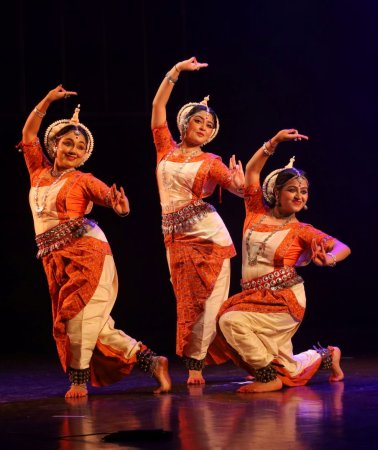 Lalitha Lavangalata Presentation of the Ashtapadi Lalitha Lavangalata, with music composed by Bankim Sethi in ragas Miakimalhar and Jhinjhoti set to ek taal, saw Vrinda Chadha, Anika Tandon and Lavanya Chugh, in a choreographic take, built round Sakhis only, without reference to the Gita Govinda context - in a scene of enjoying the unvarnished profusion and happiness of Vasanta or Spring. Ranjana as the choreographer when queried, mentioned artistic freedom, in looking at the poetry, in a context away from its original setting by poet Jayadeva . One has no quarrels with artistic license, though how far one can go, and how convincingly, is a different point. In Jayadeva's placement of this Ashtapadi, even as Radha's eyes feast on the profusion of Spring in full bloom, her mind's eye sees Krishna frolicking with maids in the midst of Nature's plenty, and she is plagued by jealousy and the heart ache of unrequited love at his absence. For a dance writer, having watched this Ashtapadi over forty odd years, rendered countless times in manifold dance forms, interpreting Nature's plenty amidst Radha's ache, with the refrain Viharati haririha sarasavasante ringing in one's ears, tearing the poetry (which many can recite back to front ) out of its Gita Govinda context and eying it with an original slant - no matter how few the stanzas used, was a bit like accepting 'Hamlet without the Prince of Denmark'. 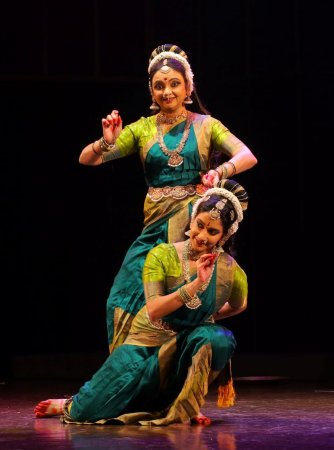 Deepika Reddy & Shloka Reddy Half hour slots of performances in various dance genres made for a varied second evening. Having occupied coveted positions like heading Telangana's SNA, dancer Deepika Reddy's Kuchipudi with daughter/disciple Shloka Reddy, saw mother and daughter, make an ideal foil for each other - Deepika's now rather sedate dance, counter pointed by the agility, quicksilver flamboyance and winsomely expressive dancing of Shloka. Following a crisp homage to Vijaya Ganapati and Balatripurasundari, came a composition of Ramadas, an ardent devotee of Rama "Takku vemi manaku," set to raga Saurashtram, portraying homage to the Lord citing his Dashavataram references, starting with Koorma avataram and ending with Kalki avataram. The recorded music comprising D.R.K Sastry's music was one of the best features adding to the quality of the performance. 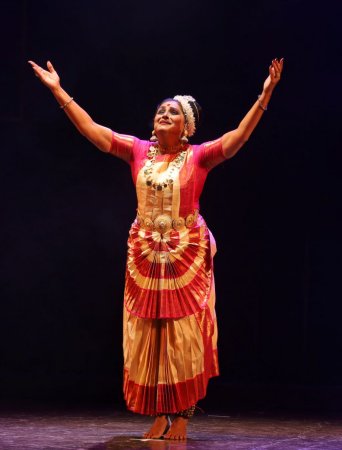 Sunanda Nair One of the very senior Mohiniyattam dancers Dr. Sunanda Nair, who has earned the Kerala Kalamandalam award for her dance, was seen taking the Delhi stage after a long time. She started with a pure dance item Tatvam, a composition of her Guru Kanak Rele, where the sollukettu of Ka cha ta, ta, pa - representing the Thou Art That principle, contained in every abstraction of movement and of Nada, a representation of the soul's journey to eternity - a very Indian philosophical concept, spun into the language of abstract rhythm and movement, requiring deep internalization in a dancer - which Sunanda ideally has. Her next item on Kubja based on a Padam "Teli Viyalum" in Punnagavarali ragam and misrachapu talam, was built round the epic story of the Hunchback, whose fate of having to make sandal paste to anoint the body of Kamsa, seemed endless, till her fervent prayers of call are answered in ultimate redemption, in the blissful embrace of Krishna, who rescues his ardent devotee. Sunanda's interpretative power was the highpoint of abhinaya in the festival for this critic. 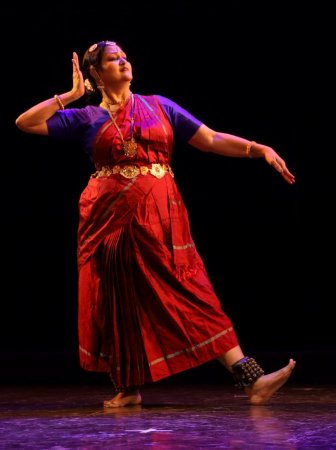 Srimathy Madkholkar Less known to Delhi audiences, Bharatanatyam Guru Srimathy Madkholkar based in Maharashtra, training students in Nagpur University, was introduced as having been groomed in more than one parampara - starting with a Vazhuvoor Guru and ending with the Mysore school of Bharatanatyam while living in Bangalore, learning under Lalitha Srinivasan. One would have thought that some stylistic features of the Mysore school would be evident in her presentation. But the solo interpretative rendition commencing with the shloka "Purvam yatra samam" before presenting the Ashtapadi "Dheera sameere Yamuna teere vasati vane Vanamali" with music in Yamunakalyani set to adi talam, carried little impact. Portraying the Sakhi, urging Radha to shed her hurt feelings and inhibitions and join Krishna where he awaits her presence on the banks of the Jamuna, the feel of urgency in the Sakhi's message, required more than the rather tepid performance. 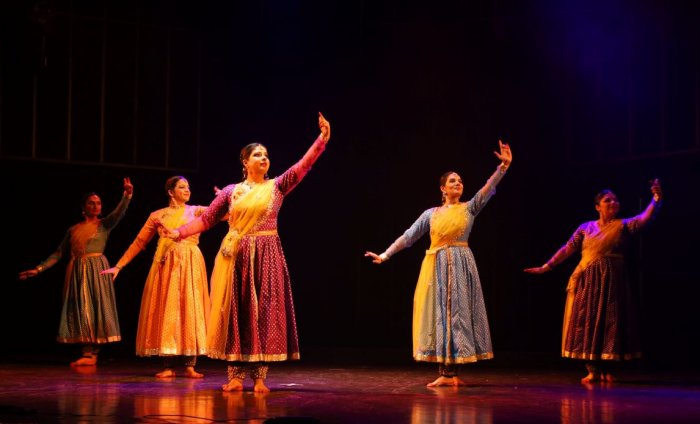 Vidha Lal & disciples The finale saw a vibrant performance in Kathak by Vidha Lal with her students Era Dogra, Anjali Munjal, Anamika Munjal and Arushi Lal. The start was with Ardhanareshwara with Vidha's choreography based on the music set in raga Bhimpalasi by her teacher Geetanjali Lal. Describing one half as "Ardhakesha Ganga ke dhaar, Chandrapal kesha Ganga," the concept of Siva/Parvati in one entity makes for a complementing of contrasts, and Vidha showed that she has choreographic ideas which are emerging, and with maturing will make for greater impact in the dance productions. The abhinaya oriented lyrical composition "Kaise nikasi chandani" again musically set in raga Bahar by Geetanjali Lal which Vidha presented, successfully conveyed the romantic, lyrical expectation with celebration of unspoken romance of night. There was a fleeting moment showing the abhisarika setting out to meet her lover on the sharad night, the heart beating for a tryst with Krishna, and it is understood that he appears and dances with her. The finale of the program, again by the group was pure nritta in an exhibition of Kathak's footwork magic, in Lakshmi taal of 18 matras - and the 4+4+4+4+2 arithmetic was brought out with clarity, even in the drut laya pointing to Vidha's growing abilities as a teacher. MONSOON FESTIVAL SANS MONSOON THEMES Years ago, one remembers the Monsoon Festival at the India International Centre built round dance forms dealing with themes surrounding the rainy season. All that is in the past for now it is like any other festival, except that it is held during the monsoon season. 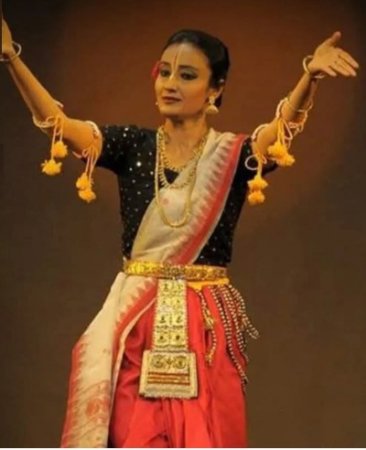 Shrobana Mitra Das The Manipuri dancer Shrobana Mitra Das, who took the stage of CD Deshmukh auditorium in the first half of the festival on August 20, not familiar to Delhi dance audiences, presented just two items barely covering forty minutes along with introductions, while the time allotted was one hour. She began with an invocatory Surya Mahima, dedicated to the homage of the early rising sun rescuing earth from darkness with the light embracing earth and the oceans - an original composition of late Guru Babu Singh choreographed by the dancer's guru, Priti Patel. Kumhei, the next composition, is a celebration of womanhood and of life itself - the particularly enterprising women of Manipur being known for their courage and active participation in the social, political and cultural activities of the State - contributing handsomely to the economic age through activities like weaving, yarn making, embroidery, sowing paddy etc - adding more than due to the welfare of the State. Meira Paibi, a collective movement of the 1980s, showed the exemplary courage of women, spontaneously safeguarding youth, keeping vigil with burning torches in hand to safeguard Manipuri youth. Shrobana's presentation was an enigma for this critic, for it seemed to have a very superficial feel, not commensurate with what one expected (as per the opening announcement about the dancer) of "an ICCR empaneled artist, a cultural ambassador of India, who is a visionary behind Riyom Society, who has received numerous awards like Dr.Sarojini Naidu International Award, and Padmavati Rashtriya Puraskar." As a long-time student of Priti Patel, one of the most creative Manipuri artistes of India, one expected something more emphatic in terms of movement and performance. No matter what the dance form, performance should evoke a feel of conviction, emerging from a body with long years of commitment to that type of movement language. Looking so slender that a breeze would blow her away, Shrobana's choreography and presentation completely lacked that feel of long-time training. While she has all the right ideas in what she wants to present, I feel that its translation into performance requires a great deal more - a stronger dance, with greater strength of stylization in movement. Dance is a jealous mistress and requires hours of toil. Whether a martial art movement of a Thang Ta sword swirl or a movement showing childbirth, of rearing a child, or engaging in agricultural tasks, there has to be an emphatic quality of the stylized vocabulary along with inevitable grace. Not having live music perhaps aggravated the sense of emptiness though music on tape had the typical Manipuri singing style with Pung, and with snatches on the stringed instrument, the Pena. IDEAL TEACHER/STUDENT CHEMISTRY The next half of the evening by Kuchipudi dancer Washim Raja, exemplified two aspects - one of total commitment to the art form by one who gave up the legal profession to devote a life to dance, and the next of perfect Guru/shishya chemistry, which alone grooms the best of dancers. Washim, a student of Kuchipudi Guru Vanashree Rao, with his involved performances, in the briefest of time has been earning plaudits everywhere. The very starting invocation "Pashupate Girijapate" was marked by impassioned dancing, with an excellently balanced body, impeccable anga shuddhi, phenomenal control over laya and tala, topped by a deep capacity for internalization - all features of Washim's dance. The Shiva/Shakti contrasts, with the feminine allure of Kasturi Gauranga Ardhangi against the manly dignity of Shiva were brought out with great clarity with the flow of the dance never suffering. One of the features of the performance was the evocative music, though not live, in Vasanta ragam set to ektali, with K. Venkteshwaran's vocal support, R. Kesavan on mridangam and other percussive instruments setting the jatis, R. Raghavendra on violin, Rajat Prasanna on flute, Varun on ghatam and special effects, and Shyamala Bhaskaran on the veena. 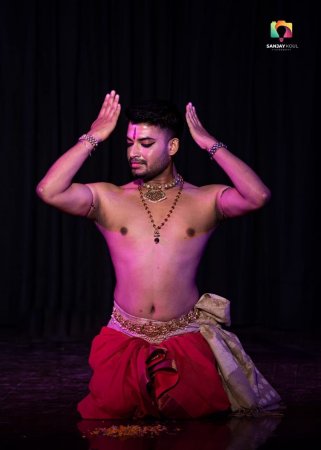 Washim Raja (Photo: Sanjay Koul) The pure abhinaya part based on the Ashtapadi "Rati sukha sare, gaatamabhisare madana mohana vesham" wherein the Sakhi working at uniting Krishna with Radha, paints before pining Radha, the desolate picture of Krishna yearning for her and looking for her footsteps in every leaf fall, was visualized according to Vanashree's choreographic interpretation wherein she vividly captures, in a dramatic manner, the three characters involved - namely Radha, Krishna and the Sakhi. Washim's involved rendition evocatively caught the trio comprising an expectant Krishna, a pining Radha and pacifier Sakhi. Vanashree's idea of music to be set in Vaasanti ragam, caught the mood in the Ashtapadi very well. The concluding item "Deva devan bhaje" in Hindolam with the talam of the original khanda chapu changed to roopakam for dance convenience choreographed by Vanashree, had a mini plot inserted into the main situation of the song - which is of Rama at Ramashram paying homage to the Devi in Adya Stotram for blessings to counteract enemy Ravana's power flowing from his Shiva bhakti. The sub plot is of Rama finding one blue lotus missing from the hundred he was to offer, decides to offer one of his eyes for after all he is known as the 'Lotus Eyed Rama.' Just as he is about to pluck out his eye, the Devi incarnates to stop him, blessing him (for his deep faith in offering such a supreme sacrifice) with victory over Ravana. This high drama as digression in a dance form which delights in theatre ending with a felled Ravana, made for an excellent end. One cannot resist a word of advice - that instant fame should not lead to over confidence in the dancer, who must continue his hard work.  Writing on the dance scene for the last forty years, Leela Venkataraman's incisive comments on performances of all dance forms, participation in dance discussions both in India and abroad, and as a regular contributor to Hindu Friday Review, journals like Sruti and Nartanam, makes her voice respected for its balanced critiquing. She is the author of several books like Indian Classical dance: Tradition in Transition, Classical Dance in India and Indian Classical dance: The Renaissance and Beyond. Post your comments Please provide your name and email id along with your comment. All appropriate comments posted with name and email id in the blog will also be featured in the site. |
