
|     |
|
| |

 e-mail: leelakaverivenkat@gmail.com A ten day period of varietySeptember 13, 2025 MAGIC OF KALIDAS POETRY EXPLORED THROUGH BHARATANATYAM / ODISSI COMBINE Photos: Naresh Gulati The evening at the Stein auditorium, Kalidas Edit, sponsored by Bhagyam Arts run by Suranya Iyer, Shreyasi Gopinath Dance Academy, Sangeet Vidya Niketan and Habitat Centre, featuring the Odissi/Bharatanatyam combine of Madhur Gupta and Shreyasi Gopinath, was a valiant attempt at catching the seamless poetic imagery of Kalidas's evocative muse, through the language of two dance forms. It was particularly heartening to see a near full hall for a ticketed show - given the prevailing general climate of free performances, wherein the ever-obliging dancer, it would seem, has to learn to live on thin air! 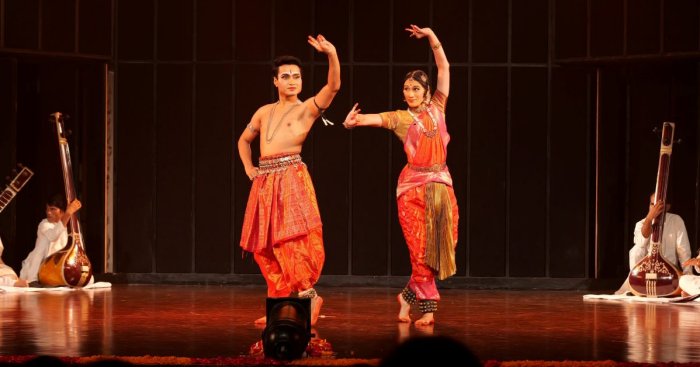 Madhur Gupta & Shreyasi Gopinath The opening scene was based on cantos from Ritu Samhar, wherein Kalidas' poetry, aside from its telling imagery celebrating the seasons in nature, becomes a Man / Nature interplay, of changing moods in nature affecting human emotions and relationships. The music, in keeping with changing seasons, was in a Ragamalika format, composed by Nikhil Kumar Behera, with the tala, interestingly, changing to a tisra, chatusra, khanda, misra, suiting the rhythmic gait of each season - like a lively Vasanta with nature in full bloom, with all its living creatures exuberantly active in a Takitatakadhimi misram tread (to use the Bharatanatyam sollus), or Grishma (Summer) with its torrid heat in a Chatusra gait or Shishira with the fear of exposure in the cold, creating arguments in a khanda, takatakita, with mother berating daughter for her skimpy bath and so on. Grishma, Varsha, Shishira and Vasanta were the four seasons dealt with. Apart from a passing, associated image of the abhisarika, unmindful of the rains, setting out to meet her Nayak (common to much of classical literature), both dancers, in solo representations, had tried to make the treatment relate more to present day life, with those caught outdoors during the Varsha season (dance narration set to tisra gati), slipping in puddles of water, or struggling with umbrellas etc. While classical dance imagery being closer to life as lived is fine, used as one is to poetic lyricism in the sensuality of seasons, translated into stylized movement presentation, these realistic images appear almost simplistic. 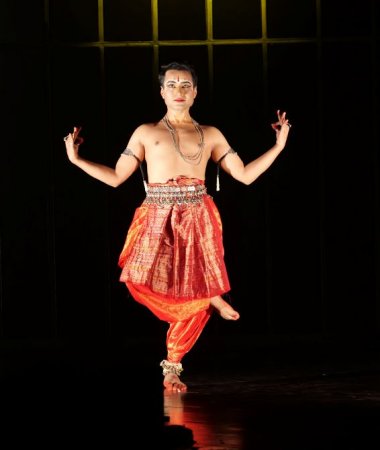 Madhur Gupta But the tailored formality of classicism took over with Kumarasambhavam, evocatively presented by Madhur Gupta's elegant Odissi technique in the Guru Kelucharan style - the result of grooming under two teachers - Madhavi Mudgal and now Sharon Lowen. Starting with a fleeting glimpse of Manmatha being reduced to ashes by Shiva's third eye and Rati's sorrow, the danced narrative switched on to Parvati's prayer to acquire Shiva as her husband. Shiva, in disguise, tests Parvati - trying to put her off from losing her heart to one so quixotic -with matted hair, attired in a tiger skin, with his strange accoutrements of snake garland and Ganga perched on the head, riding a bull etc! The situation and ideas are so absolutely similar to the Tamil Padam in Kalyani (commonly rendered in Bharatanatyam) wherein Parvati's mother querying her daughter, wonders about what she could have seen in this strange character, as to lose her heart to him - "Ettai kandu nee ichhai kondai magale?" Parvati's conviction in her love will not be shaken - and so on to the finale of the wedding scene, as Shiva, majestic, mounted on his vahan Nandi arrives, to accept Parvati (offered by Himavan and wife), as consort. After reciting the requisite verse from Kumarasambhavam (choice of passages helped by senior Odissi teacher Kumkum Lal) what followed was mainly raga music suiting the Odissi format - composed by Nikhil Kumar Behera, who was also the flute accompanist, with mardala passages played by a female percussionist Namrata Dave who also uttered the ukkutas, and interventions on the sitar were by Janab Rais Ahmed - all superimposed on the continual Mahadeva chant, contributing, particularly in the final stages, to a sonorous, moving performance. 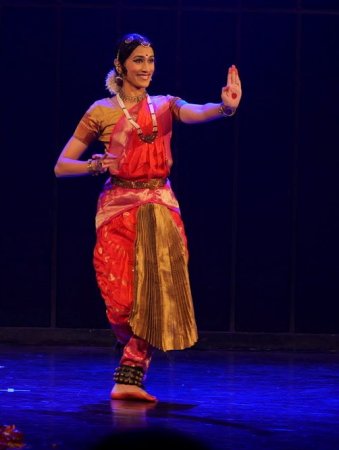 Shreyasi Gopinath With neat linear geometry of lines and dance technique, the hallmarks of the Kalakshetra school of Bharatanatyam topped by convincing interpretative dance, Shreyasi Gopinath's Bharatanatyam narrative centered round Abhijnana Shakuntalam, tracing in fleeting outline the generally known story of Shakuntala, daughter of Sage Viswamitra and Apsara Menaka, brought up in sage Kanva's ashram. King Dushyanta's wandering into the ashram premises during a hunt, followed by a warning by recluse hermit Vaikhanasa against hurting the animals, results accidentally in the male and female protagonists coming together - with Dushyanta hurrying to save Shakuntala from an impending attack of a swarm of humming bees. The love at first sight culminates in a Gandharva marriage, in the absence of Rishi Kanva who is away from the hermitage. With King Dushyanta having to hasten to the call of duty from his kingdom, the tender leave-taking from his young bride is with strong assurances that Shakuntala, with the wedding ring on her finger, (accompanied by sage Kanva) would be welcomed with royal fanfare on reaching his kingdom. Lost in the quiet ecstasy of private dreams, absent-minded Shakuntala, bathing and frolicking in the river is unmindful of the signature ring, which slips from her finger to be gobbled by a fish. Having lost the emblem for entry into the interiors of Dushyanta's palace, Shakuntala is unable to establish her identity, with the king refusing to acknowledge her. The entire Shakuntala episode has been erased from his mind (thanks to short tempered Durvasa's curse of an absent-minded Shakuntala's neglect to respond with alacrity when he called at the ashram). A grieving Shakuntala returns to the hermitage to give birth to, and later bring up her son Bharata. Meanwhile a fisherman having net the fish, discovers the ring in its stomach and recognizing the royal insignia, hastens to the palace to return it. On seeing the ring, forgotten incidents come flooding back into Dushyanta's mind. Hastening forthwith to the hermitage, he recognizes in the young courageous lad trying to subdue a lion, traits similar to him - and soon the estranged couple are reconciled. The well-conceived music of Eshwar Ramakrishnan, notwithstanding the odd off-key notes in the rendition of the raga alapana passages, set to modes Brindavani, Behag, Charukeshi, offset by taanam passages, was rendered by vocalist M. Sridhar, with Abhishek Avadhani on mridangam, and Amritha Sai Kumar proving the nattuvangam support. To provide effects on Manjira, Khang and Ghanta was Poojil Tiwari. Shreyasi's dance visualization, in areas like the fish swallowing the ring needed greater clarity. And Shakuntala's grief with shock, on Dushyanta's refusal to acknowledge any relationship with her, needed sharper focus. Seating musicians for Bharatanatyam and Odissi on two sides of the stage was a good idea, though in spite of Amit Kumar and Viren Nirgun supplying the drone on two tanpuras, the change over from one side to the other, with two styles of music involved, understandably needed to be rehearsed more, for smoother switch overs. The fitting gesture of Kalidas Suktam, as salutation to poet Kalidas in the finale with both dancers in a duet, could have been less prolonged after a program, which for some reason started at 7.30 instead of the usual 7pm, and a full blown Tillana in Bhimpalasi became redundant with the hitherto absorbed audience showing signs of becoming restive. But on the whole, one must commend a worthwhile effort at communicating to a larger audience, the richness of Kalidas' poetry. DANCE TEACHERS PROVE THEIR WORTH Photos courtesy: SBKK How changed is the classical dance climate! One could hardly imagine a Nattuvanar like Meenakshi Sundaram Pillai or a Kittappa Pillai, from the haloed perch of teaching, coming down to presenting themselves as performers! The day of giants has long past gone and now classical dance teaching has passed into younger hands, and it was an interesting evening at the Kamani, when faculty members of the Shriram Bharatiya Kala Kendra, took the stage presenting themselves as performers. 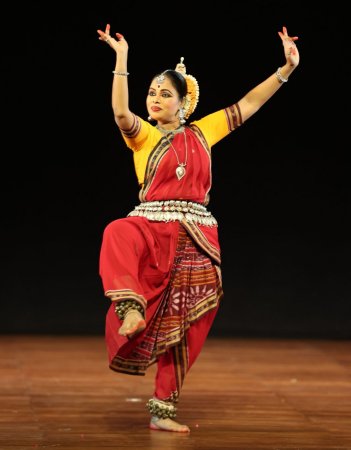 Sudha Mukhopadhyay 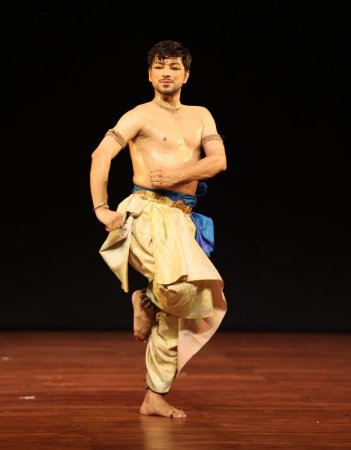 Suhail Bhan Thanks to a book release function at the IGNCA, I missed the starting Odissi recital by Sudha Mukhopadhyay. Suhail Bhan's Bharatanatyam with impeccable technique, had its high point in the Shankarabharanam varnam "Manavi chekona raada", a Ponniah Pillai composition, wherein the Nayika expresses her deep longing for Brihadeesha (Shiva) of Tanjavur. Overwhelmed with longing for the Lord (mamata meeri un na nura), she urges that he hasten to her side. Apart from the emotional underpinning, the nritta interventions too require a fine sense of fractional intervals of rhythm. It was heartening to see that Justine McCarthy's teaching has created worthy students able to take over the onerous task of teaching. Suhail danced with feeling, which over time, should acquire a more intense quality, and the footwork even in the 'arudis' was very precise. For one not born to the Tamil culture, to show the depth of involvement one saw, is creditable. The observation would apply to the field of music too, where Jayan Kottakkal, the vocalist while tuneful, seemed to get out of breath at times, mridangist Varun Rajasekharan who also did the nattuvangam, and violinist Raghavendra Prasad made a competent accompaniment. 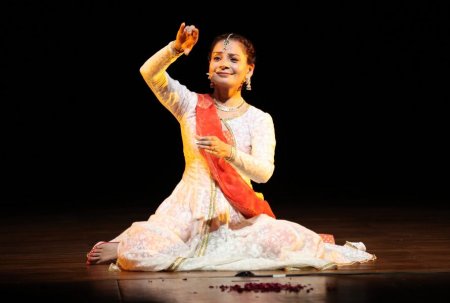 Shubi Johari Following were three Kathak teachers in a row. The start by a gandabandh student of Jaikishen Maharaj, Shubi Johari, who has also passed out from Bhatkhande, in the technical aspect with Tihais (Ginti tihai in tisra), Parmelu, various types of Gats, Paran, was infallible. She has the presence along with sparkling footwork. But the slight disappointment came when the performer went on to the interpretative part through a Chaiti, a well known composition "Yahin thaiyan hera motiyare kahan wa mein dhoondu," wherein the young bride who during her nuptial night at her in-laws' home, having lost her nose ring, is searching for it in the aangan - caught in the throes of confused emotions of shyness, of memories of felt ecstasy of first love, of shyness and hesitation at being able to question the sisters-in-law, and wondering where to look for it. The interpretation went on to a plethora of spoken words in the seated position - surely vachikabhinaya cannot totally depart from the main thread of the poet's composition one is dealing with, and has to be spelt out through abhinaya, even in the seated position, which was not to be seen. The competent musical support had a very melodious Vidya Gopal as vocalist with the rest of the accompanists comprising Anurag Jha on the tabla, Ashish Gangani on pakhawaj, and Arish Faisal on the sarangi. 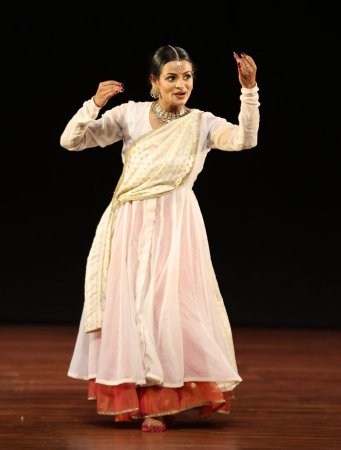 Anukriti Viswakarma The next young teacher Anukriti Viswakarma, also trained under Jaikishen Maharaj (who would seem to be turning out, in the present scenario, as one of the best teachers of the Lucknow school of Kathak), moved with foot-sure supreme grace and elan. She began with the abhinaya feel in "Varsha badariyan savariyan" in raag Purvadhanashri, which, for this critic, was too minimal in a program, where the layakari literally rained 'Ginti Tihais' in the subtlest of time measures, graceful freezes in Thaat, Parmelu, 33 pirouettes of 11 in each round of a chakradhar ad-form, in the nritta part comprising taal Ashtamangal of 11 matras. For most of Kathak, abhinaya has become just a passing phase of seasoning in a totally rhythm oriented exercise. On the tabla was Zaheen Khan, and on the sarangi was Amir Khan with Zaki Ahmed providing vocal music. 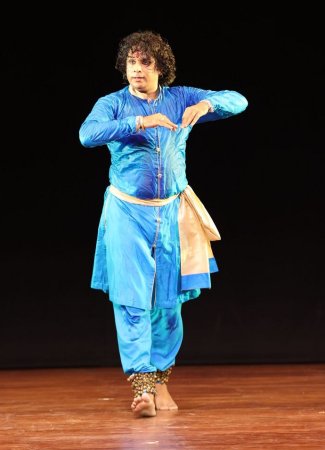 Amit Khinchi Lack of abhinaya stress apart, the Kendra can be proud of its young teachers. By the time the concluding dancer Amit Khinchi from the Jaipur gharana, trained under Pandit Rajendra Gangani, took the stage, the long evening made attending the entire recital difficult. With Ramesh Parhar's stentorian voice for singing, and percussionists like Mohit and Ashish Gangani on pakhawaj and tabla and Ahmed Khan on sarangi, even the Durga Stuti had a robust tenor wherein the Devi appeared more as the destroyer of evil, with the pure dance in taal Dhamar of 14 beats, all manly assertion - as if in contrast to the sensuality of the earlier presentations. The upaj (spot improvisations within a time measure) were strong. ADI ANANT - RARE EXPERIMENT IN KATHAK Photos: Inni Singh Usha RK, with one of the most fertile minds for conceiving and assisting in creating productions, spurred by off-the-cuff themes, in her latest effort, involved Kathak dancers Sanjukta Sinha, Dheerendra Tiwari and Sanjeet Gangani, in what in this form of dance is an unusual concept. Adi Anant was on Shiva, who incorporates within his essence the Universe with the five elements. Referring to the Dance of Shiva, Ananda K. Coomaraswamy observed, "Our Lord is the dancer, who like the heat latent in firewood, diffuses his power in mind and matter, and makes them dance in their turn". The Lord's dance represents the fivefold activity of Shrishti (creation), Sthiti (preservation), Samhara (destruction), Tirobhava (veiling, illusion), Anugraha (salvation). The Abhinaya Darpana text has the hymn "Ankigam bhuvanam" which mentions the Universe as Shiva's theatre and body, of the entire sky (Akash) as his garment, and the moon and stars as his ornaments. He stands on the earth and perched on his head is Ganga, the symbol of water. He becomes Adi and Anant (limitless and never ending) incorporating all the opposites within his person. In him is represented the entire cycle of life. If he is creation and preservation, he is also destruction which really stands for transformation. The cool waters of Ganga on his head are countered by the heat of the flame which destroys, through transformation. So how does one describe the entity who is like camphor, which evaporates - who is form and formlessness, who is time and timelessness at the same time? There is an awareness in this world view of the Universe springing from the basic Oneness of Shiva whose dance represents the endless rhythm of the Universe. In this endless flow and dance of Cosmic energy, what is born has to die or at least change to another phase - and in this dance of atoms, polarities like pleasure and pain need to be accepted as a part of basic Oneness. 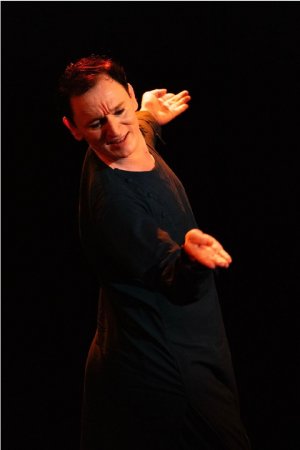 Dheerendra Tiwari Using dancers with varying experiences like Dheerendra Tiwari who trained in the Kathak Kendra under Rajendra Gangani, with vast performance experience as part of Aditi Mangaldas' Drishtikon Dance Foundation, having performed solo in the Durbar festival curated by Akram Khan; Sanjeet Gangani famous for virtuosity of laya, son and student of Guru Rajendra Gangani and Sanjukta Sinha, one of the highly acclaimed students of late Kumudini Lakhia's Kadamb School in Ahmedabad, the evening was an attempt at expressing the boundless nature of Shiva, through the unfettered rhythmic power of Kathak. 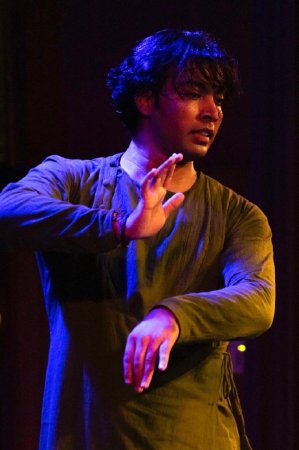 Sanjeet Gangani It was using Time, conceptualized and fettered by the human mind (for it is a manmade concept) to express timelessness. After the homage to Shiva through Tulsidas' Rudrashtakam, Dheerendra conveyed the limitlessness of one who is draped in the garment of the sky with stars and moon as ornament and Sanjeet in a brief passage portrayed Shiva with his ash covered (bhasma bhooshana) body, and Sanjukta through Kavit portrayed Shiva with his damaru (which represents the starting of the Universe with sound), with trishool (which preserves order by annihilating what is not needed.) There was an openness showing the unbounded nature of Shiva instead of the usual order in which one looks at ad-forms of Kathak technique - starting with thaat and ending with a ladhi. All premediated presentation steps are a man-made order, whereas for Shiva who dances in abandon in the crematorium, there is only eternity - no beginning and no end. 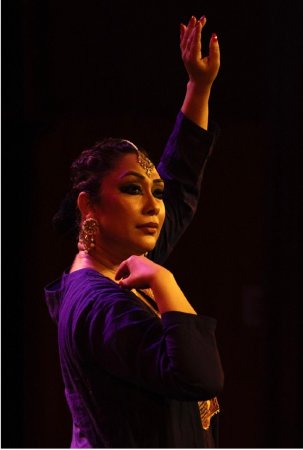 Sanjukta Sinha It was good to see both Jaipur and Lucknow gharanas get together to present a program. This kind of meeting will aid a cross pollination of ideas, which is the way for an art form to progress. Filling the gaps in a continuity assuring a program flow will take more experience. But in the meanwhile, can one expect that Sanjukta thinks of a costume more tasteful than the ungainly long gown, which covers all the footwork and body deflections? For instance, the 'Khaas Amad' of Kumudini Lakhia, which is really khaas (special) in the sheer grace, fluidity and subtlety of movements, got lost with the body deflections hidden in the gown. Altogether a ten-day period of variety! 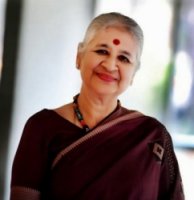 Writing on the dance scene for the last forty years, Leela Venkataraman's incisive comments on performances of all dance forms, participation in dance discussions both in India and abroad, and as a regular contributor to Hindu Friday Review, journals like Sruti and Nartanam, makes her voice respected for its balanced critiquing. She is the author of several books like Indian Classical dance: Tradition in Transition, Classical Dance in India and Indian Classical dance: The Renaissance and Beyond. Post your comments Please provide your name and email id along with your comment. All appropriate comments posted with name and email id in the blog will also be featured in the site. |
