
|     |
|
| |

 e-mail: leelakaverivenkat@gmail.com Echo of Kumudini Lakhia & Remembering Zohra SegalOctober 13, 2025 ECHO OF KUMUDINI LAKHIA'S POETRY OF KATHAK MOVEMENT IN HER SHISHYA Photos: Yash Shah Kumudini Lakhia, one of the most sensitive of Kathak luminaries whose creative output helped shape modern Kathak, is sadly no longer with us. But in the students trained by her with so much love and diligence at her institution Kadamb, one glimpses facets of her prodigious sense of aesthetics, which imparted to each aspect of the dance form, a quality of added lyricism. Titled The Dance of Celestial Ecstasy, the Kathak program at the Kamani, designed by Kumudini's long-time student Sanjukta Sinha and presented along with students groomed in her dance company, succeeded in evoking in the capacity gathering in the auditorium, a nostalgic feel of the special poetry of movement which was the hallmark of Kumudini Lakhia. The presentation, fashioned round the evergreen theme of the Gopis yearning for Krishna, starts with the romance of a moonlit night by the Yamuna, wherein the magic of Krishna's flute, has even the stars in the sky and nature with its trees and flowers swaying to the ecstasy of the music. The Gopis of Brindavan, for thirteen long years pining for Krishna in Mathura, in their abandoned loneliness dream of reunion with their heart's love. In the depth of Viraha or the pangs of separation, the Gopis discover that unmitigated love can transcend the need for a physical presence of the loved one, and along with earth and sky, the Vraj Gopis get united in a celebration of divine love. 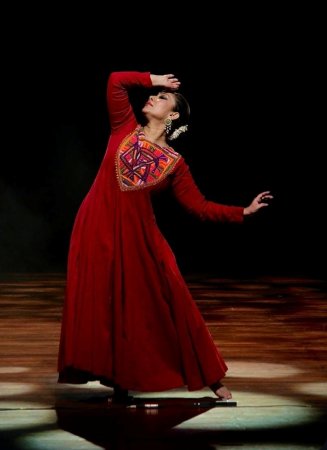 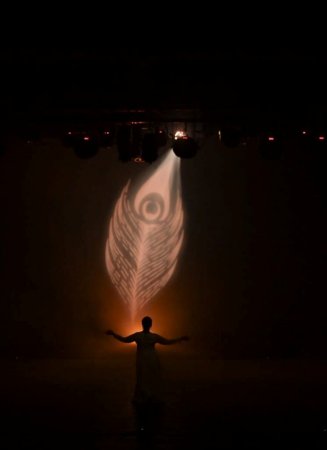 Knitting the ad-forms of Kathak into this concept the start in vilambit, "Mohe tarpat din gin rein Shayam bin" has the Gopis expressing love pangs, wondering how to find peace of mind amidst this agony of separation, at the absence of Krishna (Shyam bina mohe kaise chain mohe tarpat din gin rein). In the madhya laya section, "Shyam salone kanha tore nain," the Gopis are revealed the spiritual power of separation, wherein devotion brings about the ecstasy of eternal oneness with the divine. They hear the sounds of the flute music and in the clouds (ghir ghir ayi kaali ghata, saawan ayamaah ka), the rain drops in the month of Saavan, along with the movements of Radhika's swing (Jhoola jhule Rani Radhika), they experience a closeness to their loved one, as every night bells and anklets dance the eternal love for Krishna. The plot apart, the simple, tasteful costumes with white tops as the predominant colour, with the leggings (chudidars and salwars) in different colours caught the stage lighting, as the dancers moved round in well etched movement and pirouettes. Interspersed were fleeting solo sequences by Sanjukta herself. The subtlety of Kumudini's art was reflected in a simple foot tap, the slightest of hand gestures, a flex of the wrist, an eye glace, a movement of the head and neck, every fractional element of a movement had beauty etched in it - and it was never empty virtuosity, for it communicated a message. And that was the secret of Kumudini's eye for aesthetics, which turned every momentary element of a movement into sheer poetry. And one who heard her speak about not just spacings on the stage but to the tension filled space between dancers, and how it worked in making her group presentations charged with a special energy when dancers related to one another, realized that her productions evolved from a special feel for the subtleties of dance energy in togetherness. After so many years under such a teacher, if some of the guru's proficiency did not rub off on the student, it would be surprising. Sanjukta proved it in her production. 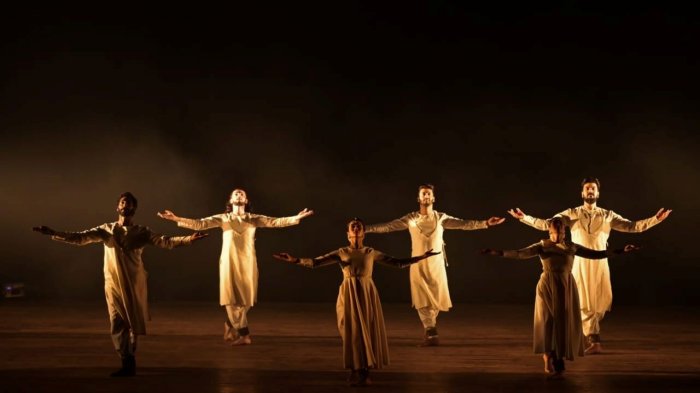 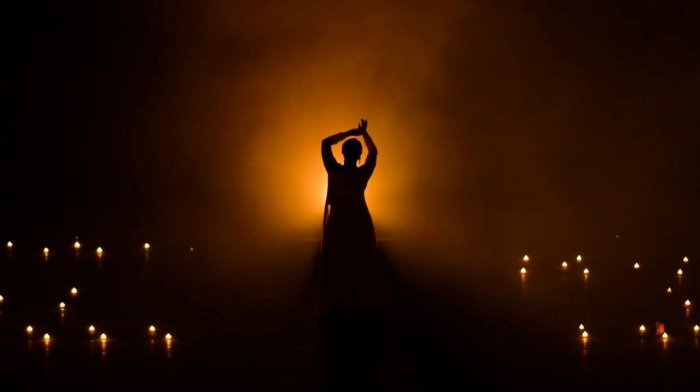 Dancers visible through a smoke screen, a mere Takita Dha Dha communicating the search for Krishna, and the clean technique with the teental footwork with changing accents manipulated through just a shift in weight and the timing of entrances and exits of female and male dancers, were all cases in point. The only aspect that, for this critic, fell short, was the over loud music, despite an efficient tabla and pakhawaj by Mohit Gangani and Ashish Gangani respectively, with Amir Khan on the sarangi. Samiullah Khan, composer and vocalist, along with the decibel levels, could lessen musical flourishes which tend to drown out odd words, for this, above all, cuts into bhav-filled rendition, which would add to the emotive strength. The post-performance nostalgic references by gurus present in the audience invited to the stage, proved how all had felt the Kumudini imprint! REMEMBERING ZOHRA SEGAL Photos: Dharmandra Dixit 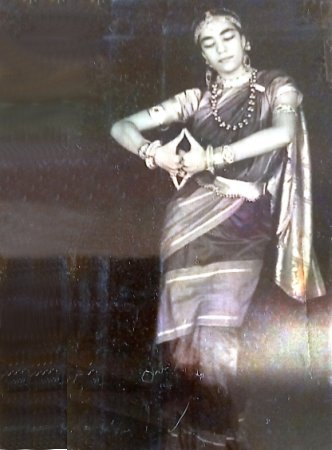 A dance Zohra had composed, Varsha Mangal, when on tour with Uday Shankar 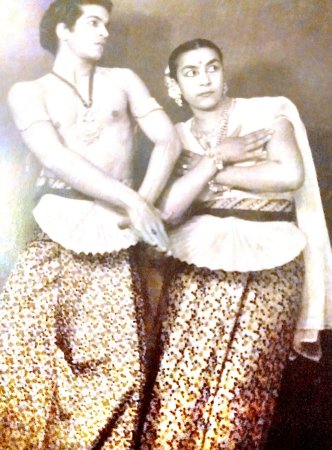 Lotus Dance choreographed by Kameshwar when they were in Lahore and had their Zoresh Dance Institute 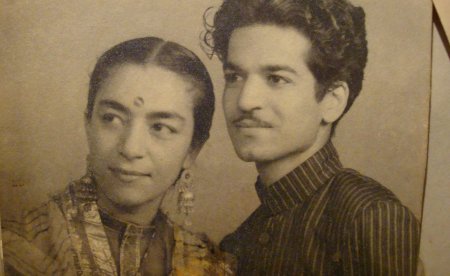 Wedding of Zohra and Kameshwar Segal 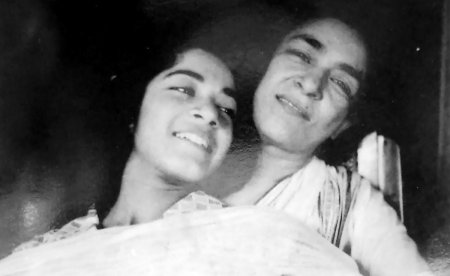 Kiran Segal with her mother Zohra (1960) 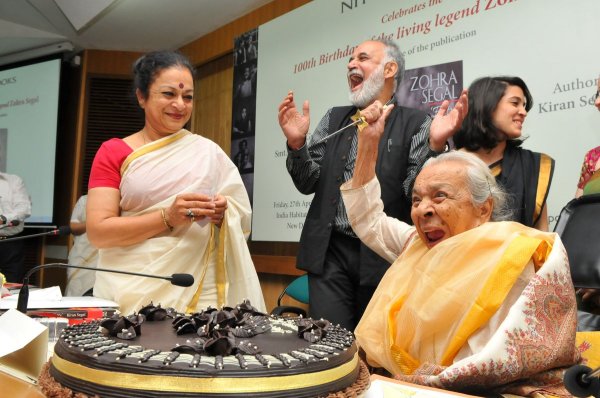 Zohra's 100th birthday celebrations Zohra Segal photos courtesy: Kiran Segal The annual Zohra Segal Festival of the Arts, conducted by Pallavi Arts run by Zohra's daughter Kiran Segal, celebrated this year in conjunction with Ahad Anhad at the Academy of Fine Arts and Literature in Siri Fort Institutional Area, very successfully captured the feel of Zohra in all her liveliness and laughter. The program spread over three days, for this critic, underlined Zohra's most cherished quality - of being able to laugh at herself. With all her talents, in a life which had its full share of ups and downs, it was the sheer fun of life coupled with an enviable sense of humour, which never left her, and enabled her not only to triumph over life's less joyous moments, but to bring joy to people she had interactions with. 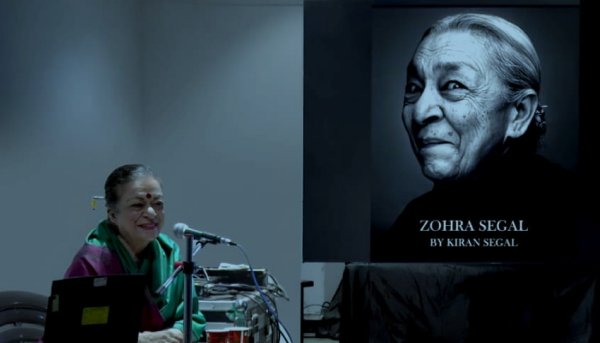 Presentation by Kiran Segal 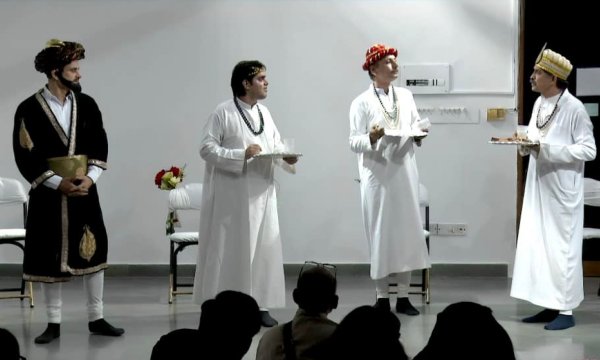 Akbar the Great Nahin Rahe Unable to attend all the events, one took in as many programs as one's schedule allowed. From what one heard of the starting evening from many sources, 'Ghar ki Murgi daal Barabar' comprising episodes from Zohra's life, recollected through episodes, supplemented by slides and videos, had the audience assembled in the gallery on the ground floor, rollicking in peals of laughter. The next evening's Hindi play Akbar the Great Nahin Rahe, a satire by Mrinal Mathur, enacted by Pierrots Troupe, under the direction of M.Sayeed Alam, a spoof with its satirical dialogue, parodying what happens through succeeding generations of changing thought processes - in the world of Indian politics in particular, had the audience giggling right through. Having lost his place (with his 'greatness' now in question), Akbar in heaven is planning to retrieve the 'greatness' tag, he has lost or been deprived of, in Lutyen's Delhi. Running into Atal Bihari Vajpeyi in heaven, he tells him that he wants to go back to earth and fight for his rightful place in history. "Right," says Vajpeyi, who however cautions him, "But have you heard of the EVM's?" The histrionic ability of the actors in imitating and capturing the likeness of characters like Vajpeyi, no longer with us, in the cast was astonishing. This entire play fits in with Zohra's character with the ability to look at herself, with humour. 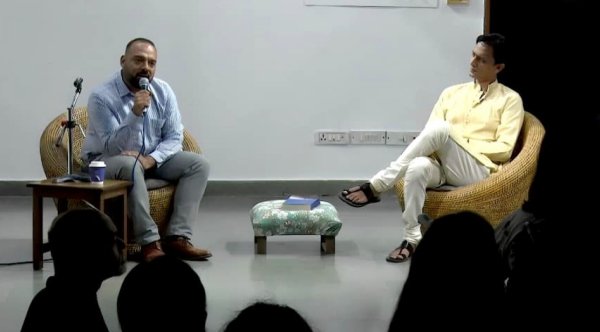 Siddarth Kapila Not a big area by any standards, the Gallery which can seat small audiences, is an ideal venue for lectures and talks - the intimate space encouraging the after/talk discussions with queries and answers. Siddharth Kapila spoke briefly about his book Tripping down the Ganga: A Son's Exploration of Faith, an exhaustive account of his yaatras to seven major pilgrimage sites along the river Ganga - which he undertook between 2015 -'22. The book, through all the mental and physical churnings of these pilgrimages, tries to grapple with the question of what religion and in particular Hinduism means to the believer. On one side is blind faith of some who have no doubts - and on the other those who seek answers to questions. Involved in the process of going through the book at present, one can only say that the book as a travelogue holds interest. But what surprised those who heard the talk, was the kind of lively After- Siddharth talk questioning, with points raised by the listeners that surprised - for it revealed that even amongst the most blasé there is that something called faith (in whatever religion) which, as an inner journey, is beyond explanation. 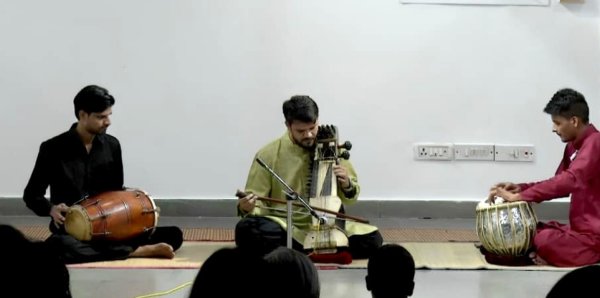 Ejaz Hussain The typical Rajasthani tunes played on the sarangi by Ejaz Hussain ushered in the flavour of this part of India straight into the Gallery space. While this instrument is used in both classical and folk music, the tunes played are particularly associated with the forerunner and more archaic form of this instrument the Khamaicha, which the Rajasthan Manganiyar tribal group has made so famous. Next came a brief poetry session by Prasad Baboo Mattaa, described as a 'lyricist, podcaster, script writer and artist' who has composed poems like Home is a peaceful place. 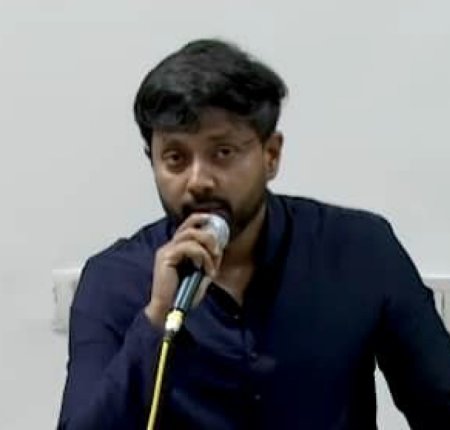 Prasad Baboo 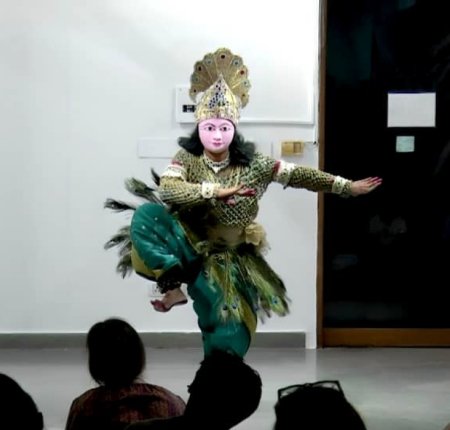 Shubham Acharya The concluding session devoted to dance, first presented Shubham Acharya, son of Sashadhar Acharya, the renowned Seraikella Chhau guru, the son of Lingaraj Acharya, representing the fifth generation of a traditional family of Chhau performers, from the Purthosahi Akhada - one of the eight akhadas of Seraikella Chhau training in Seraikella under the Singbhum rulers. Shubham, trained under his father, in his rendition of the Peacock Dance, showed what fine training can achieve. With a totally masked face restricting the dancer's vision, movement and rhythm bringing out the character of the subject are denied the facial expressions. Instead are neck and torso deflections, and gait of the dancer with a body balance where one is not groping for floor space while moving. Shubham moved with unerring balance, performing to recorded, typical Chhau piped music (mohuri) with the dhumsa (drum) providing the rhythmic element. 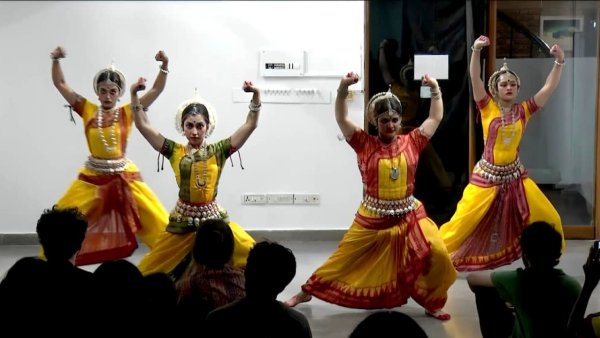 Odissi by Pallavi Odissi Nritya Sangeet Vidyalaya The concluding item by the disciples of Kiran Segal in Odissi, Aakansha Roy, Aditi Gupta, Divyangshi Sarkar, Sunishka Roy Chowdhury, of Jago Maheswara, choreographed by Kiran's late Guru Mayadhar Raut, made for a spirited, extremely well rendered end. Kiran Segal is one student of her guru who has preserved the Mayadhar Raut style of Odissi. Perfect laya, clean dance profile characterized this rendition and for once one could see a perfectly articulated 'Chauk' which would seem to have disappeared from a great deal of Odissi rendered today. 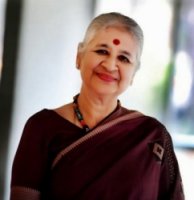 Writing on the dance scene for the last forty years, Leela Venkataraman's incisive comments on performances of all dance forms, participation in dance discussions both in India and abroad, and as a regular contributor to Hindu Friday Review, journals like Sruti and Nartanam, makes her voice respected for its balanced critiquing. She is the author of several books like Indian Classical dance: Tradition in Transition, Classical Dance in India and Indian Classical dance: The Renaissance and Beyond. Post your comments Please provide your name and email id along with your comment. All appropriate comments posted with name and email id in the blog will also be featured in the site. |
