|     |
|
| |

 Darpani completes 30 years- Tapati Chowdhuriee-mail: tapatichow@yahoo.co.in Photos: Arijit Roy December 5, 2025 To mark the 30th year of its foundation, an International Seminar on 'Dance as Discourse: Aesthetics, Pedagogy and Practice in Modern India' was held by team Darpani and its founder director Arnab Bandopadhyay on the 26th of October 2025 at ICCR, Kolkata. Darpani began the year long celebration with a discourse and debate, which was followed by a dance recital on the 5th of November at Gyan Manch. The International Seminar tried to fulfil Darpani's lofty aim of analyzing and investigating trends in the traditional and existing modern dance forms. The seminar was structured into two sessions. In the first segment speakers threw light on the following topics: How do you define Indian dance forms? Why we should not address our stylized dance forms as Classical Dances of India; Rigidity and Elasticity in Bharatanatyam Practice - changing aesthetics and pedagogies; Embodied Harmony: Dance as the resonance of Thought, Body and Aesthetics; Journey of Manipuri Dance as a gendered discourse; Enjoying the Dancing Body. Odissi exponent Aruna Mohanty in her keynote address referred to the Odissi dance style that she was well versed with and gave an all-round picture of the dance scenario and how to go about the business of dance in a professional way, while at the same time not to lose out on its creative aspect keeping in mind all the pros and cons of what it entails to be a successful dancer. This reviewer gathered that it was a thorny path which has to be negotiated with caution. From the discourses, the listeners took home with them the following ideas: since the source of all Indian dance forms is the Natya Shastra that came into existence during Treta Yuga according to the time concept of Hindu Cosmology, which precede the European Classical Age, our dance forms should be known by the nomenclature Sastriya dance. From Bharatanatyam exponent Vandana Alase Hazra, the listeners, including yours truly, learnt to think about: what defines a style; what has to be adapted beyond technique and initiate in us questions like what and why we perform. Ashimbandhu's contention was that dance in its truest essence transcends choreography and commences a dialogue between mind, body and soul. It's a vital point to be able to reach through dance to the highest level of knowledge. Bimbavati Devi's revelation was that though Meitei women play active roles in religious and social spheres yet paradoxes persist that restrict their presence in certain areas. This was an eye-opener to the listening public. Priyadarshini Ghosh Shome hopes to make knowledge transmission of dance foster in students a holistic pursuit. It was a very important point made. The second session was a roundtable on locating the aesthetics of Rabindranath's ideas of dance and its philosophy and practices. Alokananda Roy, Polly Guha, Amit Dasgupta, Vandana Alase Hazra, Ashimbandhu Bhattacharya, Bimbavati Devi, Priyadarshini Ghosh Shome, Aishika Chakraborty, Sarmistha Mukherjee, and Sudhiranjan Mukherjee were the participants in the roundtable discussions. The session was moderated by Dheeman Bhattacharya. To make a rough precis of the proceedings: Rabindranath Tagore, the renaissance man, was very much a part of the lives of the speakers, for them he was a household name. Though not present physically the poet is a living legend whose presence is felt every day. They have grown up practically under his umbrella; read his poems; heard and seen his dance-dramas etc. The bottom line of what was said is that "you don't have to know dance to dance"; dance gives one the freedom of thought and expression. It gives you the freedom of the soul. To break rules and walk on an untrodden path was Tagore's rule, so to say. Tagore grew up in a household where music was an integral part of their living. He was well versed in Hindustani music. His interest in Western music, Tappas, Baul singing, kirtans, Java music, Carnatic and other forms made him mix and match them in his compositions which gave his music aesthetic beauty, which is unique. His experimentations did not stop with music, it extended to dance too. Though he hadn't learnt dance he found in the medium a method of freeing oneself, from the fetters of rigidity. To render visual expression to his poetry was his idea of dance. So, the dance style like his music, was an amalgamation of different genres where movements were creatively moulded to suit the soft grace of his music. Fluidity and flexibility coupled with mellow expressions was what Tagore liked. Bhava was more important to him than the strict grammatical rules of our Sastriya dances. He was free-spirited and could not be bound. "Tagore's dance can be understood only as part of the larger canvas of freedom and creativity", said economist Amartya Sen and added that "he was questioning every kind of incarceration of negating them. In his Rabindra Nritya, therefore, there was gender fluidity and the ability to bring social change". Tagore's dance was a way to liberate the soul. Valedictory address was by Sharmila Roy Pommot, an internationally acclaimed Tagore scholar, who lives in Paris. From her profound knowledge, she spoke virtually on the epoch making works of Tagore with accurate dates, which are of great significance historically. She said that dance was developed as a prayer. To quote an example, Sharmila spoke of his dance-drama Natir Puja staged in 1926 with Gowri, daughter of Nandalal Bose, in the role of Srimati and Tagore himself was in the role of Bhikshuk Upali. This had a tremendous impact and brought about social and cultural changes and addressed the caste system. History about Viswabharati and Tagore is at Sharmila's fingertips, from which she quoted extensively. 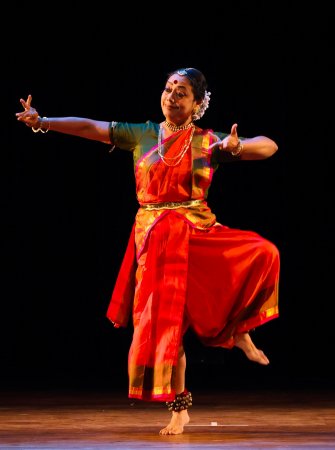 Vandana Alase Hazra On the 5th of November the inaugural performance of Darpani's completion of three decades of its existence was celebrated at Gyan Manch. Bharatanatyam dancer Vandana Alase Hazra opened the evening. Her choreography and neat execution of the popular Marathi Natya Sangeet "Jaya gange Bhagirathi" from the play 'Panditraj Jagannath' by Vidyadhar Gokhale as a backdrop to weave images of the river in its myriad forms was something new and greatly appreciated by the rasikas. The dance interestingly moved from the mythological plane to the earthly, weaving ideas, visuals, imagination and creative interpretation in a seamless presentation. The use of the mridangam and pakhawaj alternately in depicting the grand play of Shiva trying to balance and contain the Ganga in his scattered locks was impressive, while the esraj and other string instruments created the image of an ever flowing river with life unfolding on its banks- the little children boisterously splashing in the waters, the youth dallying on the banks while the aged are content to just touch its holy waters. Vandana's ability to depict such a range of characters deserves praise. A river that has multiple references in the Indian mind flowed in an out of the stage in a playful, fast tempo signifying its gati, or unhindered flow. Vandana had also used a jati in pancha nadai to depict the waves of the river which the poet mentions as advancing while they chant "Shankara Shankara". The contra rhythmic footwork created a delightful contrast to the melodic line. The original tune of the song was kept intact while the music arrangement was freshly done by the talented Shatatantri Veena artiste Dishari Chakravarty. Accompanying artistes Anol Chatterjee's vocal, young Auroni Kanti Bhattacharya on the mridangam, pakhawaj by Arijit Thakur, sitar and esraj by Bhaskar, flute by Sudip Chatterjee, sarod by Prasenjit Sengupta and Amitabha Mazumdar, all blended well to create a melodic background for the natya turned nritya sangeet. 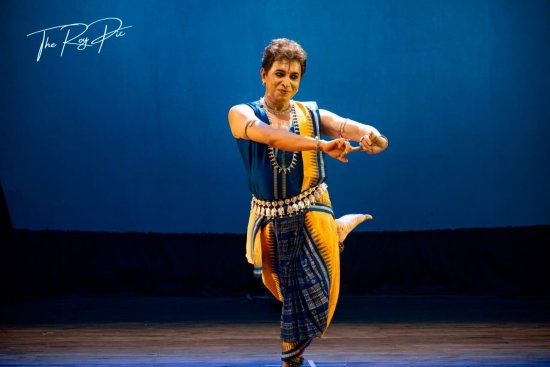 Arnab Bandopadhyay Odissi exponent Arnab Bandopadhyay's repertory members opened the show next on a serene note with "Shantakaram Bhujaga shayanam," the timeless invocation to Lord Vishnu. It came alive in Guru Ratikant Mohapatra's choreography - a composition that radiated tranquility and sacred stillness. The performers transformed the hymn into a visual prayer. Its beauty blossomed with perfect synchronization of the well-trained group. The audience relaxed with the expectations of more to come and what followed was the solo piece, the ashtapadi "Kishalaya shayana" in Bibhas raag and taal adi. The piece composed and choregraphed by Pt. Bhubaneswar Misra and Guru Kelucharan Mohapatra took roots in Arnab Bandopadhyay's mind from the divine love poetry of Jayadeva's portrayal of the tender and intimate love union of Radha and Krishna. Radha was all alone and was immersed in love's deep longing for Krishna when he arrives and speaks words filled with affection and devotion. He professes to be her slave and entreats her to be merciful towards him. The fire of loneliness is too much for him to bear, he says. Most humbly he requests his mortal lover to rejuvenate her dying servant with the nectar of her lips to bring him back to life. The delicate emotion of love, surrender and divine joy, of mortal Radha and immortal Krishna transcended into spiritual ecstasy.  Darpani ensemble Sivaranjini Pallavi choregraphed by Arnab Bandopadhyay was a group dance to a composition of raag Sivaranjini. It was a nritta piece that started with slow pulsating movements slowly increasing its speed that reached a crescendo. Dasavatar was the last presentation of Darpani. This immortal piece of choreography by Guru Kelucharan Mohapatra from Jayadeva's Gita Govinda never fails to entertain aficionados. It depicted the ten incarnations of Lord Vishnu. This was an apt conclusion to the inaugural evening's performances. 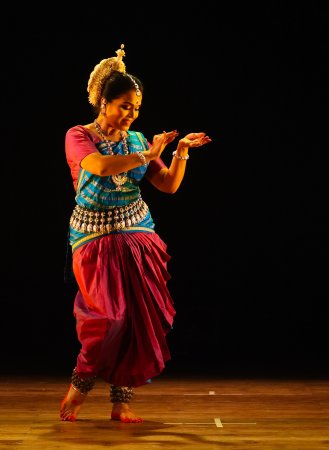 Rajashri Praharaj Sitaharan by Rajashri Praharaj was the narrative of the abduction of Sita by Ravana, which began at Pancha Vatika. The story was carried forward by the dancer portraying each character in turn. Rajashri smoothly differentiated the characters through bodily and visual expressions. From Ram chasing Mareecha disguised as the golden deer, to Ravan's arrival at their dwelling to take Sita away and the fight between Ravan and the king of birds Jatayu were all presented minutely. It was a challenging dance performance perfected by Rajashri with years of pursuing the Odissi form under the direct tutelage of her guru Ratikant Mohapatra. She has mastered the art of presenting multiple characters with the same energy to sustain audience interest.  Tapati Chowdhurie trained under Guru Gopinath in Madras and was briefly with International Centre for Kathakali in New Delhi. Presently, she is a freelance writer on the performing arts. She is the author of 'Guru Gopinath: The Making of a Legend.' |
