|     |
|
| |

 Aatmabodhi 2025 delivers a polished second edition- Nrupa Somane-mail: nrupas@gmail.com December 6, 2025 The second edition of the Aatmabodhi festival - a three day festival, organised by Abha Auti and Laheja events in collaboration with the Lokmanya Cultural Foundation - was inaugurated on the 21st of November at Samavasaran Amphitheatre, Bhandarkar Oriental Research Institute (Pune). 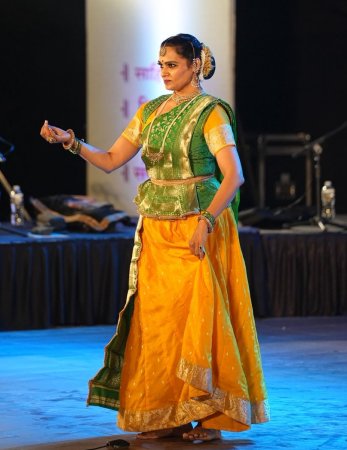 Abha Auti (Photo: Yashodhan Bhide) The festival kicked off on the 21st evening with a graceful performance by Abha Auti herself. A student of Roshan Datye, of the Guru Rohini Bhate lineage, Abha presented a Ganesh Vandana, written, composed and choreographed by Guru Rohini Bhate. Her elegant presentation was a fitting tribute to her gurus and set the tone for the evening. Sanjukta Sinha's dynamic Kathak presentation followed. Showcasing her learnings from her two gurus, Pt Arjun Mishra and Guru Kumudini Lakhia, she presented Eka - exploring the concept of oneness and harmony. It was interesting to compare and contrast the two different styles of Kathak presented so far - an example of the two different origin personalities. One, dazzling and assertive, announcing its presence from get go and the other, subtle, restrained and yet with a glint in the eye, drawing you in! 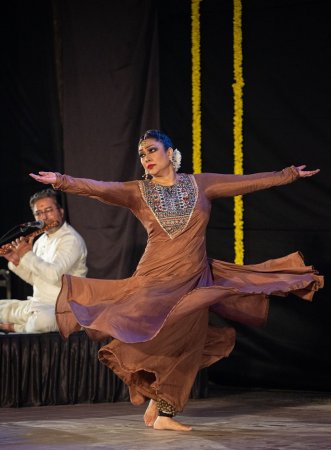 Sanjukta Sinha (Photo: Chinmay Agashe) Bringing together musicians from the Hindustani and Carnatic streams, Eka is, in its own way, a novel experience. Opening with a Devi Stuti, inspired by Priyadarsini Govind's Devi, Sanjukta Sinha, started off with the beeja mantra. Peppered generously with jumps and spins, the fierce strength of Devi in her various forms was presented. She then moved on to a more traditional tala presentation, perhaps the least cohesive thematically, though performed with flair. Her presentation of teentala was immaculate, and her explanations and anecdotes coupled with her flamboyance made for an interesting watch. She concluded with a presentation of "Krishna nee begane baro." Popular to the point of being overdone, the very popularity of this composition worked in its favor to overcome the language divide, and her presentation was well appreciated by the audience. A different composition would have had a more striking effect though. Krishna and his antics are no strangers to the Kathak tradition, and the Carnatic composition does little to break from the expected "makhan-chori" mould. Another choice could have better underlined the coming together of Hindustani and Carnatic paramparas under the Eka umbrella. 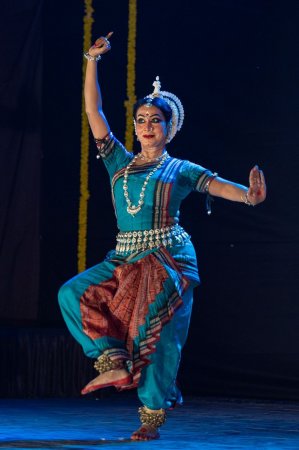 Sujata Mohapatra (Photo: Chinmay Agashe) Sujata Mohapatra was the final performer for the evening. She had chosen compositions choreographed by her Guru, Kelucharan Mohapatra, presenting a sharp contrast to the more á la mode Kathak recital that preceded her. After Sinha's energetic performance, Sujata Mohapatra's soft, graceful Pallavi felt soothing and one could feel the energy change within the audience. The Yugmadwandwa Pallavi reset the mood with its lilting melody and the delicate "Sawal Jawab" choreography with the musicians. She then presented an ashtapadi "Sakhi hey" - another fine example of the musicality of the form. But it was her "Kedechanda" that had the audience in awe - of the art and the artiste. A vintage piece, simple in its concept - a garland of stories of little Krishna that we have all heard of - and yet Mohapatra could bring goosebumps as Krishna opened his little mouth and Yashoda sees the entire universe within it. Each story had the audience applauding, underlining the fact that content is, indeed, king. A good artiste, who does justice to the form, will continue to be appreciated, even without all the frippery one has come to assume as "necessary" to connect with today's viewers. She concluded with the prayer "Moksha". Her entire recital evoked a sense of contentment, like a delicate pudding at the end of a meal. Both the artistes were ably supported by their musicians: Tabla - Joby Joy, vocals - Jayan Nair, mridangam - Manav Nair, flute - Partha Sarkar and sarangi - Sangeet Mishra for Sanjukta Sinha; and Ekalabya Muduli on the pakhawaj, Rajesh Kumar Lenka v, Jyoti Prakash Sahoo -violin and Soumyaranjan Joshi - flute for Sujata Mohapatra. Days 2 and Day 3 of the Aatmabodhi festival featured workshops conducted by the invited artistes. The workshops focussed on the craft: honing the technique, ways to improve stamina as well as focusing on the nuances of abhinaya. Sanjukta Sinha taught a Ganesh Vandana in her sessions, while Sujata Mohapatra introduced a Mangalacharan. The workshops were well subscribed. All in all, the Aatmabodhi festival delivered a finely curated experience. Building up on the success of the first edition, the second edition (incidentally an all-female star cast!) has further strengthened the festival's identity and Abha Auti's intent and vision of a renewed connect to the art and to the timeless lineage of the classical forms.  Nrupa Soman is a Pune/Delhi based dancer, dance researcher and anchor of classical dance and music festivals. |
