|     |
|
| |

 'Resonance' of Kuchipudi's choreographic voices- Manjari Sinhae-mail: manjari@sinha.com Photos: Siva Sottallu December 10, 2025 'Kalanidhi Dance', an enterprising dance institution founded by Dr Anuradha Nehru near Washington, DC, presented 'Resonance', an alluring evening of dance, celebrating Kuchipudi's choreographic voices, on November 14, 2025, at the JCC Bender Theatre in Rockville, MD. It showcased the works of choreographers who are carrying forward the Kuchipudi tradition in innovative and imaginative ways. The person behind this concept and heading the production team was Anuradha Nehru, the Founding Artistic Director Emerita of Kalanidhi Dance. She had established the Kalanidhi Dance School in 1991 in Bethesda, MD, to preserve, promote, and teach Kuchipudi dance in the US. It's heartening to see Kuchipudi thriving in the US thanks to the initiatives by enthusiastic educators like her. 'Resonance' showcased the works of seven choreographers who took the versatile technique of Kuchipudi from traditional to new directions. The performing groups included artists such as Anupama Kylash from India, Pranamya Suri, Yamini Kalluri, Shrilekha Jayanthi and Chitra Kalyandurg, as well as Guru Lakshmi Babu's Kuchipudi Dance Academy and Dr Anuradha Nehru's Kalanidhi Dance Ensemble. 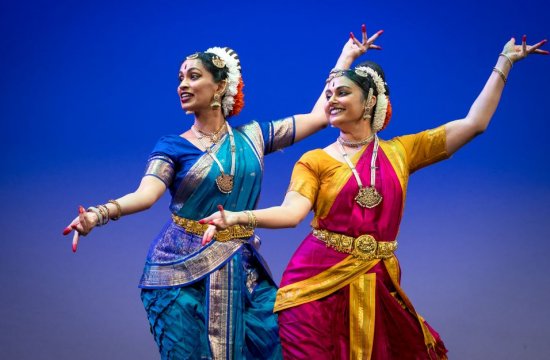 Shrilekha Jayanthi and Chitra Kalyandurg The evening opened with 'Veena Pustak Pani' in the traditional storytelling style of the Sutradhar, customarily narrated by Shrilekha Jayanthi and Chitra Kalyandurg, with a prayer to Bala Tripurasundari, the resident Goddess of Kuchipudi village, the birthplace of this art form. The twin dancers Shrilekha and Chitra invoked the presence of the Goddess by imaging her many physical and spiritual attributes, such as her occupying the mystical place at the centre of the Sri Chakra, which is another term for the concept of Bindu - the very source of creation. This term is used to describe the goddess Bala Tripurasundari, who represents the ultimate reality. The Goddess holding a veena and a book in her hands, 'Veena Pustak Pani', is a symbol of learning. The dancers depicted the tinkling bells adorning her feet, with the sound of their own ghunghroos (ankle bells), before highlighting the cosmic power Bala Tripurasundari carries as the consort of Nataraja, the Lord of Dance. The prayer's final verse was an ode to the Kuchipudi gGurus who had drawn inspiration from the Goddess, leaving behind a legacy that even the twin dancers inherited. The piece was created as a homage to the heritage of the art form on the occasion of the 50th anniversary of the Kuchipudi flag. The lyrics of 'Veena Pustak Pani' were written by Dr Malladi Rajni and composed in Ragamalika and Talamalika by DSV Sastry, both from Hyderabad. This invocatory item was choreographed by the two performers Shrilekha Jayanthi and Chitra Kalyandurg, both of whom belong to Sundari Dance Theatre. They have been performing duets for nearly twenty years, evolving their artistic vision together. Now a performer and choreographer based in Miami, Shrilekha has been studying Kuchipudi for thirty years, primarily under the guidance of Anuradha Nehru and Jaikishore Mosalikanti. Chitra is a performer/choreographer based in Washington, D.C., who has been studying Kuchipudi for over three decades under the guidance of Anuradha Nehru at Kalanidhi Dance, performing extensively with the Kalanidhi Dance Company internationally and served as assistant choreographer from 2017 to 2019. 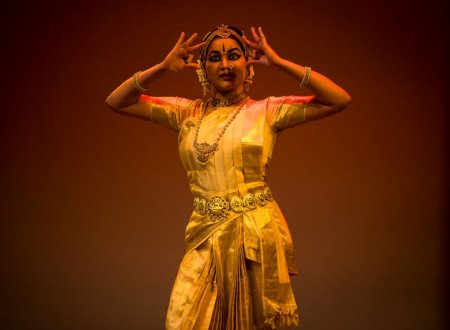 Pranamya Suri "Swagatham Krishna", the timeless composition of Oothukkadu Venkata Kavi in raga Mohanam, adi talam, was presented next by Pranamya Suri. Welcoming Krishna with devotion and love, Pranamya depicted Krishna's leelas, such as his dancing over the hoods of serpent Kalinga, protecting the Gokul dwellers under Mount Govardhan to save them from the torrential rain and thunderstorms caused by Indra's rage. She cordially greeted Krishna, who was worshipped by sages and resided in the hearts of the Gopikas, symbolising their unmeasurable love for the divine. She warmly welcomed Krishna, who was both powerful and tender, fierce and sweet. Known for her grace and precision, Pranamya did full justice to the choreography by her guru, Dr Sobha Naidu.  Yamini Kalluri Then came the Desh Thillana, a solo by Yamini Kalluri. A brilliant disciple of Dr Sobha Naidu, the New York-based Kuchipudi dancer Yamini began performing across India at the age of twelve. She has since performed and led workshops internationally across the U.S., U.K., Russia, Argentina, and Canada, while further refining her style under Guru Vempati Ravi Shankar. In New York, Yamini trains in ballet and modern dance at the Martha Graham School, expanding her repertoire and developing a unique style that blends tradition with contemporary expression. She is the founder of 'Kritya', an initiative that empowers emerging artistes and reimagines Kuchipudi for a global generation. Drawing inspiration from Vempati Chinna Satyam, Rukmini Devi Arundale, Akram Khan, and Shantala Shivalingappa, Yamini envisions 'Kritya' as a budding conservatory, where there is space for innovation, experimentation, and deep artistic immersion. All this was visible in Yamini's dance. Delving into the charming love story of Sri Valli and Lord Murugan, she envisioned Sri Valli as a huntress, daughter of a chieftain, waiting in a lush green forest, longing for Lord Murugan to ease her love sickness. Upon his arrival, they engage in playful interactions of their tender love. Given the Kritya ensemble's shared appreciation for Tamizh culture, Yamini wanted to honour the Tamizh language by weaving its beauty into the fabric of her dance. Thus, having an Antara with Tamil sahitya, her Thillana sounded like a 'Chaturang' with four segments comprising Thillana, Sargam, the Tamil language sahitya and the percussion mnemonics. She very imaginatively incorporated a Kathak Lehera also in raga Desh, to create the romantic ambience for this theme of Shringar Rasa. The refreshing Tamil sahitya by Ranganayaki Jayaraman was musically arranged by Yamini Kalluri and Harsha Mandayam Bharathi. 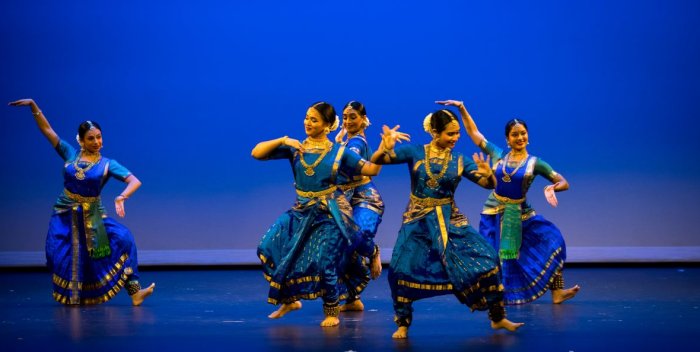 Kalanidhi Dance Company Next came the 'Ardhanareeswara Stotram', presented by Kalanidhi Dance Company. The captivating group choreography by Pragnya Thamire with five dynamic dancers, Sriyuktha Ganipineni, Anjana Kuttamath, Mytreyi Nair, Pragnya Thamire, and Deviga Valiyil, portrayed the divine form of Shiva as Ardhanareeswara. Praising the composite form of Lord Shiva and Goddess Parwati, it highlighted their inseparable unity. The dancers embodied this union, with feminine and masculine grace alternately symbolising creation and destruction, grace and intensity, that existed as one. The lyrics by Adi Shankaracharya described this contrast with her golden radiance and his ash-smeared form, her musk and saffron against his camphor-white sacred ash, her jewelled beauty against his serpent ornaments, her lotus-like eyes with his three-eyed gaze, her garlands of flowers with his garland of skulls. Together, they revealed the inseparable harmony of opposites in their combined roles in creation and destruction, offering blessings of long life, good fortune and spiritual realisation to the devotees who recited the stotra with devotion. The music for Ardhanareeswara was composed by Sweta Prasad in Ragamalika, Panch Gathi talam, perfect for the imaginative choreography of Pragnya Thamire, herself groomed in the signature style of Guru Vempati Chinna Satyam under the watchful guidance of Guru Anuradha Nehru and the intense training of Guru Jaikishore Moslikanti. Now serving as the Assistant Artistic Director of Kalanidhi Dance, Pragnya brings deep knowledge, technical precision, and compelling stage presence to both ensemble and solo works. 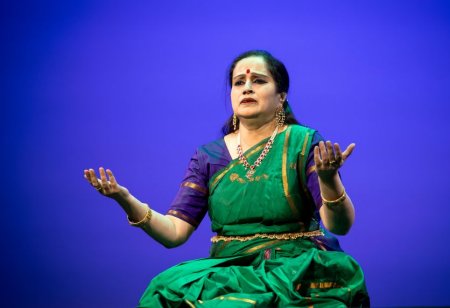 Dr Anupama Kylash Dr Anupama Kylash was especially invited from India to be featured in 'Resonance' for her extempore interpretation of abhinaya. Her moving presentation of 'Subhadra Vilapam' in 'Baithaki Bhava', the seated abhinaya format, also underlined her academic acumen, sensitive perception, and in-depth discernment in the selection of Sanskrit verses from the Vyasa Mahabharata and a 'Vachana' in Telugu from Srimad Andhra Mahabharatam to delineate the lamentation of Subhadra, upon seeing the lifeless body of Abhimanyu, her beloved son. Subhadra wonders how a warrior like him, who had learnt the art of warfare in her womb itself and who was as valorous as his father Arjun, could have been defeated and killed in this manner? The body, which was like the dark sky, eyes like a crescent moon and teeth like shining stars, how could she see it covered in the dust and debris of the battlefield like a felled, majestic tree? Anupama also took recourse to the 'Vachika Abhinaya' when Subhadra's anger continued to mount, and she says, "Five valiant Pandavas could not rescue one child? What is the use of Bhima's strength, Arjuna's archery, the bravery of the Vrshni and Pancala clans! I care nothing for such valour! The son of Arjuna, nephew of Vasudeva, how can he meet such a fate?" Her anger then turns towards Krishna, and she chides, "You came in an instant when the elephant, Gajendra, was being tormented by a crocodile! Where were you when so many crocodiles surrounded my son? You subdued the venomous snake Kaliya, but you could not subdue the deceitful snakes spitting venom at my son? When Indra showered thunder and rain, you lifted the mountain with your little finger, but when the harsh winds of calamity were buffeting my tender lotus-like son, why didn't you save him?" Not wanting to end on a distressing note, Anupama incorporated Krishna's powerful address to Subhadra from the Mahabharata, "You are a daughter, sister, wife and mother of 'Shoor Veeras'. Your son attained Sadgati, befitting a great Kshatriya warrior, so lament not, Bhadre!" And Subhadra bows down in surrender to the one who will come again and again for the re-establishment of Dharma, believing that Abhimanyu's death would be avenged. The intense abhinaya by Anupama was enhanced with music by Sweta Prasad in Ragamalika, adi talam. 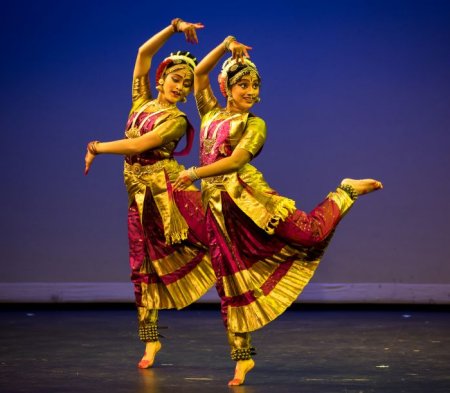 Sadhana Thilak and Vaishnavi Uppalapati This was followed by "Koluvai unnade Devadevudu", a 'Shiva-Stuti' composed by Shahji Maharaj in raga Shankarabharanam, adi talam. Choreographed by Dr Sobha Naidu, this was performed as a duet by Sadhana Thilak and Vaishnavi Uppalapati from the Kuchipudi Dance Academy founded by Guru Lakshmi Babu. 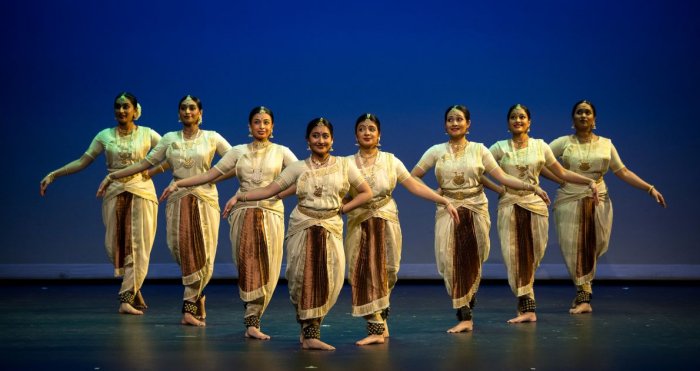 The Circle is Unbroken 'Resonance' concluded with a vibrant touch of contemporaneity in 'The Circle Is Unbroken', exploring the power of spheres and circles. Pulsating with life and vigour, it was a group choreography by Daniel Phoenix Singh featuring dancers Sriyuktha Ganipineni, Akshara Girish, Samhitha Gurram, Anjana Kuttamath, Mytreyi Nair, Ritika Reddy, Pragnya Thamire, and Deviga Valiyil, all dressed in pastel shades. The quicksilver movements of the dancers were a visual depiction of 'some of the most frequently occurring shapes from the planets and stars, to the circular motion of waves, the softness of circular pathways in a harsh and rigid world.' Music by Illaiyaraja had the aura of a Western orchestra to open with, which merged into the swaras of raga Patdeep towards the end. Both the abstract dance and the mesmerising music echoed Daniel's wide range of experiences and work in Arts practices. Daniel began his journey in Bharatanatyam with Guru Meena Telikicherla of Nrityanjali. In his modern dance practice, Daniel was mentored by Pamela Mathews as curiosity took him from computer science to a dance major in college. Lorry May, Harriet Moncure Williams, and Karen Bernstein helped shape his choreographic voice. Mallika Sarabhai, Madhavi Mudgal and Leela Samson in India also helped broaden his perspective on the space Indian dance forms occupy within the body, in the pedagogy, and in the field of dance. He acknowledges the complicity and internalisation of colonial, racial, and caste-based oppressions in his life and works hard to approach issues from an anti-caste, anti-colonial, and anti-racist perspective in all his work, especially dance. No wonder, representing circles as symbols of community strength, he dedicated this piece to the liberation struggles everywhere. The performances were followed by a question and answer session with the dancers and choreographers, initiated by Anita Vallabh, with enthusiastic floor participation. 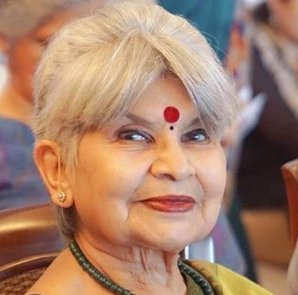 Manjari Sinha is a musicologist and an acclaimed classical music and dance critic. She has an MA in Sanskrit from Allahabad University, MA in Music from Vikram University, Ujjain; Sangeet Prabhakar in Hindustani Vocal, Tabla, Sitar and Kathak dance from Prayag Sangeet Samiti, Allahabad; and further training in Sitar under Guru Pt. Arvind Parikh in the lineage of Ustad Vilayat Khan. She has authored a book on Ustad Bade Ghulam Ali Khan, commissioned & published by Roli Books. She has contributed the chapter on Kathak for 'Indian Dance: the Ultimate Metaphor'. Her articles in English and Hindi on Music, Dance, Art & Culture are regularly showcased in a variety of leading journals and periodicals. |
