
|     |
|
| |

 Pankajam, Rasa Ramayana and Lines Unbound- Satish Surie-mail: satishism@yahoo.co.in Photos: Prof K.S.Krishnamurthy December 13, 2025 'PANKAJAM' - LOTUS OF PLURALITY IN ODISSI SPLENDOUR On November 22, 2025 in the hallowed acoustics of ADA Rangamandira, the Odissi Dance Centre (ODC), Bangalore, unveiled Pankajam, a thematic production conceived and choreographed by the visionary Devjani Sen. Performed by her dedicated students, the premiere wove a luminous tapestry of Hindu, Jain, and Buddhist narratives around the lotus (pankajam in Sanskrit), that eternal emblem of purity rising unsullied from primordial depths. Premiering as a celebration of "the union of plurality and divinity," the evening unfolded across three segments, each petal of the lotus revealing layers of cosmic churn, sacrificial faith, prophetic vision, and humble surrender. Under Sen's meticulous guidance, the young ensemble breathed life into ancient lore with the fluid precision of Odissi's tribhanga curves and expressive abhinaya. 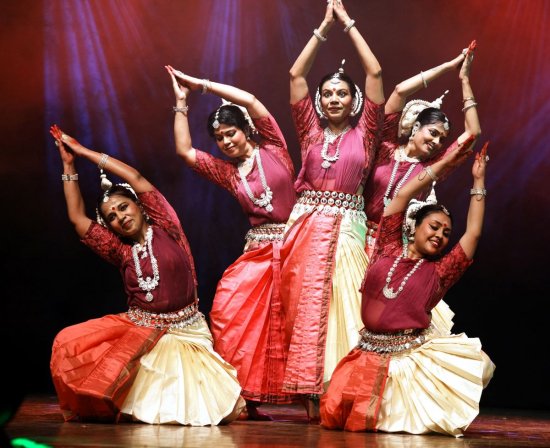 Pankajam The production commenced with the primordial vigour of Samudra Manthan. As the pakhawaj pulsed beneath their movements, the stage gradually shifted from tumult to revelation: a lotus rising from Lord Vishnu's navel, heralding the emergence of Goddess Saraswati. Sen balanced spectacle with lyricism; the dancers' gentle blooms and buoyant footwork mirrored the lotus's delicate ascent, suggesting that wisdom often arose from the very heart of chaos. Seamlessly transitioning into the epic fervour of the Ramayana, the narrative alighted upon Lord Rama's ardent worship of Durga Devi on the eve of his confrontation with Ravana. In a procession of devotion, the lead dancer as Rama proffered 108 lotuses - each meticulously placed in a spiralling mandala of offerings - his posture a tower of unyielding bhakti. The ensemble, as ethereal attendants, mirrored the piling blossoms with cascading arm extensions and synchronised spins, the air thick with the scent of imagined jasmine. Yet, the Devi, portrayed with regal poise and a flicker of divine mischief, concealed the final lotus, testing the worshipper's resolve. Rama, the lotus-eyed one (kamala nayana), responded not with despair but with the ultimate vow: to pluck out his own eye as a substitute. In a heart-stilling abhinaya sequence, his fingers hovered near his face, eyes widening in sacrificial clarity - until the Goddess, moved by such depth, unveiled the bloom and bestowed her blessings. The segment's climax erupted in triumphant nritta, feet stamping victory's rhythm, as the lotus motif unified the threads of trial and grace. The students conveyed the emotional cadence with maturity, revealing Sen's deft shaping of expressive detail. The production then ventured into the serene prophecies of Jainism, illuminating the dreams of Queen Trishala, mother of Lord Mahavira, the 24th Tirthankara. On the cusp of his incarnation, she envisioned sixteen auspicious omens from the Digambara canon, with the tenth - a celestial lake (Padma Sarovar) teeming with pristine lotuses - heralding the advent of an enlightened soul. 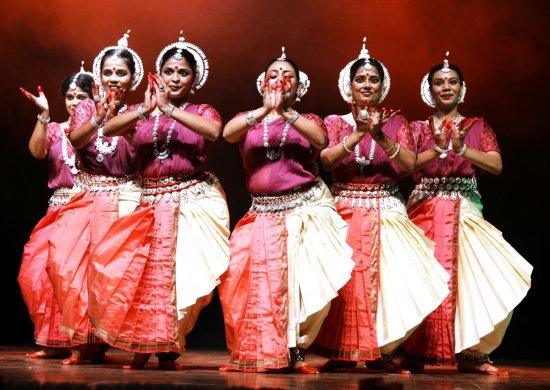 Pankajam Accompanied by the meditative pulse of mardala and flute, the choreography evoked Trishala's awe: her form gliding through the visions, hands cupping invisible petals in gestures of prophetic wonder. A touching counterpoint emerged through the portrayal of Mahavira as both a lively child and an ascetic sage, the transitions executed with impressive finesse. This segment embodied the Jain ideal of vairagya (non-attachment), the lotus standing as an unstained witness to samsara's illusions. Culminating in a poignant inversion of value, the finale drew from Rabindranath Tagore's Fruit-Gathering ("The Price"), reimagined through the tale of Sudasa, the humble gardener. A relentless winter had ravaged the garden, sparing only one defiant lotus amid the frost. Sudasa, portrayed with earthy groundedness in chauka stances, cradled this survivor toward the marketplace, only to spark a bidding war: a merchant's single gold sovereign met by the king's doubled offer. The ensemble animated the escalating fray with vivid interplay. Sudasa's encounter with the Buddha, rendered in tranquil radiance, shifted the scene into spiritual focus. His surrender of the lotus and his plea for nothing more than "a grain of dust from your feet" provided a luminous conclusion. The students - Debashree Baral, Akshata Thirumale, Amrita Randhawa, Arundhati Singh, Jyotirmayee Sabat, and Apala Chakraborty - disciplined yet expressive, responded with sincerity to Devjani Sen's choreographic vision, embodying both technical precision and emotional depth. The script by Dr. Nithyananda Misra, rendered in Sanskrit, and the carefully curated music further enhanced the production, giving it an added layer of depth and resonance. RASA RAMAYANA: ARUNA MOHANTY'S ENSEMBLE BLOOMS WITH EMOTIONAL DEPTH IN ODISSI MASTERY The evocative grace of Odissi, as embodied by Aruna Mohanty and her Odisha Dance Academy ensemble, took centre stage at ADA Rangamandira in Rasa Ramayana, a dazzling exploration of the ancient epic through the lens of the Navarasas. Mohanty, a stalwart of classical Indian dance, once again demonstrated her unparalleled ability to blend tradition with innovation, delivering a performance that was both a visual feast and an emotional journey. From the moment the performance began with the Jagannatha Sahasranamam - a devotional invocation to the Holy Trinity of Brahma, Vishnu, and Shiva - there was an air of sacred reverence that enveloped the room. The ensemble's precise, fluid movements and graceful salutations evoked the very essence of Odisha's rich devotional culture. Each dancer's articulation of the hands and the steady rhythm of the mardala drums created an atmosphere of transcendental devotion that reverberated through the audience. 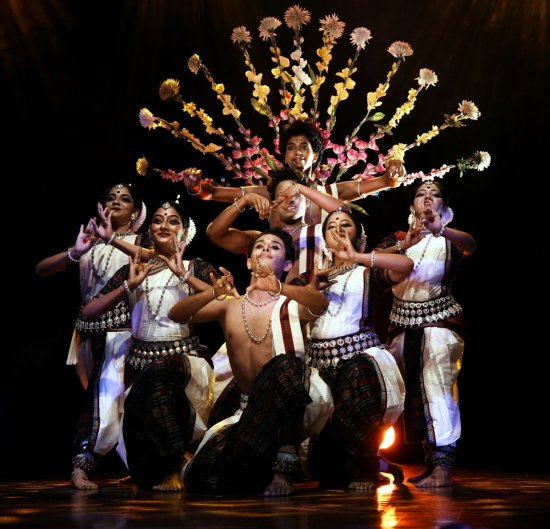 Odisha Dance Academy ensemble The program seamlessly transitioned into a Khamaj Pallavi, where Mohanty's choreography shone brightly. The raga's lilting melody served as the perfect backdrop for the dancers' intricate adavu sequences, which were performed with impeccable precision. The ensemble's synchrony, coupled with Mohanty's guidance, made this segment an absolute highlight, with the dancers' movements reflecting both the cyclical nature of the raga and the ever changing rhythms of life. The visual appeal of the flowing leharias, embroidered with mythic motifs, enhanced the performance's aesthetic quality, creating a vibrant tapestry of movement and colour. However, it was in the core segment of the performance - Rasa Ramayana - that Mohanty's brilliance truly took flight. Here, the nine rasas were explored with remarkable depth, each rasa brought to life through the body, face, and soul of the dancers. The opening Shringara (love) offered a poignant depiction of the tender romance between Rama and Sita. The duet between Sita and Rama was infused with gentle longing, their intertwining forms expressed the purity and intensity of love. The subtlety with which the dancers conveyed the emotional nuances - longing, joy, and devotion - captured the essence of the relationship in a moving way. The tempo shifted as the performance transitioned into Veera (valour), where Rama's triumph in breaking Shiva's bow was recreated with great vigour. The dancer's assertive arm gestures and determined strides, supported by the ensemble's dynamic movements, conveyed a strong sense of strength and courage. The choreography here was fast-paced and forceful, with leaps and intricate footwork creating an atmosphere of triumph and collective fervour, drawing the audience into the tension and excitement of the moment. In Karuna (compassion), the dancers captured the tragic fall of Jatayu, the vulture king, with heartbreaking precision. The artiste's portrayal of Jatayu's final moments was haunting, her faltering movements echoing the bird's desperate yet futile struggle. The expression on Sita's face, imbued with sorrow, was deeply touching, with the sorrowful flute strains adding to the poignancy of the scene. It was a performance that spoke to the heart, showcasing the dancers' ability to evoke complex emotions with minimal yet powerful gestures. Hasya (humour) arrived as a playful interlude, with the portrayal of Shoorpanaka providing much needed levity. Her exaggerated gestures and comically elongated nose captured the demoness's mischievous attempts at seduction, offering a moment of joy in an otherwise emotionally charged evening. The ensemble's lively interactions, complete with witty leaps and cheeky evasions, lightened the mood, drawing laughter from the audience while maintaining the narrative's essence. 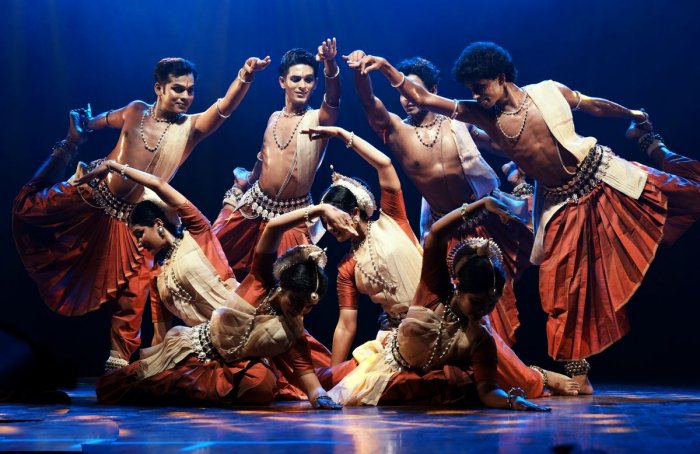 Odisha Dance Academy ensemble As the evening progressed, the remaining rasas unfolded with similar depth and expertise. Raudra (anger) simmered through the tension of conflicts, while Bhayanaka (fear) emerged in the eerie portrayal of Sita's abduction. Bibhatsa (disgust) manifested in the grotesque revels of the Lanka court, while Adbhuta (wonder) showcased the awe-inspiring leap of Hanuman, with gravity defying poses stealing the show. Finally, Shanta (peace) brought the performance to a serene conclusion, as the ensemble converged in tranquil formations, symbolising the resolution of the epic and the return of harmony. Throughout the performance, Mohanty's choreography was marked by a perfect balance of technical rigour and emotional depth. Her dancers - Shreepurnya Mohanty, Sayani Chakraborty, Suprava Sahu, Sandhyarani Sahu, Chinmay Behera, Diptiranjan Barai, Himansu Kumar Ray, and Shubham Kumar Ojha - excelled in conveying the complexities of their roles, seamlessly transitioning from one emotional state to another with grace and fluidity. The choreography was neither overly ornate nor too sparse; it allowed the dancers' natural expressiveness to shine, enabling the emotional arc of the Ramayana to unfold with ease. The ensemble's connection to the music was equally striking. The recorded track, featuring a range of ragas and rhythms, complemented the dancers' movements without overpowering them. The music supported the emotional tone of each segment, with the mardala's steady pulse grounding the performance in its Odissi roots while the accompanying vocals added a layer of spirituality to the narrative. LINES UNBOUND: YAMINI KALLURI REIMAGINES BALLET THROUGH THE SOUL OF KUCHIPUDI In the intimate embrace of the Bangalore International Centre, Yamini Kalluri unveiled Lines Unbound: Ballet in the Language of Kuchipudi on the evening of the 25th of November - a performance that shimmered not simply as an artistic experiment but as a bridge of rare luminosity, spanning continents, idioms, and centuries. What emerged was neither a hybrid nor a novelty; it was a revelation. Here, the stately poise of Western ballet dissolved - almost surrendered - into the fluid, narrative-infused elegance of India's Kuchipudi, yielding a dialogue at once tender, rigorous, and transformative. Kalluri, the New York–based prodigy celebrated by The New York Times and the BBC, commanded the stage with the seasoned authority of an artiste far beyond her 27 years. She moved like a force of nature shaped by discipline: each nritta segment a storm of crystalline footwork and rhythmic tattadavus, each expressive arc of nritya a distilled shard of emotion. What she offered was not fusion but translation - balletic vignettes reimagined through the linguistic and emotional architecture of Kuchipudi. 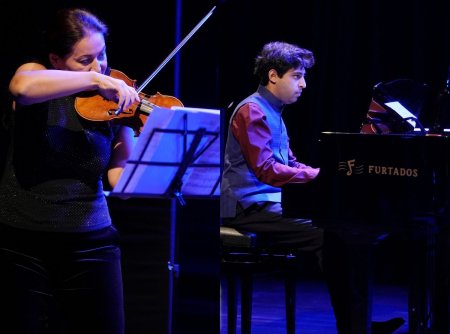 Gulzara Shakir and Neville Bharucha The evening opened with a musical prologue by pianist Neville Bharucha and violinist Gulzara Shakir, whose performance of Delibes' Le Roi s'amuse excerpt and Grieg's Violin Sonata in C minor traversed its shifts of majesty and melancholic fire. Their partnership - both restrained and lush - set the tonal compass for the night. When Kalluri entered, the performance's thematic concept unfolded with striking clarity: 'Ballet in the Language of Kuchipudi' could have, in lesser hands, slipped into stylistic gimmickry, but Kalluri's curatorial intelligence and deep grounding in both Indian classical idioms and Western modern dance anchored it in artistic integrity. Her palette drew upon works with strong narrative and kinetic profiles - Mozart, Bach, Chopin, Kreisler, Moszkowski, Rachmaninoff, Stravinsky, Dvořák, Tchaikovsky's Swan Lake and The Nutcracker, and Grieg's Sarabande, the latter steeped in an unmistakable erotic undertone. The Baroque selections, with their inherent improvisational logic, allowed her to explore ornamentation in movement, while the Western classical canon's precise notation imposed a counter-structure that she navigated with remarkable finesse. 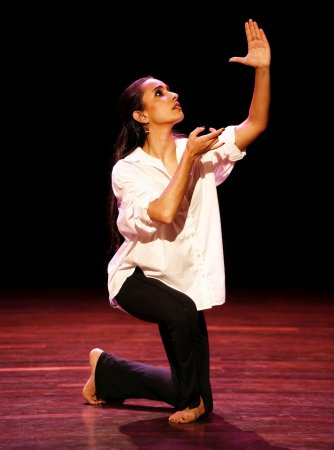 Yamini Kalluri Kuchipudi's rhythmic intelligence came into even sharper focus in the way Kalluri negotiated jatis within Western classical scores. Instead of tala-bound korvais sitting atop a mridangam framework, familiar step patterns were stretched, syncopated, and re-accented to ride the phrasing of the musical score, as though discovering hidden percussion within the piano and violin. Hand gestures responded to this musical re-mapping with equal nimbleness: where a conventional composition might sustain a hasta through an entire avartanam, here the same mudra flickered in short pulses, sliced cleanly through a phrase, or glided across bars to shadow a melodic swell. The upper body became as attuned to harmonic progression as it was, in the traditional repertoire, to sahitya - a rare kinetic conversation between melody, meter, and meaning. Neville Bharucha articulated the musical architecture succinctly: the score was not bent around the choreography. The music remained strictly faithful to its written form - no rearrangements, no dilutions - inviting the dance to meet it on its own terms. That choice heightened the creative tension of the evening. Instead of accommodating the dancer, the music stood as a fully realised edifice, compelling Kalluri to negotiate her phrasing within Tchaikovsky's sweeping lines, Dvořák's angular clarity, and Stravinsky's rhythmic provocation. What emerged was a heightened sense of dialogue, sound and movement speaking to each other across cultural and structural divides. Kalluri herself, in her prelude remarks, framed the evening's movement vocabulary through a striking anatomical insight. In Indian classical dance, the pelvis "surrendered" to the floor - rooting the body in araimandi and sending energy downward. Ballet, by contrast, drew its defining impulse from lift: energy rising through the spine, arms, and legs in an aspirational ascent. That philosophical polarity - groundedness versus elevation - became the quiet thesis threading the choreography. Many passages began from a recognisably Kuchipudi stance: hips anchored, knees bent, weight dropping into the earth. From this rooted place, the torso and arms reached skyward, chasing long, balletic lines as though unspooling from within the traditional form. The result was a visible conversation between descent and flight, gravity and transcendence, surrender and aspiration. Kalluri offered an illuminating reflection on the deeper overlaps between ballet and Kuchipudi, noting that the body was "tuned very differently" in Western classical dance, where the hands remained relaxed, the placement of movement was precise, and each gesture originated from a distinctly articulated centre. She acknowledged, with characteristic candour, that her own Kuchipudi had perhaps acquired a "balletic accent," a subtle inflexion shaped by years of immersion in multiple movement vocabularies. She further elaborated on the contrasting articulations of the feet in the two traditions. In ballet, movements such as tombé - literally "to fall" - carried a sense of floatiness, an upward-directed energy even in descent. Kuchipudi, by contrast, sent its energy downward: the leg sliding to the floor with purpose, the weight dropping into the earth rather than lifting away from it. This divergence in kinetic intention, she noted, became a fertile space for exploration when the two vocabularies met. Lines Unbound ultimately offered more than technical virtuosity or cross-genre interplay - it illuminated the possibilities of dialogue when traditions were treated not as rigid containers but as living, breathing languages. Kalluri's artistry did not compromise either idiom; instead, it allowed each to sharpen, challenge, and soften the other. In that delicate tension lay the evening's brilliance. In Yamini Kalluri's hands, Kuchipudi spoke in accents the audience had not heard before - rooted, soaring, and wholly her own.  Bangalore based Satish Suri is an avid dance rasika besides being a life member of the Music and Arts Society. |
