
|
    |
|
|
|


Krishnanattam, a visual treat by Padma Jayaraj, Trissur e-mail: padmajayaraj@sancharnet.in June 14, 2004 Krishnanattam, a dance oriented theatrical performance is the product of the Bhakti movement. Prince Manvedan of Kozhikode, Kerala, India who scripted and produced this visual treat bequeathed a unique performing art to the cultural stream of Kerala that culminated in the world renowned Kathakali. Born to pay homage to Krishna, Krishnanattam has refused to adopt innovative themes- both its strength and limitation. And it demands a special ambience, as it is the synthesis of dance, spectacular costume, music and rhythm re-enacting a cosmic play in macroscopic dimensions. The texture of the performance and its resonance draw the audience into a specific communion rooted in Bhakti, the intense self-negating love, the soul and spirit of the Krishna cult. In the evolution of the dance drama, Krishnattam is a milestone. It incorporated drama from the rarefied performance tradition of Koodiyattam, ancient Sanskrit drama; dance from the ritual performances like Theyyam, and folk dances like Kaikottikali. Its artistic beauty lies in its costume, make-up and dance steps. It remains a one-troupe theatre because of the Sanskrit text. The original Krishna Geethi is sung in the background in Sopanam style to the rhythmic beat of the madhalam and chengala recalling the entire gamut of Bhagavatha stories. And the performers dance to the rhythm of the music that rarely coincides with the narrative. The dancers have their own text made up of gestures, movements and tableaux evolved by countless gurus over decades. The hand-held curtain punctuates the rapid scene-changes making the story leap forward. Krishna is ever present, pervading the atmosphere and on the stage in his solitary splendour. And the spectators experience a multitude of ecstasies intensely personal, yet part of the collective consciousness. Guruvayoor temple is the sole patron of Krishnattam. Every year there is a continuous performance of Krishnattam starting from September 1st for eight days. People watch Krishnanattam in its traditional format from the divine descent to renunciation, and rounded off on the ninth night with Avatharam again to stress the cycle of life and death. Eight becomes a mystic number: the story of the eighth incarnation of Dasavathara, born as the eighth son of Devaki, told in eight chapters in eight continuous nights with eight measures of oil that burns eight wickers lighting the lamp. Avatharam opens the performance. Bhumi Devi tells of her woes under the stranglehold of evil to Brahma, the four-faced who promises her quick relief. In the next scene, after the marriage, Kamsa the all-caring brother transforms himself into a demon when his life is threatened. And he dominates as the overwhelming power of the evil until Vasudeva promises to deliver all their unborn children into his hands. In the next scene Lord Vishnu descends in his Viswaroopa and the parents prostrate in worshipful reverence. Does it symbolise our own times: of the greed of Power, and the burden of the unborn? Away from the enchanting myth the scene depicts psychological realism, a moment of truth when each couple realises that their child is a gift from God, godliness incarnate! Then follows the charming pranks of the boy Krishna told and retold by countless artists over centuries, of which the Indian mind is never tired…an aura of eternity plays around when the stick in Yasoda's hand asks, "Telling lies…?." " No, no…no…!" is the guilt-ridden frantic answer. How human, yet how divine!! Oh, you fall in love, deeply with this adorable, boy-god that carries joy in his heart. And India has named her boys after him down the ages. 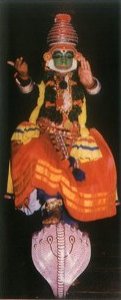 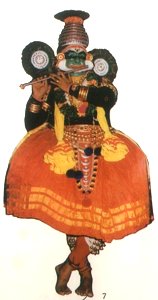 On the second night Krishna grows up in stature for his special mission of the destruction of evil. The stories are narrated in verse while the scenes like Poothna Moksham, Bakasura Vadham, Kaliya Mardhanam are displayed in spectacular masked dances. And they are interwoven into the idyllic life of Krishna in the pastoral settings of Gokulam. The powerful thandava dances of the fighting scenes alternating with the lasya style of the celebrations of his triumphs build up the tempo as Krishna grows up in heroic proportions. Yet, the Vasthrapaharanam in which Krishna enjoys the visual treat of the naked beauties keeps him down to earth. 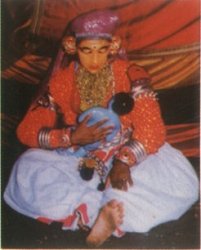 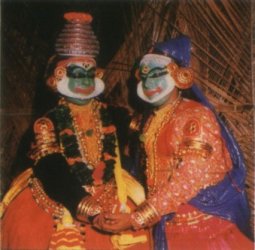 Rasakreeda on third night depicts one night of erotic bliss on the banks of the Yamuna: one night of music flowing from his flute that drives lovelorn hearts crazy, one night of dreams for the dreamers of all time to dream of, one night of love for all the lovers to treasure in their hearts. Adolescence blossoms here. Generations have grown up with the youthful Krishna setting their hearts aflame; the mystique of love setting their souls on a trail of aching, yearning, longing. This quintessence of romance is presented in a harmonious ensemble steeped in feminine grace. All the males that play the Gopis exude femininity. Mullappoo Chuttal, the celebrated garland-dance, is rich in old-world charm. The fluid movements of the dancers weave circles, and triangles, in twos and threes; in liquid meanderings they dance in circles and ellipses around the lighted lamp. Its patterns unfold like petals of blossoming flowers of an endless garland. Krishna dances through, in, and out of these changing patterns in charming glitter. Clanging cymbals, jingling ankle-bells, soft thuds of dancing feet controlled by the loud gong create a symphony. As music surge, the ebb and flow of a hectic round of love draws the spectators into an emotional participation. The throbbing madholam resonate their heartbeats as the Gopikas scintillate with Krishna in an astral plane, the glory of Krishna cult. Kamsa Vadham, the performance of the fourth night, is the turning point in Krishna's life and philosophy. 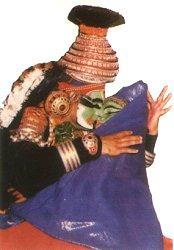 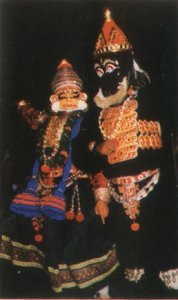 Swayamvaram, on the fifth night enact the marriages of Balarama, and Krishna accepting Rukmini and Sathyabhama, which are really colourful. Swayamvaram is perhaps the most enacted performance in Guruvayoor temple as an offering by devotees for perfect alliances. BanaYudham on the sixth and Vividha Vadham on the seventh nights are famous for the varied masks used to depict Krishna's life fulfilling his dharma as the destroyer of evil. Geethopadesam and the tender tale of Krishna and his one-time friend Kuchela are unforgettable renderings. 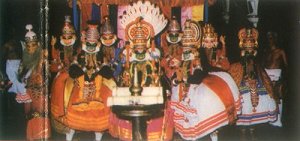 The tendency to adapt from Kathakali, its make-up and costume, robs this art form of its native simplicity. Setting the songs to music has enhanced the tone to create the mood of bhakti. That the actors need more practice and more artistry and emotional involvement is perhaps due to the sad neglect owing to security of patronage and lack of competition, for Guruvayoorappan feeds, clothes, shelters and pays the actors. Boys at the tender age of eight are recruited to learn this performing art. Krishnanattam now travels beyond India to European countries and to the US. An edited version of 2 to 3 hours is what they enact abroad, not the traditional 9 day performance. Far removed from the immediacy of the intracultural horizon of India, can the gestural language of Krishnanttam convey the mystique of Krishna? Perhaps, cultural tourism does not pause to ask such questions. But as long as the Indian mind yearns for a child, as long as men and women fall in love and as long as the human soul yearns to unite with the Eternal, as long as the unheard flute enchant the Indian spirit, Krishnattam is bound to excite humanity. Padma Jayaraj is a regular contributor to narthaki.com |
