
|
    |
|
|
|


Gender Switch! (Meaning no offence to any one in particular) - Padmaja Suresh, Bangalore e-mail: padmajasuresh@hotmail.com June 30, 2007 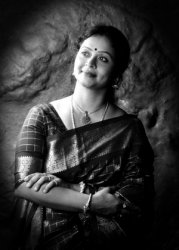 Women are suitable to do both male and female roles but can the same be said of men? Worth considering if there is a hidden man inside a woman (the word 'woman' also approbates this) and what about vice versa? We should analyze first on the external front and then the internal levels giving us a gender gallery of contrast and congruity. It is exciting and enhancing for women to drape shirts and trousers designed to befit their style or sometimes even without any variations by wearing typically male clothes. But can one imagine men in sarees or any other typically female attire? What men do can be imitated and to counterfeit their appearance to deliberately create a semblance would still be for women, in conformity with norms. If a woman could carry herself well with elegance and grace alike, she becomes a true beauty; if she exudes confidence, courage and determination, she becomes a true example; if she can fight a battle, and also nurse the wounded, stare boldly yet shed tears, she becomes a legend! But unfortunately though, a man seen crying, lamenting or moaning without sufficient reasons could become a defaced and deformed figure, not befitting his 'manhood.' Qualities of kindness, warmth, compassion are also extolled in a man but are appealing only if veiled in his inherent, habitual 'ruggedness.' Otherwise, he gets belittled and chided and a crude word 'effeminate' gets attached to him. The corollary of the above is noticed in the world of Bharatanatyam as well. Ordinarily, the dance of Shiva, Lord Nataraja (even His pose) requires the highest brilliance, sheer pulsating tempo and a powerful vocabulary. If at all one is capable of reproducing this, then maybe one or two shades of the cosmic dance becomes visible in the dancer. This 'Tandavam' by both male and female dancers exudes delight and aplomb. The other dance aspect of 'Lasya' which is the graceful and charming element is equally delectable but care has to be taken while performed by a male dancer to see that this effect does not linger beyond the stage limits and seep into his 'persona.' It is commonly remarked by many (meaning no offence to any one in particular) that many a male dancer especially in Bharatanatyam, happens to sacrifice unknowingly, his virile stride, mannerisms and 'macho' image. Instead, the kind of dance articulations usually associated with women, look more pronounced in him than his very own manliness. To tackle the situation, a pragmatic reaction without emotional bias or penchant to this allegation is essential. It is worth noting here that male dancers rarely performed those days but often taught as Nattuvanars. It is related to the Purusha - Prakriti dualism embodied in the dualism of the human nature. Purusha (the macrocosm) remains unmoved whereas Prakriti (containing the Purusha's atom or seed as microcosm) is permitted to oscillate. It was felt 'not' without any grounds that a woman's body is better suited for performing this dance, while a man's mind is better at analyzing and teaching it. Learning from the traditional lineage of male gurus gave the girls the best training to dance and blend the dualities cohesively. This disparity and insinuation regarding the 'style' of male dancers would remain as long as man's age-old perception of beauty and philosophy of aesthetics having been fortified by historical and mythological role models, would remain… Padmaja Suresh is a classical dancer, choreographer, teacher and director of Kalpataru Kalavihar, Institute of Arts, which has a charitable wing for training lesser privileged children in performing arts. She is a commerce and Law graduate, has a Masters in Philosophy and pursues a Phd from Mysore University at present. |
