
|
    |
|
|
|


Who am I? In search of Me in Abhinaya - Purvadhanashree, Delhi e-mail: purvadhanashree@gmail.com Pics: Lalitha Venkat July 13, 2008 (This article is courtesy Purvadhanashree's blog) Abhinaya is that aspect of Indian classical dance which explores the depths of emotions in a performer and the audience within the framework of a piece of literature. The word, the melody, the rhythm and the body movements of the dancer weave a fabric of abstract images which when mentally 'worn' by the audience brings them face to face with their own being. Once the dancer selects a piece of literature she places herself in the core of the setting laid down by the writer and then asks the following questions in order to paint this setting in her own individualistic way. Who is this character I am going to portray through the language of dance? How far do I identify with her? How do I treat the other characters vis-à-vis the protagonist? 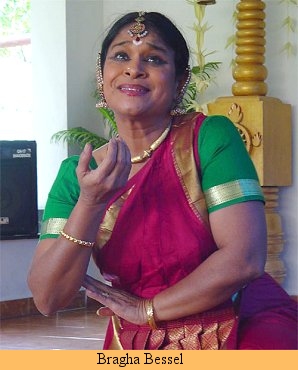 Abhinaya in Indian aesthetics is highly complex. An artiste develops an understanding of one's own art over a considerable period of time, which translated in a performance transports the performer and the audience to a state of realization which is aesthetically supreme and spiritually outstanding. The world created by the performer is a coming together of many spaces - aural, philosophical, spiritual and human. She defines different contexts. She even travels back and forth in time which is an illusion within an illusion. Bragha Bessel's performance of a composition by Kshetraiyya 'Vadaraka po pove' explains this. She plays the role of a nayika (heroine) who has spent all her life waiting for her lover. When finally he sends a message of his arrival through the friend of the nayika, she tells her to ask him not to come as the idea of a union would be too much for her to cope with. She recalls the past moments they shared together and now after all these years the same moments float in her memory giving her strength to survive. The dancer moves back and forth in the time zones and carries the audience through the lonely journey she has made to finally come to a state of resignation. No matter how illusory these imageries are, never does the artiste move away from the core of her personality. While every character is clearly defined in a piece of literature, the dancer gives life to it according to her personal interpretation of it. She does not dissolve into the character to the extent of purging her own identity completely in the performance. How 'real' this abstract world of dance is, depends on how much the dancer understands herself. The switch from one character to another is very smooth when she does not lose track of what role she is playing. Not only is the transition from one character to another smooth, even the shift from the art world to the real world is effortless. Abhinaya - a highly individualistic expression of art How is abhinaya a highly individualistic art form? Natya Shastra - the treatise on dramaturgy by sage Bharata answers this question succinctly. It says that it is the temperament of a person which moulds the treatment of a character. The costume, the spoken or musically rendered words and the entire body aid the dancer to finally project physically what the mind conceptualizes. And that makes abhinaya not only the most difficult part of dancing but also a method by which the dancer comes closest to her being. And while doing this she heightens the proximity between the spectator and her inner self. The spectator is not dancing but when pulled (by his/her own volition) aesthetically into an emotional experience, confronts one's emotions. Anupama Kailash, a Kuchipudi and Vilasini Natyam dancer reflects, "It ( abhinaya) does a very difficult thing which as people we might not do to each other. We might not reveal ourselves to others. In the process of maintaining a certain decorum or behavioral pattern, there are certain parts of us that get hidden from others. That is why abhinaya is the most difficult art because it strips that veil." 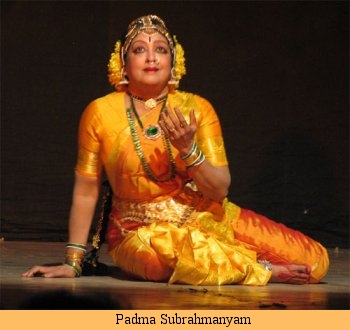 In dance there are two kinds of characters that a dancer deals with - mythological (larger than life) and secular (closer to life). Although the mythological characters are familiar to everyone and the secular characters are often presented through a frame of a popular lyrical piece, still the exposition changes from person to person because no two persons are same. Dashavatar - the 10 incarnations of Vishnu are performed by many dancers in some form or the other. As human one can only mention these forms, at the most describe them. But to be actually living the form and bring it alive is a challenge for every artiste. Narasimha avatar is one form which can only be imagined. No painting or description can give a complete idea of how that half beast half human form would have looked. Dr. Padma Subrahmanyam enlivened this avatar in a performance. The genius of her artistry reflected in every movement. The way she walked, left the audience completely awestruck. At that moment she looked like the most hideous, unnatural, frightening yet compassionate entity. Interesting thing to note here is also the fact that our dances are not age specific or gender specific, which is a double challenge for the performer. The first challenge is to dissociate oneself from one's immediate reality and go into a make belief world in a flash of a moment and the second is to even forget how old one is and who one is. The extreme examples are - a male dancer doing 'Kuruyadunandana' (a song from Jayadeva's 'Gita Govinda' in which Radha beckons Krishna to adorn her), a female performer doing 'Priye Charusheele' (another song from Gita Govinda in which Krishna pleads to Radha for forgiveness and expounds his love for her), an aged dancer doing child Krishna and a young girl enacting a mother's role. No matter how different the dancer is from the roles she is portraying, she still is able to do justice to it because there is a part of her 'emotional self' which she tunes-in with the character she is playing. This aspect of classical dance, in which the physical personalities of the dancer and the audience dissolve when the performance reaches a heightened moment during an aesthetic experience, is called sadharanikaran - a theory explained beautifully by S Sarada, a scholar and former teacher in Kalakshetra, Chennai "..the full attention of the audience is drawn to the various emotions and actions of the dancer and the experience of the dancer and the audience, (which is the outcome of the theme depicted on the stage) establishes a rapport between them and sublimates the different emotions felt." Theories in the West The two theories of theatre acting in West propounded by Konstantin Stanislavski and Bertolt Brecht during World War I and II spoke of the relationship between the actor and the character in distinct ways. "How does an actor act? How can the actor learn to inspire himself? What can he do to impel himself toward that necessary yet maddeningly elusive creative mood?" These were the simple, awesome riddles Stanislavski explored throughout his life. Stanislavski clearly could not separate the theatre from its social context. He was influenced by the revolution. He set up many studios and trained actors in his style of acting. At the First Studio, actors were instructed to use their own past experiences to naturally portray a character's emotions. In order to do this, actors were required to think of a moment in their own lives when they had felt the desired emotion and then replay the emotion in the role in order to achieve a more genuine performance. Some of the artistes who re-visited their past went into "hysteria" which drained them completely and then Stanislavski had to mend his approach a little bit in which he eventually emphasized the actor's use of imagination and belief in the given circumstances of the text rather than her/his private and often painful memories. His way of working on a character was 'to work from the inside outward,' 'the focus remained on reaching the subconscious through the conscious.' The Stanislavski System, or "the method," as it has become known, held that an actor needed to take his or her own personality onto the stage when she began to play a character. This was a clear break from previous modes of acting in which the actor's job was to become the character and leave their own emotions behind. The Brechtian school of acting was influenced by the horror of World War I, by the suffering of the middle and lower classes during the postwar recessions of the 1920's, the Great Depression of the 1930's and by the teaching of Marxism. Brecht and his fellow epic theatre artists devised a set of staging and acting techniques meant to teach their audience to criticize the injustices and inequalities of modern life. Two key factors in their technique were the notion of "theatricalism" and the concept of the "distancing" or "alienation" effect. The first, theatricalism, simply means that the audience is aware that it is in a theatre watching a play. Brecht believed that "seducing" the audience into believing they were watching "real life" led to an uncritical acceptance of society's values. Brecht wanted actors to strike a balance between "being" their character on stage and "showing the audience that the character is being performed." The sudden shift from one behavior to another put the audience off-balance. It was a theatre that was addressed to reason rather than empathy. The audience was always made aware that it is watching a play, and should remain at an emotional distance from the action. This kind of theatre was largely a reaction against other popular forms, Stanislavski being one of them. Stanislavski attempted to mirror real human behaviour, and to immerse the audience totally into the world of the play but Brecht saw this as another form of escapism. Rasa in Indian aesthetics It is very clear that these two schools of thought emerged as an artistic reaction to what was happening around at a social and political level. Theatre acted like a medium of catharsis. Whereas the approach that classical dancers in India have towards the art of emoting/acting is purely based on aesthetics and spirituality. S Sarada, in episode 6 of television series 'Natyopasana' (worship through dance), explains that, "The whole Universe is impregnated with rasa or supreme Brahman (universal being) and therefore the divine rasa in us is ananda or bliss. It is without a beginning or an end and it is eternal. It can manifest itself as we learn to appreciate the beauty of fine arts and literature. Brahman is the embodiment of sat, chit, ananda. Sat means positive masculine existence, chit means feminine aspect of consciousness denoting movement, ananda means happiness. Union of sat and chit is ananda- divine bliss." Taking this as the sine qua non the Natya Shastra sprinkles various inputs into the art of abhinaya. The entire gamut of emotions is spread out, analyzed and the movements of the major and minor limbs used to bring out these emotions, are discussed in great detail in the chapter 6 -10 and 24. Having this theoretical background and knowledge of aesthetics, religion and mythology, the dancer treads the path of abhinaya which falls somewhere between the two extremes of Stanislavski and Brechtian schools of thought. Neither does the dancer completely dissociate herself from the character nor does she fully associate with it. In the entire repertoire; there are pieces in which she is just eulogizing the god as a devotee; there are elaborate expositions in which she switches roles and also comes back to the 'neutral' mode of being a dancer, and still there are others in which she dons the character of a heroine going through various shades of emotions. Role of the audience in a dance presentation is so different from how it is treated in the non-Indian schools of theatre. Leela Venkataraman, noted scholar and critic explains, "Indian aesthetic concept is the only one which places so much importance on the audience. Rasa is based on the response of the audience. They are not receiving the dance in a passive way. They have to go on the same journey in order to experience rasa. Indian aesthetics always talks about the sahrdaya - or the initiated audience who alone can understand all that is being presented. And can experience this great aesthetic joy." Psychology of human emotions as explained in Natya Shastra A human being is programmed with latent emotions by birth, which act and react on his psyche in many ways. In this process of action-reaction he gets consumed to the extent of losing himself which is why many people either do not know what they are doing or do not want to know what they are into because the process of knowing is very stark and ruthless. For many, the entire life is a continuous cycle of losing oneself and then finding oneself to again lose one day. But classical dance is a kind of a yoga which, in a joyous way, brings people face to face with their inner being. In Natya Shastra, Bharata explains how the performer and the audience can reach a state of enjoyment. A dancer with her study of Natya Shastra becomes a medium of self - knowledge. She takes the audience along with her through the web of bhavas {states of being fabricated with sthayi (permanent), vyabhichari (transitory), and sattvika (temperamental) bhavas}, vibhava (cause for bhava) and anubhava (consequences) to leave them completely blank with ecstasy. During the process the audience may cry, laugh, feel hurt, get angry…etc. but they finally reach a stage where they are left with pure bliss. It is like the seven colours of VIBGYOR converging to become white. 'I' - of the dancer and the character Who am 'I'… this question is asked by every dancer from the very moment of choosing an abhinaya piece because his/her interpretation of the protagonist depends heavily on how one wants to re-invent oneself through the skin of the character. Anupama Kailash says, "I always take a character which need not necessarily be like me but with whom I can identify. I may not identify with the character completely but some aspect of her life might excite me which I then choose to portray. Like Radha - I would choose to portray her contemplative side and not where she is beating sticks and dancing around." Sanjay Joshi, Kathak and Vilasini Natyam dancer, feels that an artiste should be able to do any role and not be biased towards certain type of characters. He feels that the personality of an artiste should be like water which can take on any character. Piyali De, Orissi dancer has a slightly different approach. Her choice depends on the mood that is set by the invocation piece of the evening performance. And she selects that abhinaya piece which further brings out the dominant mood of the program. S Vasudevan, Bharatanatyam dancer feels, "The more 'Like You' content brings out the more real sensations through abhinaya. The comfort of playing the role that is more or less like you is a very natural way to get into abhinaya. And I select the character that is more or less like me." Sometimes the artiste chooses a piece for sheer artistic reasons. And while working on it she is revealed to different layers of her personality which were latent. Abhinaya provides certain experiences which the dancer and the audience might not have or will never live in real life. Putting oneself through those experiences brings a kind of a self-awareness which is unique. None of us will ever walk through fire to prove oneself the way Sita did but when that incident is portrayed in dance it's a heart-rending experience for any woman. A memorable performance by Kamalini Dutt of 'Varugalamo Ayya,' a piece from Nandanar Charitam is a cry of a devotee at the threshold of the temple who has been debarred from entering the shrine because of his caste. It is a reminder of how even today many of us are denied something very basic and how they spend their entire lives longing for it. Anupama Kailash shares, "while doing Subhadra (Arjuna's wife, Abhimanyu's mother) I had grave doubts because I'm not the lamenting kind of person. But sometimes even if you are not the kind of character you are portraying the literary power of the piece, drama of the piece is so powerful that somewhere it neutralizes the discomfort with the character. When you do a character which is unlike you, you need to have a stimulant which will take you closer to that character." A slightly different approach is when a dancer deliberately chooses a piece she cannot identify with completely just to know herself better through the character she is going to play. Satyabhama is one such character who goes through an entire gamut of emotional states. She has everything a woman would want in terms of beauty and brains but yet she is constantly struggling to have Krishna who is the very meaning for her existence. From another woman's point of view, Satyabhama might look as someone who is cribbing and crying unnecessarily but when one tries to understand her more, she comes across as a vulnerable person who is constantly pretending to be someone she is not. Her naiveté, arrogance, passion, devotion, possessiveness, desperation make her a multi-layered character playing which is a challenge for every dancer. Universality of the art of abhinaya Abhinaya - the art of expression is neither culture specific nor style specific. Human feelings are universal. People grow in different kinds of cultures but they do not have different sets of emotions. Love-hate, respect-insult, compassion-arrogance…, anybody can identify with them. To say that it is difficult to expect a non-Indian to understand a mugdha nayika (a girl for whom the feeling of love is new) is absurd. To say that it is near impossible to instill a feeling of devotion and respect in today's children is again a very callous statement. It is understandable that certain emotional reactions, which come naturally to someone might be difficult for the other person but research in the field of multiple intelligence has proved that one can learn about different emotional states by studying others' experiences and psyche oneself to be in the same situation to such a limit that a feeling is no longer alien to one's emotional being. All of us are connected to each other with the common thread of human emotions. 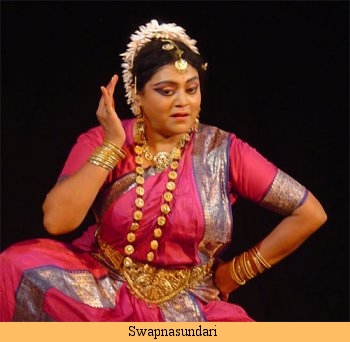 During a dance performance if the dancer and the spectator are sensitive to this bond, then through the power of the performance the relationship is exalted to a different level. In today's age when a person is divided into so many 'self(s)' by social, economical and emotional factors it is very rare to find an audience who lends itself to be consumed by an aesthetic experience. But for people who are willing to be touched, a dance performance can be a different kind of a personal experience- for example the performance of Swapnasundari as Andal in Andal Kalaapam. Andal, saint poetess of Tamil Nadu, is searching for Krishna and when he finally arrives she is not able to see anything as her eyes are moist with tears. The performer as Andal was excitedly looking for Krishna and suddenly she stood still when he had finally arrived. She kept looking at a distance with a faint ironical smile and tears flowing from her eyes. It was a long awaited moment of the devotee when she finally had her desired darshan (vision) of her lord. Abhinaya is like elixir which transforms every experience into a moment of bliss, a moment of celebrating humanness. It enables people to confront their emotions, look at life in a different light. The aura created by the dancer and the musicians engulfs the audience into experiencing the human emotions in an aesthetic, artistic and at times spiritual manner. The character in a piece of literature provides an entire new world of experiences which the dancer brings to life through her imagination and skill. Al Pacino's statement in his acceptance speech for the Lifetime Achievement Award at the AFI award function explains this point beautifully. He said, "There are so many things happening within me right now I need a character to bring them out".  Daughter of Kamalini Dutt, Purvadhanashree is one of the outstanding Bharatanatyam dancers of the younger generation. She is amongst the youngest ‘A-Grade' artiste of Doordarshan, India's national broadcasting corporation. Apart from many awards in India, in 2001 the Kala Bharati Foundation Montreal, awarded Purva the Oniel de Memorial Fellowship. She is an empanelled artiste of Indian Council of Cultural Relations, Govt of India. Purvadhanashree has also been receiving intensive training in Vilasini Natyam from Swapnasundari for five years which include her study of this style under a 2 year scholarship awarded by Sahitya Kala Parishad. |
