
|
    |
|
|
|


"Past your Prime -Ageism in dance" A commentary from across the continent... by Ramaa Bharadvaj, Yorba Linda, CA, USA e-mail: angahara-ramaa@yahoo.com |
April
25, 2003
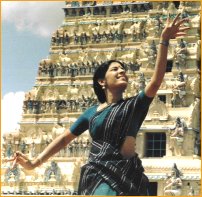 "All the photographs that accompany this article are of dancers aged 45 and above ... including that of the author!!!" Okay let's face it! When you live long enough you have seen, heard of, encountered (and if you are unfortunate enough) even experienced them all ... those crippling social "isms" - racism, sexism, classism, ableism! 
Komala Varadan But, when Justice Arjan Kumar Sikri brought his gavel down in the Delhi High Court on February 28th 2003 upholding an ICCR rule that dancers over 45 shall be retired from the category of performing artists to that of lecture-demonstration presenters, it was the sound of Ageism that resonated loud and clear, carrying its discordant tones even across the oceans. The ruling came in response to a petition filed six years ago, in 1997, by 62-year old Bharatanatyam dancer Komala Varadan who had taken the ICCR to court insisting that her name continue to be kept in the category of performing artists. The ICCR (Indian Council for Cultural Relations) is no ordinary Indian sponsoring organization. It is a governmental agency under India's Ministry of External Affairs, and is primarily responsible for putting together "cultural" packages catering to the coveted "foreign" market of an eager international audience. Therefore a bureaucratic internal rule that picks the country's cultural representatives based on their birth certificates and sends them abroad for me to "experience" somehow seemed like a direct attack on my aesthetic intelligence. And sure enough according to those interviewed by musician/journalist M.S. Rajan in an article published in Narthaki-On-Line, we, the international audiences, are supposedly responsible for ICCR drawing up such bizarre rules. He quotes Delhi based dancer-choreographer Geeta Chandran as saying "it is body that matters for dancers and audiences abroad, and not the mind." In other words we had all been delegated to the role of cattle, stampeding with drooling tongues towards lush green pastures ... the greener, the better! Is it a body thing after all? ICCR's categorization of dancers into the three age-defined designations of budding artists, performing artists and then all those retirees, is clear indication that they have not read the pulse of the foreign audience, for if they had, they would know that our pulse does not beat in counts of 36-24-36! To prove my point, I decided to personally test the pulse of the dance community here by forwarding Rajan's article to the presenters, dancers and critics, in my circle, and all those who responded were unanimously either annoyed or enraged. Lewis Segal, the dance critic of Los Angeles Times called this "a bizarre cultural event" and said "Stalinism in the arts is always bad news. Stalinism coupled with ageism and the assumption that the classical dances of India ought to inspire erections rather than reverence is downright ridiculous." My point exactly! If it is a young firm body that I want to see, I would head straight to Las Vegas, and not to a Bharatanatyam concert. I must also vehemently disagree with Indian critic Subbudu who is quoted by Rajan as saying "those dancers above the age of 45 can give lecture-demonstrations instead of solo dance performances. Otherwise dancers with disappropriate bodies would invite demonstrations outside the auditorium". First of all it is presumptuous on his part to assume that dancers over 45 have bodies that are "disappropriate" for dance. I should know! Today I look, feel, and can dance better than any of my 20 year old students. Secondly you don't have to turn 45 to let your body go to the dogs. You can do that at any age, in which case you should not be dancing anywhere ... not on stage, not locally, not abroad, not even in your shower, especially not there - that could be dangerous! With all this focus on the physical, has the ICCR essentially reduced the dignity of Indian dances to that of runway modeling? What about the unique ability of its experts to transform the sensual to the sacred and the vulgar to the venerable? Does it not require a great deal of introspection, self-discovery and growth before dances of such depth can be created or performed? How can anyone in his/her right mind impose an age restriction on a journey so profound? David Roche, who had for many years produced the famous San Francisco Ethnic Dance Festival, and who is currently the director of Old Town School of Folk Music in Chicago, found this rule quite inane, and raised another important point which he found to be a "double standard". "Ramnad Krishnan (carnatik musician) once told me that musicians are mere children until they reach the age of 60" he said. "Up until then their raga interpretations are considered puerile." Interesting! Wouldn't a similar growth period be essential for dancers as well, especially in an art form that continuously seeks to transcend the physical? 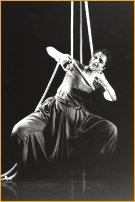
Anita Ratnam Intergenerational warfare: Ageism has always been expressed as "intergenerational warfare," primarily focused on the proportion of job opportunities and the Federal budget allocated to programs benefiting older adults. Therefore, in defense of the ICCR, let us assume that this rule was made only to make it easier for it to support young talent or as New York based dancer Uttara Asha Coorlawala says "an attempt to spread the goodies around rather than allow a few, and now senior stars, to hog all opportunities." Noble indeed! However, do the ICCR officers have the guts to apply the rule across the board to every artist instead of sneaking in clauses of "extraordinary circumstances" or "exceptional cases"? Everyone knows that such clause-filled-rules were made to be broken, by artists who are now legends and therefore are beyond all "Rules". And then again, as Anita Ratnam, one of India's brightest choreographers, appropriately points out "how does one grow into a legend without government patronage and support?" The ICCR officers need to have the courage to find ways to support their own issues without turning them into national statutes for their own convenience. Instead of discriminating on the basis of age, telling a dancer that she/he has lived too long to be taken seriously as a performing artist, why not discriminate on the basis of quality? "We regret to inform you that your application was rated number 15 by our selection panel and our budget can only support 12 touring companies this year." Simple isn't it? Catering to the audience: Let us assume for an innocent moment that this august cultural body has absolutely no hidden agendas whatsoever and that this rule is made in the genuine interest of marketing their "best cultural package" to their international audiences. Since no successful marketing of a product can happen without a survey of its consumers, I wonder if the ICCR has ever ventured into a field study of their audiences abroad? Have they surveyed the event producers and booking agents? Have they talked to the presenters, the grant makers and the critics? And when presenters approach them with specific requests, do they readily listen? Obviously not, at least according to Anita Ratnam. "They have their own agenda. During the recent Edinburgh festival, while the organizers only wanted Contemporary work from India, the ICCR insisted and "recommended" a package of classical dancers instead" she commented and also added that when ambassadors have approached ICCR asking for her performances, they were told that she was not available, even without her being contacted. Jonathan Hollander, the director of Battery Dance Company in New York had another story to share. "When I introduced the Jhaveri Sisters in the U.S. in 1993, I had to twist their arms because they didn't want to send Ranjana. They thought she was too old. I respectfully disagreed and insisted: and I was proven right. Jenneth Webster, the producer of Lincoln Center Out-of-Doors Festival, agreed with me that Ranjana was the Margot Fonteyn of Indian dance." 
Balasaraswathy Well, maybe it is time ICCR starts paying attention to the cultural trends in the markets that it serves, for never in the age of dance history has the admiration for mature performers been higher than in the last 50 years or so. In the concert dance circuit, it is not the Britney Spears look-alikes but the "past their prime" dancers such as the Margot Fonteyns, the Martha Grahams and the Balasaraswathys who have always danced to sold out theaters. Fortunately the trend does continue unabated. When my message reached Los Angeles based dancer/choreographer/ Don Bondi, he was rushing off to his rehearsal after a quick celebration of his 70th birthday. Ironically he was rehearsing for an upcoming summer production in "celebration of longevity in dancers and rejuvenation through dance", to be staged at the acclaimed Highways Performing Venue. 
Ni Ketut Arini, Chitresh Das, Govindan Kutty Celine Schien, who works with the dance company of the 58-year old dancer Chitresh Das, shared a triumphant story of their upcoming collaboration with 75-year old Kathakali exponent Govindan Kutty and 60-year old Balinese master Ni Ketut Arini. As they embark on a National Dance Project funded tour, she spoke of the excitement that this project has generated from presenters and from the Rockefeller Foundation, which gave them a major grant impressed by the age range of the dancers and their mastery. Let me tell you that at a time when funding for the arts in the U.S has gotten scarcer than the Chennai water supply, such stories don't simply happen. And talking about audiences ... who are these audiences that ICCR is supposed to serve anyway? Fifty years ago when this organization was first born their audiences might have been the political dignitaries and international Festival circuits. Their role according to Uttara Asha Coorlawala was supposedly to "show how India at least had "culture" if nothing else. I even have an article," she says, "on how they sent dancers to perform in France to precede negotiations for French fighter planes." 
Alarmel Valli But today the scenario is completely different. It is the Indian diaspora with its own formidable presence, large enough to be divided and subdivided into groups and clubs based on distinctions of language, religion and maybe even last names that provides the main support for these events. So when Alarmel Valli (who by the way is over 45) made her very first Los Angeles appearance here a few weeks ago, it was the Subramaniams and the Venkatachalams and their weekend-dance class-attending-teenage-daughters that flocked to see her. The Patels and Desais could care less and the mainstream Western audience or media weren't even aware of this event. This being the case, whom are the ICCR trying to impress with their youthful cultural packages? And what did senior Indian dance critic Shanta Serbjeet Singh mean when she applauded the judgment saying "after all, it was only focused on presenting classical dance abroad"? Are those of us living abroad not entitled to the best that India has to offer, the craft that has been honed to immaculacy, and the wine that has been aged to perfection? 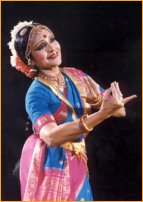 Vyjayanthimala We are not interested in your crumbs ... give us your best, your export quality, and in the field of classical dance and music that comes only with age. 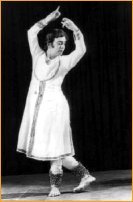
Birju Maharaj Ask us, the Indian diaspora audience, and we will tell you that our most memorable dance events have been that of touring artists who were way past their half a century mark in age. When Vyjayanthimala at age 70 presented a non-stop 90-minute performance in 2002, the packed theater sat in stunned silence as if we were in the presence of divinity; When a portly Birju Maharaj also in his seventies, created thunder with his quicksilver footwork, or a bald Kelucharan took us with him for a secret rendezvous in the moonlight with Krishna, we rejoiced, dreamt and fantasized along with them. In fact the appearance of their youthful dance companies (as brilliant as they were) actually turned out to be as much of a distraction as a siren on a silent night. 
Kelucharan Mohapatra Lewis Segal put it correctly when he said, "it is the best older dancers who have lived with their art long enough that can focus their energy and our attention on essential and often revelatory movement statements, or break our hearts by infusing layers of complex emotional, intellectual and spiritual implications". It is these layers and revelations in art that we wish our next generation to experience - all these thousands of teenagers attending Indian dance classes, week after week, uninspired and unmotivated. With our social calendar full of dance debut performances we have enough youthful exuberance to last a lifetime. Our eyes and minds long for something more sublime, more substantial and more divine. So keep your young and beautiful. Send us your old and your wrinkled Your aged masters yearning to breathe free, The wretched refuse of your teeming shore. Send these, the homeless, tempest-tossed to me. I lift my lamp beside the golden door." And by the way as a footnote to this commentary I wish to inform you all that on August 25, 2003, I will be celebrating my 27th birthday ... for the 18th time of course ... and you are all invited!  Ramaa Bharadvaj, the Director of Angahara Ensemble in California, is a dancer, teacher, choreographer and writer of distinction. She is the winner of multiple Lester Horton Dance Awards for her choreography and performance, and a recipient of numerous grants from local and state and national agencies. She has served on dance panels for the California Arts Council and National Endowment for the Arts. She is on the dance faculty at Orange Coast College and a visiting faculty for Ballet San Jose in California. In June 2000, she was featured on the cover of Dance Magazine, the world's most prestigious dance publication and in January 2003, Ramaa was selected as a Master Artist of California by the Alliance for California Traditional Artists. ramaadance.org |
