
|
    |
|
|
|


NEW DIRECTIONS, OLD WAYS The Second East West Encounter in Mumbai 15th-19th March 2001 by Ashish Khokar, Bangalore e-mail: ashishkhokar@hotmail.com Mar 2001 The first East West Encounter in March of 1984 was a historic moment for Indian dance. It "discovered" Chandralekha and Kumudini Lakhia and there was no looking back for them. Looking back in restrospect, what the Encounter did was to provide a time for stock-taking and for realising where contemporary dance then was headed. While Uday Shankar is regarded as the father of "creative dance", it was this 1984 event which set the tone for truly avant-garde works. Although the Sangeet Natak Akademi (the National Academy for Dance, Drama and Music) had done a major Ballet Festival in 1976 when Prof. Mohan Khokar headed it, the event showcased dance-dramas or ballet as it was then called. A new movement in dance was yet to begin and 1984 provided that watershed. The 1984 initiative came about thanks to a German, George Lechner, then head of the Delhi branch of the Max Mueller Bhawan but better known as one of Sonal Mansingh's husbands!He was motivated by a desire to see and share what was revolutionary with Indian dance. His platforming of Chandralekha, a Bharatanatyam dancer of yesteryears and of modest abilities, gave her career a new lease of life. In Kathak, he gave Kumudini Lakhia a platform to move away from the courtly etiquettes of Kathak form and make it minimal. Lechner stands complimented for good taste 15 years ago. Fast forward to 2001. The month of March again, Bombay now is Mumbai but George Lechner remains the common link and the motivating factor. He is now the Commissioner of the entire German Festival in India and since dance is close to his heart, he starts off the Festival last year with a dance event, the Bavarian Ballet and concludes with a dance event - this 5 day Dance Encounter featuring some of the old and the new. 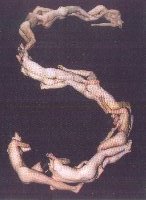 German Encounter - Sasha Waltz style Titled New Directions in Indian and European Dance but limiting itself to Germany in Europe, the festival at NCPA in Mumbai showcased the current situation in German dancetheatre, as I prefer to call it: Heavy, negative, torturous.The works of Susan Linke, Reinhild Hoffmann, Sasha Waltz shows excessive heaviness, as though negativity is all the current crop of German choreographers are surrounded with and interested in. Breast pinching, dragging of bodies, tight faces with no emotion, gory stage calisthines are all woven in to show the audience that Germans continue to excel in torturing, this time themselves! Sasha Waltz went on to elaborate, in the morning deliberations that for her the holocast left an indelible impression. Are the Germans atoning by self-inflicting pain? Susane Linke, that odd-faced dancer, commented in yet another session "why should we seek and show happiness on stage?" That explains some of German precoccupation with the dark forces of life. From the Indian contingent, only two dancers made sense:Daksha Sheth and Kumudini Lakhia. While attempts to make Chandralekha a cult figure fell flat and audiences walked out of her new offering Sareera which was soft-porn disguised as Bharatanatyam, audiences clapped for every scene in Daksha's Bhukham. 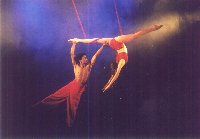 Daksha Sheth's Bhukham The production was panned by Delhi critics who felt it was a spectacle more than dance or high-art but Daksha retained her artistic license to do a production different from her earlier works. Using Malkhamb, the Maharashtrian pole-rope feats as base, she created a spectacular production which had no story line and much less structure. She is a genius and the only one in this whole deliberations, with a sense of a new direction. Sonal Mansingh went on and on about women and their suffering and showed clips from her Draupadi, done six years ago but when criticised for making it a caricature of herself conveniently took refuge by saying it was a "work-in-progress". Sadanand Menon, rabble-rouser and activist, writer and commentator, questioned her affording luxury of trying to be modest since she represented dance for the masses in the current political dispensation. Astad Deboo and Navtej Singh provided moments of thought with their demonstrations and articulated speech. While Astad came off as sad, Navtej came off as angry. Narendra Sharma made interesting reference points to the Uday Shankar style, to do honours for which Amla and Mamata Shankar were specially invited. Sussane Kirchner a dance-sculpture showcased how dance can be meditative by doing every posture in vilambit or very slow pace. It was a new approach to dance and she remained an important milestone. Sunil Kothari tried to promote Maulik Shah (when not projecting himself!) and his over-weight wife Ishira Parikh but they fell flat trying to show an improvement over Shambhu Maharaj's Thaat! So much for the new directions. The selection of the above duo in addition to Ileana Citarsti and "french" Shakuntala made little sense especially as many more talented names with much more concrete and consistent output were missing:Veenapani Chawla, Auro Anu, Anita Ratnam, Bharat Sharma, Aditi Mangaldas. The list can go on. The Sangeet Natak took a back-seat as George Lechner dominated the proceedings but good graces won in the end and Jayant Kastuar, its Secretary put matters in perspective by stating it was an event under the German Festival umbrella. He remains dignified despite provocations and that's how an officer and a gentleman ought to be! Critics Leela Venkataraman, Shanta Serbjeet Singh, V.R.Devika and Joechen Schmidt provided introductions, in additions to observations. Editors N. Pattabhiraman of Sruti and Ashish Khokar of Attendance made for strong policy directions, with the former putting lots of discussion in context in his powerful summing up which the organisers tried to stop! Dancers Sruti Banerji (Manipuri) was invited but never got a chance to speak, the more voluable and dominating having taken over. In the end, after 5 days, one left with the feeling that new directions was made of old ways! While tradition was debunked by those who've dined out of it (what would Chandralekha be without Ellappa or Bharatanatyam?), new excuses were platformed for not truly finding new directions in dance. In the end, it was a case of Much Ado About Nothing. |
