
|
    |
|
|
|


KATHAK AS A SPRINGBOARD FOR CHOREOGRAPHY by Maya Rao Natya Kala Conference 2001 - December 16 e-mail: stemdt@yahoo.com |
| Apr 2002
INTRODUCTION The term 'Kathak' as we refer to the classical dance style of the North, was originally the name given to the performer of Kathak or kathakaar, as he was known-(Kathan Kahejo Kathak Kahaye). The Kathak-s narrated stories of the Gods to gatherings of devotees in the Vaishnava temples of Uttar Pradesh and Rajasthan. They recreated the stories in verse heightening the impact of the narration with dance and rhythm patterns. But, with the devastations of the temples in the 10th and 11th centuries by invaders, the art of the Kathak-s underwent a period of silence, till it was revived in the Royal Courts as an entertaining art. During this phase of its evolution the spiritual aspect receded to the background and virtuosity of the performers became the criterion. Since the undercurrent of Vaishnavism was still there in the hearts of the Kathak-s, new elements had to be adopted by them to interpret the art. In the process, the art of "Kathak-s" evolved into a sophisticated art wherein the earlier dance and rhythm patterns were developed. The three-fold base of Nrtta, Nritya and Abhinaya was also nurtured drawing upon the precepts of Natya Shastra and Abhinaya Darpana. Thus equipped, Kathak (as it is now known) emerged, entering theatre to cater to larger audiences. In its journey from the temple to the royal courts and then to the theatre, Kathak gained new dimensions "ceaselessly renewing itself" with the needs of the patrons and audiences. SCOPE FOR CHOREOGRAPHY Kathak, with its rich narrative content in Gat bhav and Abhinava aspects as well as the abstract in Nrtta have provided ample scope as resource material for choreography. I have drawn upon the various salient features to enrich my creation. For instance, in Nrtta, the rhythmic patterns with various time-cycles in varying speed or tempo and Tatkar have been the mainstay of Kathak. To a large extent they have over shadowed the repertoire of a Kathak programme to invite criticism that "Kathak is fragmentary in presentation and has no Abhinaya". But to me the rhythm and tatkar have been effective elements to create mood and atmosphere in Choreography, besides their being just a means to display virtuosity. For instance - The use of Tatkar in my ballet "Hoysala Vaibhav" and also the anguish and agitation of Queen Shantala with the use of Jhantaal in slow and fast tempo. (Demonstrations of these). Another instance is that of Thaat or Kasak Masak - the preliminary Nrtta items used by me in the ballet "Hoysala Vaibhav" when the statues come to life to recreate the glorious history of the kings. (Demonstrations). Similarly in the Nritya aspect, we have Gat-bhav, wherein a single dancer interprets stories to the accompaniment of the rhythm of a basic taal and a melody or a lehra played on a sarangi to indicate the basic rhythmic scale. Added to this, to intensify spontaneity of the rendering, the hastas (hand gestures) are Swabhavik or natural. Further more, the hastas implied in the narrative are used with an association of ideas. All these inspire innovation. Thus, Gath-bhav, which has evolved from Lasyanga, is a treasure house for choreography, while the traditional method is to interpret stories from mythology. I have utilised it for choreographing a contemporary work, Yashodhara by the Gyanpeeth Awardee, Masti Venkatesh Iyengar. I chose to call it as 'Duvidha' it portrays the conflicts in the mind of Yashodhara when she hears that Buddha (her husband) is coming to Kapilavastu on a mission of spreading his message. Her happiness is tarnished with anger and disappointment as she awaits his arrival for an encounter. This could portray the feelings of any woman who is separated from her husband - whatever the reason may be! (demonstration). I have used the technique of Gat bhav in the Soviet ballet 'Shakuntala' when Shakuntala narrates the story of her union with Dushyanta when he fails to recognise her at his court. Another salient feature of Kathak is Kavit or Bamaina Paran wherein an anecdote is recited to the accompaniment of percussion and lehra only. Kavit-s are rendered in variegated metres (chanda) - I have drawn upon this feature in a scene from the ballet 'Vision of Amir Khusro' where he converses with a few girls at the village well. (demonstration). Bhav-batana is one more aspect of Abhinaya where a great deal of importance is given to the delineation of expressions in accordance with the development of the word imagery in music. In the interpretation of the thumris and ghazals - it is another source for inspiring choreography. I shall cite another instance where a ghazal is interpreted in a group. (Demonstration - Amir Khusro well scene). The ghazal portrays the feelings of a young woman who is suffering from the pangs of separation from her beloved. I have mentioned before, that Kathak originated as a narrative form, and gathered abstract elements as embellishments through its course of evolution. Hence, choreographers find an untold wealth in this dance form for their variegated compositions. 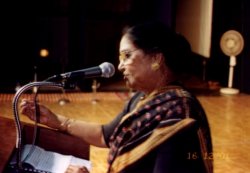 Maya Rao was trained in Kathak under Shambu Maharaj of the Lucknow Gharana and Sunderprasad of the Jaipur Gharana. She founded the Natya Institue of Kathak and Choreography at Bangalore with the support of the Govt. of Karnataka. The institute is affiliated to the Bangalore University and is the first of its kind in India. Over 1000 students have been trained and many of them are fine performers and choreographers in India and abroad. Maya Rao is the only Indian with a Post Graduate certificate in Choreography from the USSR and the recipient of several awards including the National Award (President's Award) for Choreography from the Sangeet Natak Akademi, the Karnataka State Award, The Choreofest Award, the prestigious Shantala Award from the Govt. of Karnataka and the Emeritus Fellowship from the H.R.D. Govt. of India. Maya Rao has been invited to Europe, U.S.A, U.S.S.R, on many occasions as a consultant choreographer and as a Jury member for international projects. |
